


In 2018, social psychologist Erica Boothby and her colleagues invited people to make brief small talk with a stranger. After separating the two, each person was asked a few simple questions about their novel conversational partner. Namely, “how much did you like this other person?” and “how much do you think they liked you?”
What emerged was a rather shocking liking gap. Overwhelmingly, participants liked the other individual more than they thought the other individual liked them. It was something that hadn’t been demonstrated empirically prior to Boothby et al.’s simple study, and it’s a bit of a headscratcher.
Given that we delusional human beings hold unrealistically flattering views of ourselves in comparison to the average person—seeing ourselves as smarter, better-looking, nicer, funnier, more talented, better at driving… a famous study in this area was even titled “Unskilled and Unaware of It”—why don’t we have similarly favorable warped views of others’ personal feelings about us? It’s not just the within-subjects ratings differential, either. After those fleeting conversations, participants genuinely underestimated how much the other person really did like them. In other words, we’re not suddenly seeing ourselves more clearly and soberly through a stranger’s eyes, but we’re unduly selling ourselves short in likability.
If that isn’t sad enough, the social illusion is present in kids as young as five years old.
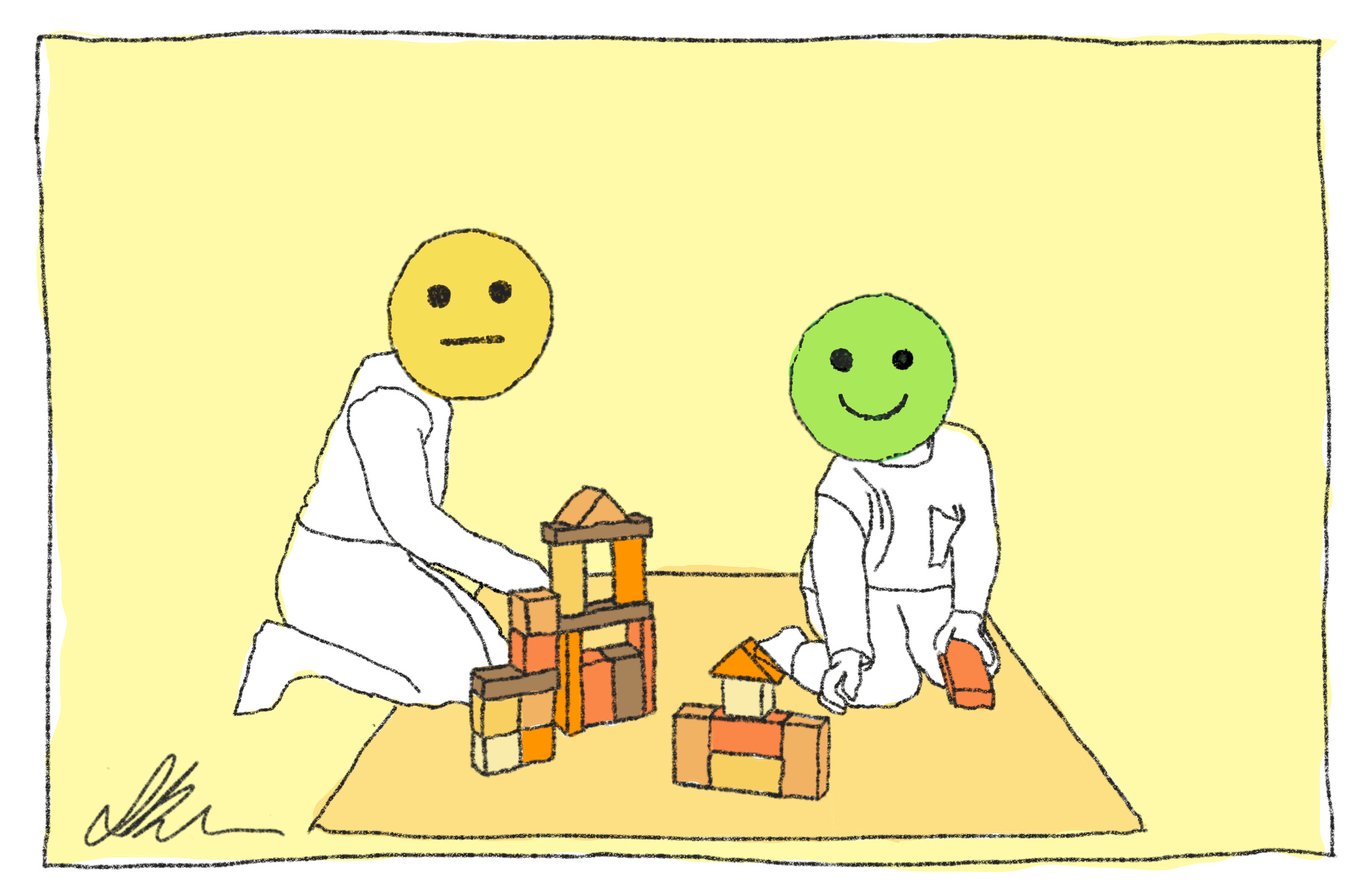
In a 2021 study published in Psychological Science, a team led by Wouter Wolf, now at Utrecht University, attempted to pinpoint the age at which the liking gap first rears its Eeyore-like head. As with Boothby’s original study with adults, Wolf’s study with children aged between 4 and 11 was a straightforward, elegant little design. Introducing kindergartners to one another for the first time and instructing them to “talk amongst yourselves” for five minutes would be weird. So instead, the age-appropriate study involved each child being paired in a play session with another random kid about the same age, given some toy blocks, and told:
The two of you are going to build a tower together. You can build any kind of tower that you want, but the important part is that you do it together. Okay? You will have 5 minutes to build the tower and at the end of these 5 minutes we will ask you a couple questions about how it went and then get you your prize [stickers]. Okay you are all set to get started building your tower together.
There were two experimenters present, both pretending to be busy while the kids interacted. Then, once the five minutes were up, Experimenter A took one child to a separate area to ask them some questions, and Experimenter B took the other to do the same. Each child was asked six questions: three about how they felt about the other kid (“How much do you like the other boy/girl?”; “How much would you like to play with the other boy/girl again?”; “How much would you like the other boy/girl to be your friend?”) and three about how the other child would answer those same questions about them (“How much did the other boy/girl like you?”; “How much would the other boy/girl like to play with you again?”; “How much would the other boy/girl like to be friends with you?”). To make it as easy as possible for the youngest kids in the study, Wolf and his colleagues used a 7-point Smiley-face Likert-type scale to measure the children’s responses, basically with “not at all” being a super sad unsmiling face at one end and “a lot” being an ecstatic toothy smile at the other end. The kids just had to point to whatever face on the spectrum best expressed their views.
The three items in each of the broad question categories were compiled into two general scores. “A liking gap score for each participant was created by subtracting the participant’s score indicating how they thought their partner evaluated them from that participant’s score indicating how they evaluated their partner,” explain the authors.
All told, 125 random dyads were tested (N = 250 children), with each chronological year equally populated and forming its own age group: 4-year-olds, 5-year-olds, 6-year-olds, and so on. The results were stunning. The 4-year-olds’ judgments about how much—or little—their partner liked them was accurate (i.e., no liking gap). That clear-eyed assessment of the social situation had already begun to diminish in kids just a year older. Comparing the responses of the 4 and 5-year-old groups, a liking gap cropped up. But this initial effect wasn’t due to a depreciation in how kids thought the other child felt about them. It was instead due to a sudden bump in positive views of one’s partner. “Between 4 and 5 years old,” the authors write, “children’s evaluations of strangers after a single interaction become more positive.” This could be, they postulate, because it’s around this age that kids are increasingly exposed to novel people, for example through mandatory schooling, “contributing to a decrease in stranger anxiety and a consequent increase in the social value of interacting with novel peers and the social relationships that could emerge from them.”
Something else entirely was going on with children aged 5 to 11. For them, those generally positive ratings of the novel person remained stable. Instead, with each passing year that was reflected in this cross-sectional study, children thought their partners liked them less and less than the other child did in reality. That is, the liking gap became increasingly more extreme.
Oh, you might be wondering if gender mattered. It didn’t. In fact, the liking gap happened among the mixed-gender pairings, too.
What’s driving this self-defeating wedge between social realities, argue the authors, are advances in children’s social cognition enabling recursive reasoning about mental states. Here, that means thinking about what others are thinking about us. It can get quite Dostoyevskian—many adults can get up to seven or more levels of recursiveness. But its earliest stubs begin to appear just when the liking gap emerges.
As the engine behind reputation management, recursive thinking is a big part of what makes us human. Unfortunately, it’s also the source of many of our species’ ills. Knowing that others are forming impressions about us, and knowing that others know we know they’re forming impressions about us, can make us second-guess everything. “The liking gap [may be] the consequence of individuals during interactions constantly monitoring others’ evaluating them,” Wolf at el. write. “In doing so, people worry about being evaluated negatively, perhaps particularly when interacting with a stranger. This anxiety might make negative thoughts more salient or relevant, causing individuals to become more skeptical about the impression they make on others.” This social skepticism extends to doubting others’ motives in their own self-presentation (e.g., they’re “just being nice” or “just saying that,” etc.).
The study didn’t investigate individual differences, yet across age groups the liking gap would certainly be more pronounced for some children than for others. “It is not implausible,” suggest the authors, “that, in some cases, shyness, social anxiety, or insecure attachment could be a manifestation or a consequence of a relatively high discrepancy between how much children like other people and how much they generally think other people like them back.”
That strikes me as a serious tear-jerker of an implication, probably because it really hits home with my own experiences as a shy and socially anxious kid (and to some extent as an adult too, for that matter). Perhaps we introverts secretly like other people so much that it’s just too emotionally draining, or painful, to feel their minds on us. Remember that line from Sartre’s No Exit, the introvert’s version of Hell where for all eternity the unlucky inhabitants are subjected to one another’s presence?
“See how weak I am, a mere breath on the air, a gaze observing you, a formless thought that thinks you.”
The normal lopsided liking equation wasn’t the case, however, for at least one of the children in Wolf’s study, who vented such a bitter opinion about their partner (“a liking gap 2.5 times more extreme than the second-most extreme score on that side of the distribution”) that the dyad had to be dropped entirely from the analysis, for fear of skewing the data. We’ll never know what led that kid to give such a harsh evaluation of a child who really liked them. But any worried parents out there should take comfort, I think, in knowing that this type of negative reaction from prospective playmates was so statistically anomalous, that it didn’t even make the cut.
Wolf, W., Nafe, A., & Tomasello, M. (2021). The development of the liking gap: Children older than 5 years think that partners evaluate them less positively than they evaluate their partners. Psychological Science, 32(5), 789-798.
Questions? Concerns? Ideas? Email the corresponding author, Wouter Wolf, directly: w.wolf@uu.nl
Like what you read? Toss a tip in the jar—any amount that makes sense for you—so I can keep overthinking things on your behalf.