


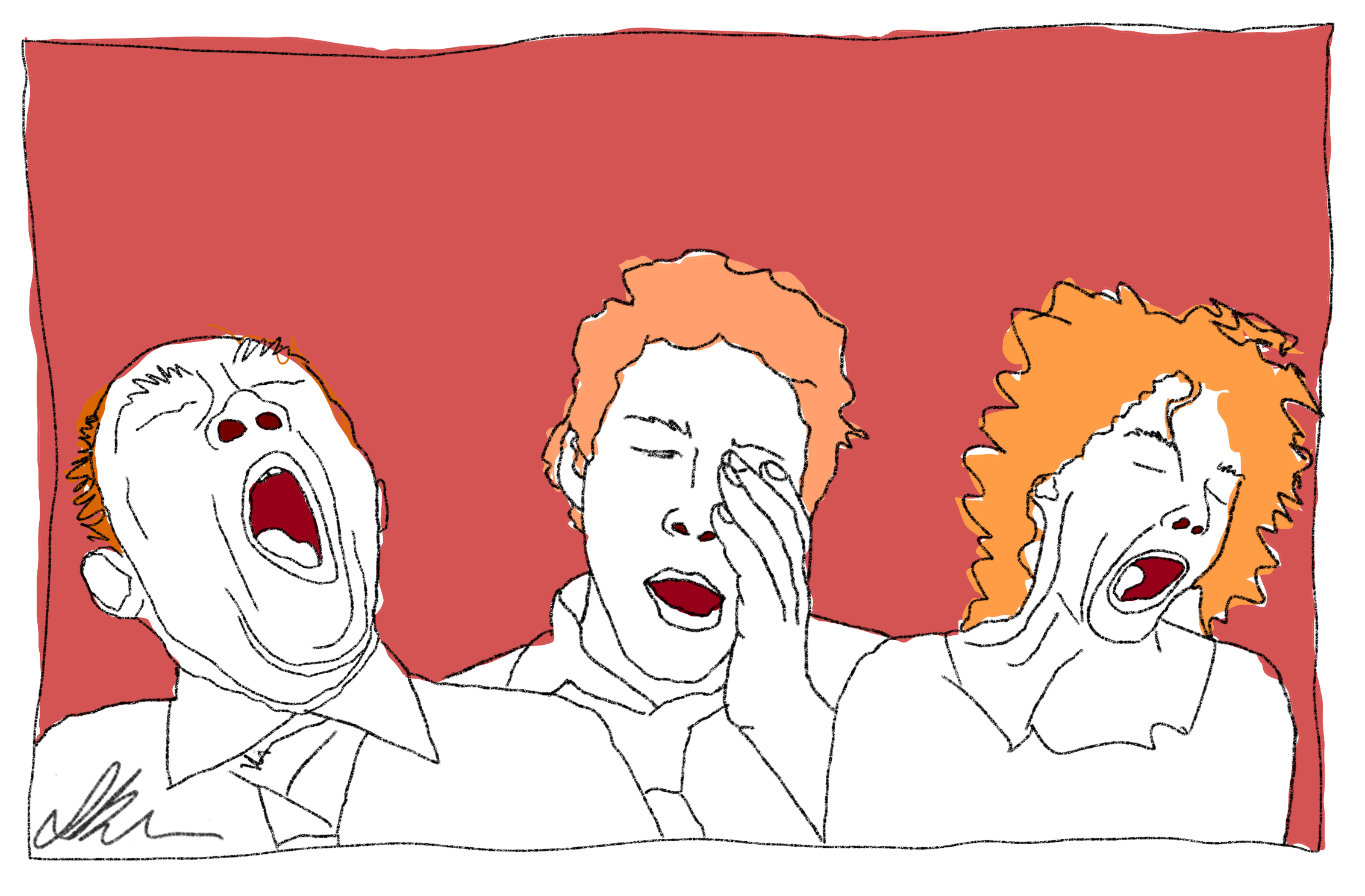
There’s a reasonably good chance I’ll be putting you to sleep with this one. But for once, I’ll take that as a compliment. We’re about to examine the curious phenomenon of yawning contagion—more specifically, whether “catching” a yawn from someone else makes us subjectively sleepier too. And since there’s some indirect evidence that merely thinking or reading about yawning, as you’re doing right now, pushes those buttons, go on, let ‘er rip.
It’s quite weird, really. It’s not like we want to or decide to yawn after seeing someone else—the so-called releasing agent—do it. After all, it’s not the most flattering look to emulate, what with gaping mouth, squinty eyes, stertorous gulping of air. Some have even compared it to orgasm face (which may be no coincidence, as sexual climax and yawning in mammals share some ancient neurobehavioral components). As a “fixed action pattern,” as it’s known in the classic ethology literature, yawning contagion is automatic, basic, and uncontrollable.
We don’t even need to see the prototypical open maw for it to be triggered. Exposure to a vertical slice of yawning eyes does the trick. Just hearing someone works. I used to have a departmental colleague in the office next door whose yawn was somewhere between a sea lion’s barking and the exasperated sigh of Kermit the Frog, and it got me every time.
There’s no shortage of research on this banal, bizarre display of interpersonal syncing. It’s been a hot topic for decades. Like any niche area, there are disagreements and wonky data. But here’s a quick summary: (a) we’re not the only species to do it; yawning contagion happens in other highly social species as well, such as chimps, lions, even sheep; (b) children start doing it around the preschool years (even though yawning itself is evident in human fetuses from as early as the end of the first prenatal trimester); (c) there are individual differences in susceptibility to yawning contagion, with some studies suggesting females are more prone than males, but others finding no sex differences; (d) certain clinical populations characterized by impairments in reasoning about others’ mental states (such as autism spectrum disorder, schizotypal personality disorder, and schizophrenia) or those with empathy deficits (people scoring high on psychopathic traits) exhibit less contagious yawning, and; (e) knowing someone is watching us often inhibits contagious yawns; we might have the urge to do it but, annoyingly, can’t quite get it out when there’s a spectator.
Most of these studies have focused on the yawn-spreading itself (i.e., behavioral contagion) and have overlooked whether it induces a change in the replicator’s own internal state (i.e., emotional contagion). That’s where psychologists Kristie Poole and Heather Anderson from the University of Waterloo came in with their 2023 study in Human Nature. If such a change indeed occurs—catching not only the yawn but the feeling behind the yawn as well—this could be evidence, they reasoned, of behavioral contagion’s role in getting people on the same psychological page, facilitating group cohesion. Also, such findings might shed light on more advanced perspective-taking. Are individuals who are more susceptible to contagious yawning also demonstrably better at understanding what others are thinking and feeling?
In fact, it’s not just contagious yawning that might help answer these questions. Contagious smiling is a thing in our species as well. Ages ago, the neuroscientist Robert Provine (arguably the founding father of evolutionary yawn theory—he jokingly described himself as a “yawn stimulus,” as just thinking about his research had that effect on people) also showed that seeing or hearing a person laughing often releases a response. It’s not usually a one-to-one releasing match as with yawning—there’s not much literal LOL-ing in these studies. Think canned laugh tracks in 90s’ sitcoms. But exposure to a laughing person makes many at least crack a smile. For those unfamiliar, Poole and Anderson helpfully clarify this as “an upward turning of the lips.” As with the yawn-fest in that other research area, some evidence with children suggests a possible link with empathy: kids who are more prone to catching the giggles rate themselves, at least, as being higher in empathy than do their stone-faced peers.
To help tease these issues apart, the authors conducted a rather involved study via Zoom (the data were collected during the height of the pandemic, when researchers needed to make do). When they first logged on, participants were greeted by an experimenter, who instructed them to hide the “self-view” feature so that they could see only her face. Next, they completed a questionnaire about their current emotional state, to measure baseline affect. Then the experimenter got a tad sneaky, feigning she was having trouble figuring out how to share the screen and asking the participant—using three scripted nudges—for help with that technical bit. The idea was to ascertain pre-existing individual differences in participants’ likelihood to help at all (prosocial behavior) and, if they did help, how many pleas or nudges it took.
Once that ruse was over and the experimenter finally shared her screen, she told the participant that they were about to see some video clips. While watching these, the experimenter explained, she’d turn her own camera off, so they’d have privacy. All they had to do was to say out loud when they’d finished watching, and then she’d return. Remember that being watched can inhibit contagious yawning, so the idea here was to minimize the impression of the experimenter’s yawn voyeurism. All the while, of course, the participant’s facial expressions as they watched the clips were being recorded for later coding.
The first video was a silent two-minute nature scene, presumably sun-dappled trees and clouds and chipmunks, that sort of thing. Soporific in itself, perhaps, but this gave a baseline measure of each person’s spontaneous yawns and smiles in the absence of any contagion stimuli. (The study was done during daylight hours, to help control for normal sleepiness.) Next were trotted out 24 silent clips, seven seconds each, featuring actors doing the following, and in this order: eight people laughing, eight people yawning, and eight people just sitting there. So, in the parlance of experimental methodology, this was a repeated measures (or “within-subjects”) design, meaning that all participants got the same treatment, rather than being randomly assigned to different conditions. Each action category included an equal mix of male and female actors. Also, because earlier research had shown that contagious yawns may happen more often among close contacts, participants were told to pay close attention to what they were about to see, as though the person were a friend or partner.
So, you get the gist of it. One obvious question was whether participants became “infected” (that’s an actual term used in this research area) by the yawns or laughs shown in the clips. They only had to show the contagious behavior once, during the right time slots, to be classified “yawners” or “smilers,” respectively, rather than “non-yawners” and “non-smilers.”
As expected, participants were indeed significantly more likely to yawn during the yawning videos than during the nature video, and likewise to smile during the laughing videos.
The more interesting stuff came later. First, compared to the non-yawners, the yawners reported feeling more tired after the vids than how they said they’d felt at the start. Notably, there was no difference in self-reported sleepiness between yawners and non-yawners before the clips. So, it seems the yawners caught the feels. “To our knowledge,” write the authors, “[this] provides the first empirical support that contagious yawners may not only show contagion on a behavioral level but also experience changes in their internal state.” Smilers and non-smilers differed too. Here it’s more complicated. The smilers were happier than the non-smilers from the get-go, even before the vids. But whereas the latter got significantly grumpier as the study wore on, the smilers were just as happy at the end. The authors therefore speculate that contagious smiling helped them to maintain their positive affect.
Certified yawners and smilers were also more likely to have helped the experimenter with her pretend screen-sharing issue from before, and to offer that assistance more promptly. (This panned out even when controlling for participant’s knowledge of this irritating Zoom feature.) Moreover, the smilers outperformed everyone on the famous “Reading the Mind in the Eyes Task,” a test of social cognition in which participants are shown photos of just the eye region of the face and asked what the person in the image is thinking or feeling.
Like most studies, it wasn’t flawless, but Poole and Anderson’s results are fascinating. I wouldn’t necessarily recommend yawning and smiling contagion as litmus tests for, say, gauging partner material on a first date. There are of course way too many confounds in real life. But I can also imagine sillier surreptitious dating heuristics, at least for those wishing to be understood in a relationship. It’s their study, so I’ll let the authors have the final word on what it all (might) mean: “Overall, our findings suggest that contagious yawning may be most closely related to emotional contagion, which has been regarded by some as a basic and automatic form of empathy and may signal a likelihood to help others. On the other hand, contagious smiling may too be related to a likelihood to help others, but also to other higher-order factors of social cognition such as emotion recognition and mental state decoding.”
Poole, K. L., & Henderson, H. A. (2023). Social cognitive correlates of contagious yawning and smiling. Human Nature, 34(4), 569-587.
Questions? Concerns? Ideas? Email the corresponding author directly: Kristie Poole poolekristie@gmail.com
Like what you read? Toss a tip in the jar—any amount that makes sense for you—so I can keep overthinking things on your behalf.
Thanks Jesse, great read. I caught a yawn from my dog last night and I’m glad to know what that may say about me.