


This article was originally published in Le Point on 09.03.2026
It’s strange to think that glimmers of our beastly nature are found even in the contours of shiny modern technology. From sex and AI porn, virtue signaling and social media, predators and VR horror games, to—as we’ll see momentarily—cuckoldry and sonograms, advances in technology capitalize on old adaptive problems. Try as we might, we can’t divorce ourselves from the reality of our species’ basic predicament, which is, first and foremost, to multiply genetically. We’re just like any other animal in that regard.
I’ve written previously in this column about one very pressing concern among males: being cuckolded, i.e., raising another man’s offspring under the false assumption that the child is one’s own. It is doing a rival’s bidding, with all those costly resources being invested in someone else’s genes while the latter spreads their seed unhampered by fatherly concerns. For the woman in this original battle of the sexes, meanwhile, it is to her advantage to ‘convince’ her committed partner that the kid really is his, even if it was sired by the dimwitted lothario with the glistening six-pack at the watering hole one steamy night. I’ve placed ‘convince’ in square quotes, because a woman who finds herself pregnant by a man other than her romantic partner isn’t necessarily trying to deceive him. She might be trying to convince herself, or perhaps she’s operating with an implicit bias, even memory distortions.
Anyway, to some extent, the truth doesn’t matter. If her partner believes the baby is not his—even if it is or she’s never been with anyone else—this will likely drive his unconscious daddy decision-making. Many, many studies have shown that men invest more in children who are likely to be their biological offspring. Remember, we’re talking about a brain with neural architecture forged eons before DNA testing could scientifically clear up any male confusion. There’s zero ambiguity on the mother’s part, by contrast. The child literally came out of her and, if you’re following the evolutionary psychology breadcrumbs, it will eventually become a self-perpetuating spreader of her genes.
To get to that point, however, the child first needed to survive to reproductive age. That is a non-negligible challenge still today, let alone tens of thousands of years ago, when an estimated 27% of infants failed to survive their first year, and approximately 48% of children died before reaching puberty. However, the odds greatly improved by having a father who provided protection, resources, status, and specialized knowledge, among other high-value offerings. So, from every strategic angle, it is to the woman’s advantage to nudge her partner toward “paternity certainty.”
One important clue that men would have used to gauge the probability that it’s indeed their own cooing, dimpled little cherub gazing up at them, rather than Bob’s from a few huts down, was the child’s appearance. In a previous article, I explained why some scholars believe that human eye color was driven, at least in part, by anti-cuckoldry tactics (a blue-eyed man whose blue-eyed wife gives birth to a brown-eyed baby has reason to be suspicious). The trouble is that newborns are otherwise notoriously cryptic. When presented with facial photographs alone, for example, most people fail miserably at guessing which baby belongs to which parents—although interestingly, performance improves when judging maternal over paternal matches. Not to get too layered, but some researchers have even speculated that this neonatal ambiguity might itself be an adaptation, for both the mother and her child. After all, if the man can’t be certain one way or the other, it’s best for him to err on the side of caution, given that child neglect, abuse, or even infanticide would obviously be self-defeating.
Remember, though, it’s not so much whether he is or isn’t the father, but what he believes. And that’s where moms’ natural skills of persuasion seem to come into the picture. Over four decades ago, legendary husband-and-wife duo Martin Daly and Margo Wilson—whose work on the origins of human violence and homicide helped define the field of evolutionary psychology—found a curious pattern of behavior among parents of newborns. When asked in the hospital who the infant resembled most, fathers mostly shrugged their shoulders or essentially chose at random between themselves and their partners. Mothers, meanwhile, were significantly more likely to say that the baby was the spitting image of their husband or boyfriend, rather than themselves. The fact that the men didn’t see any such thing, nor could naïve observers, suggested to Daly and Wilson that women are operating with an adaptive cognitive bias that makes them overperceive infant resemblance to their romantic partners—whether he’s the biological father or she just hopes that he is.
These findings have been replicated over the years, along with another empirical revelation, which is that women are even more likely to express this opinion of paternal resemblance when the father is in the room than when they’re asked the same question without him there. The logic, therefore, is that such statements by new moms work to persuade their partners, or at least to alleviate anxiety that it might be someone else’s child. “Together,” explain a team of investigators led by Carlota Batres of Franklin and Marshall College in Pennsylvania, “these results suggest that at birth, in order to decrease paternity uncertainty, mothers claim paternal resemblance that does not correspond to actual resemblance.”
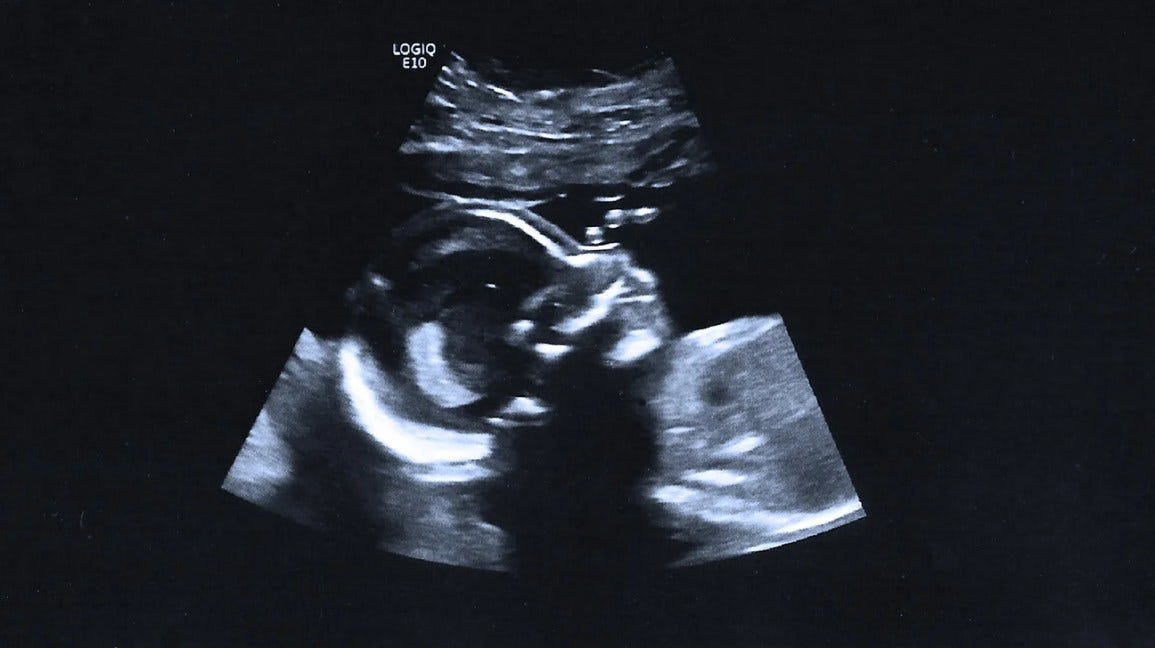
But Batres and her team went a step further (or in some ways, backward), and this is where modern technology amplifies those age-old concerns about cuckoldry and fatherhood. In a study published last year in the journal Evolution and Human Behavior, the researchers posed the “resemblance” question to nearly a hundred expectant couples during their standard 20-week sonogram appointments at the local obstetrics and gynecology clinic. That’s about the halfway point in a normal pregnancy. The fetus is about the size and weight of a banana then, and the obstetrician checks to see that everything is where it should be. If fully developed newborns have ambiguous features, it’s safe to say that the faces of these fetuses are about as, well, clear as a 20-week-old banana peel. Moreover, the images in Batres and her colleagues’ study were just standard 2D, not the high-tech 3D, 4D, or even 5D sonograms that can show incredibly rich detail. Even if you haven’t had a fetal ultrasound yourself, or been the cause of someone who has, you’ve no doubt seen those murky greyscale pics of what appear to be translucent slices of a tiny human form, usually in profile.
The question, therefore, was whether expectant mothers display that telltale bias for perceiving paternal resemblance even when the fetal face is, more or less, a blank slate. “In this study,” clarify the authors, “we aimed to examine if maternal claims of paternal resemblance extend in utero.”
More specifically, whether in the absence of visual clues to resemblance such as skin color, eye color, and adiposity, mothers would still claim that the fetus looks more like the father. Even with such limited visual information, we predicted that mothers would be more likely to say that the fetus resembled the father to ensure paternity.
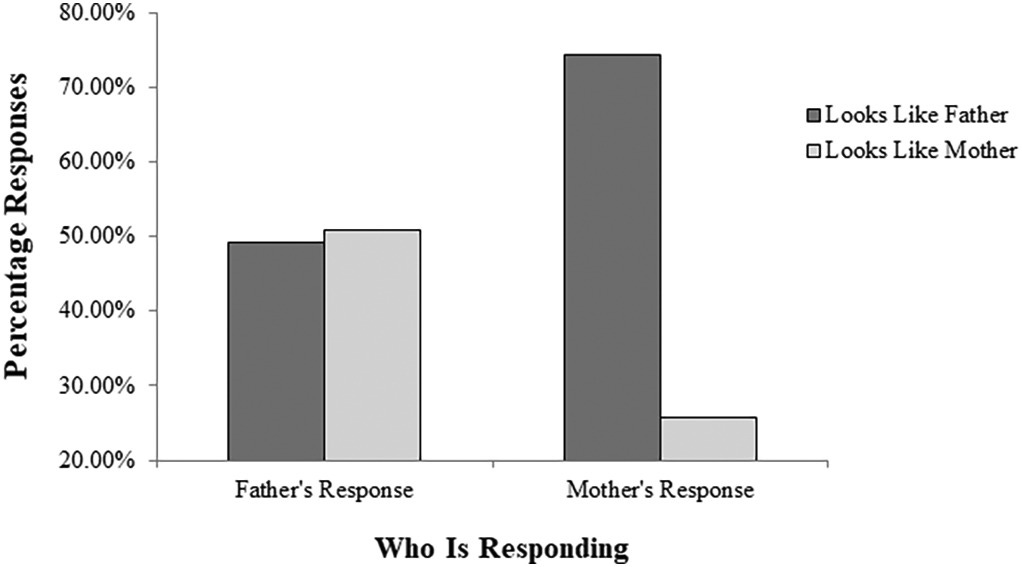
Rather shockingly, the authors found precisely that. As soon as the ultrasound technician got a good shot of the fetus in the womb and everyone could see the image “clearly” on the screen, they paused to ask each parent who they thought the baby looked like. (The technician, incidentally, had no idea what the hypothesis was, or even what the study was about.) Whereas expectant dads were just as likely to say themselves (49%) as they were their wives (or girlfriends) (51%), expectant moms were significantly more likely to say the fetus looked like their husbands (or boyfriends) (74%) than they were themselves (26%). Those differences were magnified for unmarried couples, presumably because infidelity was more likely. Marriage, after all, emerged primarily as a public vow of sexual exclusivity. In those unmarried cases, a whopping 93% of pregnant women said that the fetus was a dead-ringer for the guy holding their hand in the examining room.
Given that pregnant women are twice as likely to suffer domestic violence—heightened by the man’s suspicions that the child she carries is someone else’s—these maternal assertions of “fetal resemblance,” speculate Batres and her coauthors, “is a way that mothers might protect their offspring even before they are born.”
Bear in mind, of course, that such research, reliable and theoretically cogent though it may be, reflects general trends of human behavior. One thing I personally detest is the meanspirited, and frankly dumb, colloquialization of the word “cuck,” which, as far as I can gather, has been adopted by the manosphere crowd to emasculate opponents or refer to any perceived liberal male, especially those with feminist leanings. Not long ago the insult was hurled at me, the irony clearly escaping the genius who did so, since he knew perfectly well that I’m gay and the only children I’ll ever be raising have full terrier DNA.
Also, while we may be tethered to our evolutionary past, the wonderful thing about human nature is that it is nuanced and expansive, with adaptive tributaries and indirect paths all wending their way toward the same ultimate end of genetic continuity. In the case of adoption, for instance, a man is knowingly raising a child that is not his own, but in addition to simply being a compassionate person providing for a child in need, he may be securing future care, lasting alliances, expanded networks, and ancillary resources for years or even generations to come. Such a figure would obviously have a genetic leg up over a man so jealous or paranoid about being cuckolded that he sabotaged every relationship he ever had.
Like what you read? Toss a tip in the jar—any amount that makes sense for you—so I can keep overthinking things on your behalf.
As a newborn, there was no way to tell which parent my neighbor's daughter resembled. She was too small and her facial features too... babylike.
But when she got to be about one year old, she looked so much like her father that we started joking about who her mother really was. Someone would exclaim, "You daughter is the spitting image of her father!" And the mom would say, "Yeah, I keep hearing that so much that I'm beginning to wonder if I was involved in the process at all."
Which is all to say: Are there any studies where people were asked a year or two in if the child resembled the father?