


This article was originally published in Le Point on 22.02.2026

One of the reasons the field of evolutionary psychology is so endlessly fascinating to me is that it opens up new ways of seeing. Darwinian reasoning is an intellectual lens that reveals unseen dimensions of reality, allowing us to notice things in our daily lives that are otherwise so banal that they escape our attention altogether. Take human yawning, for example. Can there be anything more uninteresting, more instantly forgettable, than this common, open-mouthed display of slothful drowsiness? It is the very embodiment of boring. And yet, argues the psychologist Andrew Gallup of Johns Hopkins University, through this puzzling everyday behavior our primate ancestry really pokes out.
Clues to the mystery of human yawns, Gallup suggests, lie in the fact that they most often occur during transitions around sleeping and waking. See for yourself. If reading this article isn’t enough to do the trick, wait until this evening when lying in bed listening to some soporific yapping on TV, or when you emerge foggy-headed from your nightmares tomorrow morning. Notice that irrepressible urge to spread your maw wide and emit a strangely bestial, slow-witted howl of torpor. In fact, because yawning is accompanied by drops in alertness, you might not even have the wherewithal to remember your task.
It’s not just people’s subjective impression of diminished cognition during yawning. Imaging studies show yawns are preceded by telltale neurophysiological signs of mental flagging, such as an increase in brain temperature and greater delta activity (slow brain waves). And an entire field of human factors research uses yawning as a behavioral index of driver fatigue.
What’s especially interesting, however, is that observing someone else yawning has very different effects on our brains. In numerous studies, scientists have found that exposing people to “yawning stimuli”—brief video clips or even just sounds of stertorous yawns—effectively wakes them up. (Well, at least most people. We’ll get to the issue of those contagious yawners later, who also fit into this evolutionary equation.) Exposure to others’ yawns activates areas of the brain such as the prefrontal cortex and superior temporal sulcus, neuroanatomical regions charged with, among other important functions, monitoring and scanning the environment for potential threats. When you consider that humans evolved as an intensely social primate species, and individual survival was contingent on the actions of other ingroup members, the big story of the yawn really comes together, adaptively speaking.
If you’re feeling too sleepy at the moment for mental labor, relax. Here is Gallup and his coauthor Sabina Wozny doing the heavy lifting in a recent report from the journal Evolutionary Behavioral Sciences. “Witnessing an individual yawn provides potentially important information about their alertness, which in turn could alter the cognitive processing of nearby conspecifics.” That last word—conspecifics—is just a fancy way to say other members of your own species, which in this case (hopefully) is human beings. Thus, the logic behind the group vigilance hypothesis for yawning is as follows:
Seeing someone yawn should trigger neurocognitive changes to enhance the vigilance of the observer as a means of compensating for the reduced alertness of the yawner . . . . The tendency to be attuned to, and affected by, the yawns of others may have evolved due to the outcome this had on enhancing survival within groups.
Now, the fun part, which is putting those airy “just-so” story ideas (as critics of evolutionary psychology like to vacuously call theoretically informed empirical predictions) to the test. Gallup and Wozny clarified how the group vigilance hypothesis should play out in a controlled experiment. “When compared to nonthreatening stimuli, the observation of other people yawning would selectively enhance the detection and distracting properties of [significant threats to ancestral humans].”
What constituted a significant threat back in the Pleistocene? One frighteningly broad category, of course, covers that large roster of creatures that would eat us, poison us, cripple us with disease, or otherwise render us as reproductively viable as a desiccated carcass in the hot African sun. Those creepy-crawlies and predators still have no qualms about doing so today (did you know that over 100,000 people die from venomous snake bites every year, and many more are permanently disabled?), but living in exposed natural environments—not to mention buck-naked for most of our hominin history—our ancestors’ only real protection would have been their wits. . . or the wits of those around them. With man-eating tigers on the prowl, or deadly snakes at your feet, or poisonous spiders threatening to drop from the branches above onto your face, or whatever other nonhuman horrors lurked eons ago, sleepyheads would have been a real problem. You’d want eagle-eyed others around you.
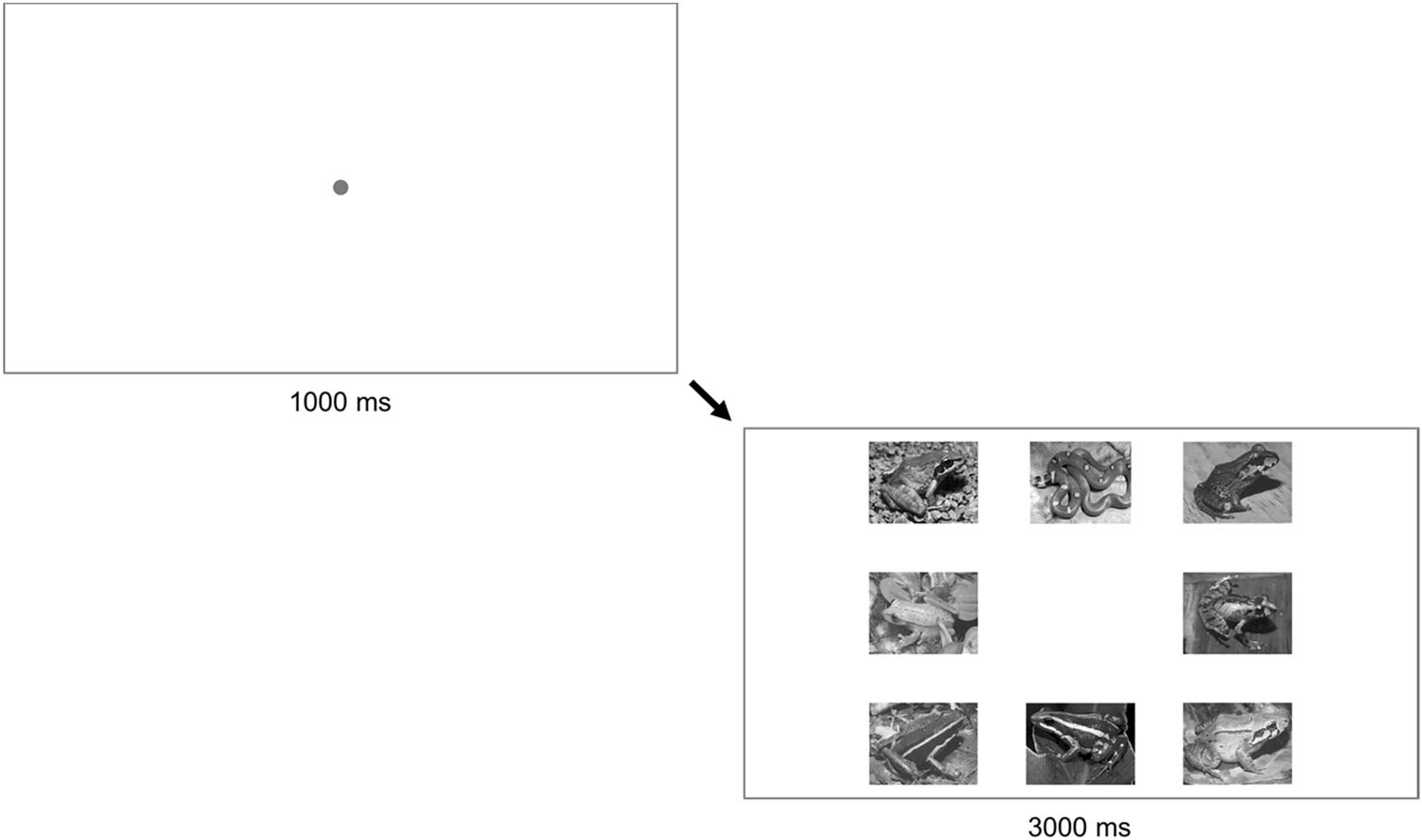
Gallup and his colleagues came up with an elegantly simple experimental design to test their group vigilance hypothesis. The procedure involved systematically exposing participants to silent video clips of strangers yawning, or those same strangers opening their mouths as if talking. Next, while wearing gaze-tracking eyeglasses, participants were shown a matrix of seven images—one “target” image and six “distractor” images—and instructed by an experimenter to locate the target visually as quickly as possible. Half of the time, the designated target was an evolutionarily relevant, dangerous animal (in one study, a snake) and the distractor images were of an innocuous animal (in that same study, a frog). The other half of the time, it was the reverse. This same setup was repeated over many sessions.


As predicted, seeing someone yawn just prior to this visual search task, but not seeing that same person opening their mouths to talk, led participants to detect the threatening animal more rapidly (as measured by their gaze latency and fixation). By contrast, it had no effect—and in some cases even a negative effect—on finding the harmless target. When told to find, say, the impala among a mix of lions, the yawn condition caused them to look more often at the lion distractors before their eyes ever even landed on the impala target.
In addition to snakes (versus frogs) and lions (versus impalas), the authors also investigated exposure to yawning in detecting spiders. In that study, the comparison species was cockroaches, and it turned out that seeing strangers on video yawning their heads off made people more hypervigilant to cockroaches as well. This forced the authors to do some minor backpedaling, but the results, I think, are still perfectly in accord with their evolutionary model. “While these results were predicted for spiders, as these animals have been a recurrent survival threat to humans during evolutionary history and some species are lethally venomous,” they explain, “we did not expect this for cockroaches since these insects do not pose the same level of acute threat.”
However, cockroaches are vectors of disease transmission and, therefore, likely activate detection and avoidance mechanisms linked to minimizing infection risk . . . It could be that stimuli receiving increased prioritization after observing a conspecific yawn covers a range of levels of implied threats, including both immediate and less immediate threats.
In any event, while the growing data certainly support the group vigilance hypothesis, there are still questions remaining. An obvious one, Gallup and Wozny concede, is whether seeing other people yawn would lead to more rapid detection of threats to human life more generally, including modern ones that cause far more deaths these days than do dangerous animals. If they were to run the same gaze-tracking study with images of handguns versus mobile phones, or cars versus sofas, would they find a similar effect of yawning? If so, it wouldn’t dismantle the central logic (many adaptive mechanisms involve learning yet are still part of an evolved system), but it would challenge straightforward claims of yawning’s role in innate sensitivity to specific animal types. For the record, I don’t think they would find this effect with modern, technologically recent threats to human life, but it is an open question.
Another issue is one I alluded to earlier. How exactly does yawning contagion fit into this evolutionary scenario? For now, Gallup and Wozny have some speculative ideas about that. We know from previous studies, they remind us, that only about half of people sampled in laboratory settings are susceptible to contagious yawning. There are all sorts of ambient, social, and personality factors that make “catching” yawns more or less likely, but even if some people do so (and their own alertness falters), the cumulative group effect would be enhanced. “Just a small number of relatively subtle vigilance cues can be amplified in real-world settings,” the authors explain. “Therefore, even if contagious yawning was insufficient to modify one’s immediate vigilance, any spreading of yawns via contagion would serve to amplify this cue to others. As a result, just a minority of contagious yawners within a group could appreciably improve overall collective vigilance under natural conditions by enhancing threat detection of observers.” It may also be no coincidence, they add, that both spontaneous and contagious yawns are most frequent in the evening hours, that creeping crepuscular window when our ancestors settled in for the night and were most vulnerable to predators.
All this yawning is making me sleepy. Or alert? Better look under the bed, just in case.
Like what you read? Toss a tip in the jar—any amount that makes sense for you—so I can keep overthinking things on your behalf.