


This article was originally published in French at Le Point on 13.04.2026
When it comes to sex and regret, there’s regret over not doing it when one could have (passive sexual regret), and doing it when one shouldn’t have (active sexual regret).
Which form is more common—and more tragic—is debatable. Existentially speaking, a solid case could certainly be made for the former. I have a sneaking suspicion that few on their deathbeds wish that dazzling night of debauchery with a beautiful stranger half a century ago never happened, whereas a life filled with such missed opportunities and carnal what-ifs—out of shame or fear or religious guilt or whatever else—before passing into oblivion seems a genuine human tragedy.
That being said, in the messy real world of STDs, sexual assaults, drunken one-night stands, broken hearts, divorces, unplanned pregnancies and abortions, stalkings and obsessions, gossip and rumors, ruined friendships, and a million-and-one other unlikely but possible negative outcomes of genital liaisons, it’s also easy to underestimate the potential emotional costs of casual sex. In a recent study in Archives of Sexual Behavior, psychologists Christina Sagioglou and (if I may, the perfectly named) Maximillian Dick from the University of Innsbruck in Austria investigated people’s regret in the wake of a one-night stand. That is to say, active sexual regret.
It’s important to define a “one-night stand” clearly, stress the authors, as it’s just one of several types of casual sexual relationships and experiences—or CSREs, as it’s known in the business. There are also “booty calls” and “friends-with-benefits,” for example, both of which imply a degree of regular occurrence with the same person. One-night-stands, by contrast, mean just that: a single sexual encounter in which, after the deed is done, you probably will never see the person again, bar that awkward moment in the grocery store five years later. (By the way, it’s called a one-night “stand” rather than a one-night “lay” due not to the hasty literalness of lust catching us on our feet, but because it stems from the historical use of the word stand, which was like a mobile stall set up temporarily in the market, often for a single night only. There’s a terrible meat market pun in here somewhere.)
Nowadays, there are plenty of apps built for lascivious purpose, with countless other horny souls near you being just a swipe or two away, if you so desire. The phrase “one-night stand” in that respect feels almost old-fashioned or quaint. But even before hooksups were at our proverbial fingertips, such casual, one-off encounters have been a part of human sexuality. And in their sticky aftermath, say Sagioglou and Dick, may come the dreaded “post-ONS regret,” basically having negative feelings about someone done rather than someone not done.
Previous research, they explain, made two things very clear. First, most one-night stands don’t lead to regret, but are instead viewed either neutrally (pretty much instantly forgettable) or positively. Second, there’s a gender gap: women are more likely to regret having a one-night stand than are men. The authors therefore sought to carefully dissect that hornet’s nest of factors that give rise to post-ONS regret, while also trying to figure out why women are so much more susceptible to having those negative second thoughts than are men. As for the gender gap, it could be, they reasoned, an evolutionary artifact, or alternatively it could be the toxic residue of the patriarchy, or maybe some combination of both.
Let’s put a pin in that for now, and first have a look at how Sagioglou and Dick went about measuring post-ONS regret. As psychological scientists, they developed a survey instrument that asked people to reflect, specifically, on their most recent one-night stand. (Those who hadn’t had any such experience weren’t included in the study.) This served to standardize the responses; participants weren’t simply thinking about their worst-ever or best-ever ONS experience, which would skew results, but just the latest one. The final sample consisted of 1,044 participants (649 females and 395 males) representing a diverse forty nationalities. There was quite a range in sexual experiences, as you’d expect—from a single ONS to 561 such casual sexual encounters. But the median number was three. Most (78% of the sample) were single at the time of the one-night stand, and the average age of the sample was 25.
Each person was asked to think about their most recent one-night stand, with the survey deliberately posing the types of intimate and uncomfortable questions usually reserved for conversations with your therapist... or maybe ChatGPT. Was this a same-sex encounter? Did you use protection? Were you single at the time? Cheating on your partner? Did you feel pressured, or was it your idea? Did you give or receive oral? How about anal? Did you climax? To what extent was it disgusting or unhygienic? How drunk were you, exactly? And so on. I’m paraphrasing here, but not by much. The researchers’ intent with these rather personal survey items was to get at the nitty-gritty details in a way that allowed them to pinpoint—with surgical statistical precision—what is most likely to lead to post-ONS regret.
A few clear contenders emerged. Among these were decision heteronomy (the less ownership people felt over their decision to have casual sex, the more regret); moral concern (the more intrinsically “wrong” they felt it to be, for whatever reason, the more regret); reputational concern (the more worrying about what others would think, the more regret); alcohol intoxication (the more sloshed at the time, the more regret). In addition to these predictable factors of sexual dynamics, some people are also just more regret-prone. The personality dimension of emotional stability significantly predicted regret (the more emotionally volatile, the more post-ONS regret). Age mattered too (younger respondents had more regret). Interestingly—and somewhat contrary to my deathbed hypothesis above—the more time that had elapsed since the one-night stand, the more regret people had about it. Whether this modest trend is due to the fading of positive memories of physical pleasure over time, or people just getting crankier and more conservative as they age, the authors couldn’t say.
One of the biggest predictors was simply sexual satisfaction. For both sexes—in straight and in gay pairings—those who got off during the casual encounter had less regret about the episode than did those who didn’t. But this buffering effect was especially pronounced for women who had hookups with men, “with orgasm achievement playing the critical role.”
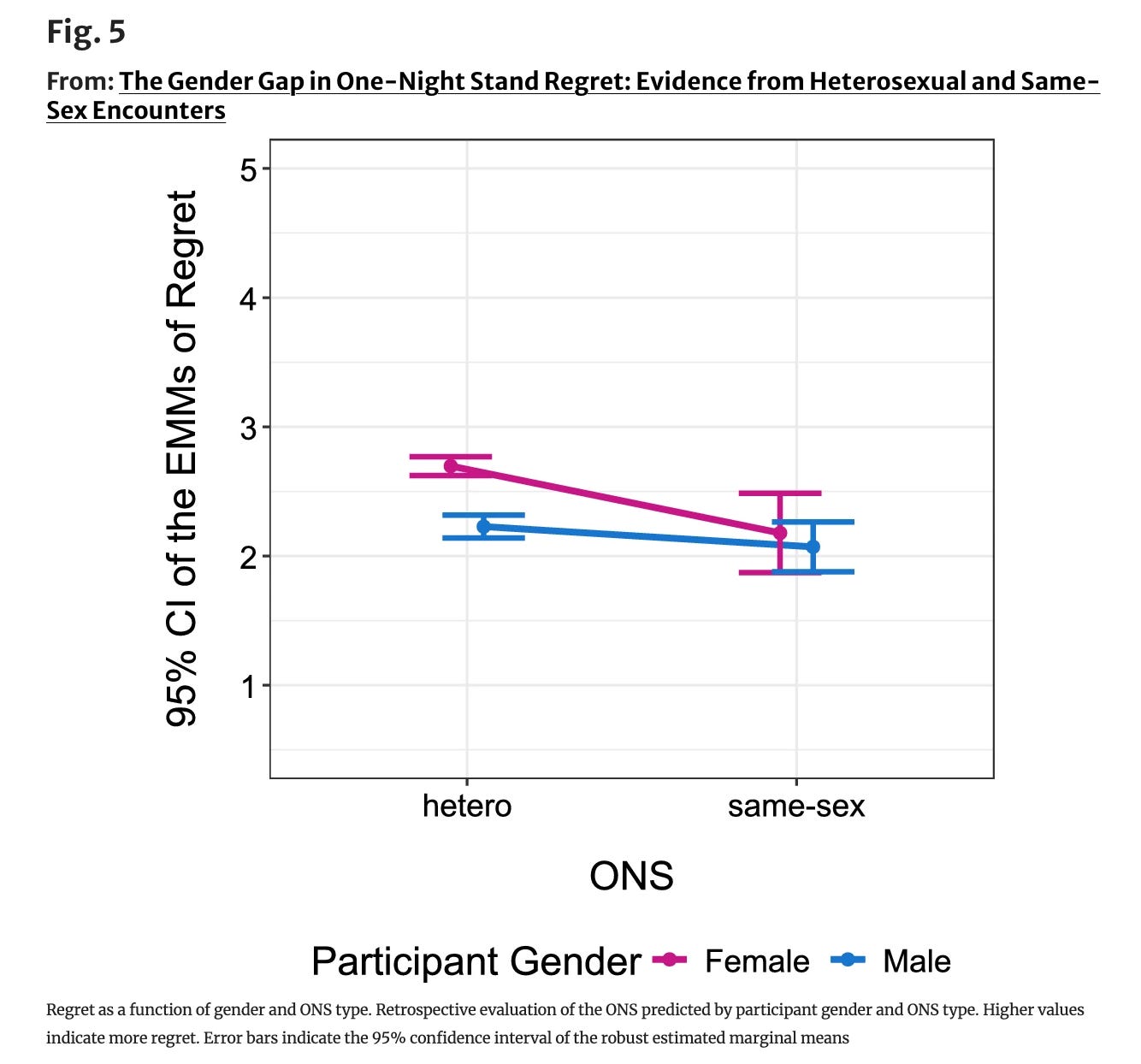
In fact, heterosexual sex is apparently a risk factor for post-ONS regret—but only if you’re a woman. Men who had one-night stands with women, women who had one-night stands with women, and men who had one-night stands with men, all had significantly lower regret than the women who had sex with men. “This pattern suggests that the elevated regret commonly observed among women following [one-night stands] may be driven primarily by dynamics specific to mixed-sex encounters rather than representing an inherent sex difference in psychological response to casual sex,” write the authors. Although they interpret this as evidence against evolutionary psychology explanations for sex differences in post-ONS regret, I don’t see it this way. Human brains could have certainly evolved to distinguish between different types of sex partners and the adaptive implications thereof. Not to be crass, but a penis inserted in her vagina obviously has more genetic ramifications for a woman than another woman’s vulva pressed against her own. It’s that old parental investment theory again: today’s birth control measures mean the playing field has leveled, but for most of human history, women had far more at stake in having casual sex than did men. Well, straight sex, anyway. In other words, not all CSREs are equal, and as far as I’m aware, evolutionary psychologists have never argued any such thing.
Still, as Sagioglou and Dick point out, and as their findings also suggest, any evolved dispositions for post-ONS regret are likely to be meaningfully shaped by sociocultural forces anyway. Even in the modern progressive West, heteronormative scripts—particularly those that prioritize male sexual pleasure and tacitly favor patriarchal control—may indeed be seeping in. Again, women who had one-night stands with men expressed the highest regret overall (and remember, even that was pretty modest). But statistically, the primary reason for this male-female gap in post-ONS regret was that only in that particular erotic combination was one side more likely than the other to get their rocks off. And you can guess which one.
Like what you read? Toss a tip in the jar—any amount that makes sense for you—so I can keep overthinking things on your behalf.