


This article was originally published in Le Point on 13.07.2025
One of the most vexing problems of being a human animal today is that, despite our more principled aims, and in stark contrast with our lofty self-image as progressive “free thinkers,” our ways of thinking will only ever be—can only ever be—tethered to a brain that is adapted to the social conditions of a largely obsolete past. It’s like we’re all still driving on a few dirt roads in Model-T Fords but, somewhere along the way, we decided to operate under the collective delusion that we’re spinning without limits in another dimension. Nowhere is such admirable but fantastical thinking more apparent than the curious notion of “colorblindness,” a racial ideology jarringly out of whack with our species’ psychological reality.
Of course, saying one is colorblind isn’t meant literally—but instead that skin color is such a superficial characteristic that it shouldn’t be factored into our interactions, and that even discussing or acknowledging racial categories is itself prejudicial. White people, perhaps not surprisingly, are much more likely to endorse a colorblind ideology than minority groups.
Although the construct of race is debatable (Einstein called it “a fraud” nearly a hundred years ago), there’s no denying that different peoples from different geographic regions display conglomerates of genetic traits (including skin color and other shared physical features) that maximized their ancestors’ chances of survival and reproduction (e.g., more melanin content in populations closer to the equator as a buffer against the deleterious effects of high UV radiation, and the inverse in those at the farthest latitudes to ensure sufficient Vitamin D production), and that these observable traits make them easily identifiable today as “races.” So, while you may declare proudly that you try not to even notice the color of someone’s skin, your brain isn’t a willing partner: it automatically processes race in milliseconds, about as fast it computes sex and age.
According to psychologists XT Wang and Geoffrey Miller, it’s not that we evolved to detect race per se (after all, “Caucasians” or “Africans” or “Asians” weren’t bumping into each other at the local watering hole during the Pleistocene), but instead this cognitive vigilance to cues of physical otherness is an artifact of threats, tensions, and opportunities between prehistoric tribes. These included not just bodily phenotypes, but other obvious cultural markers too, such as clothing, tattoos, hairstyles, jewelry, and so on. While such a rapid-fire heuristic in ingroup-outgroup tagging would have been highly adaptive, it dragged with it from those ancient bowels all the dumb, horrible machinery of stereotyping and prejudice.
Are colorblind people immune from this way of thinking? Hardly. Researchers measure degree of colorblindness by asking how much one agrees with statements such as “it is more important to be colorblind than it is to celebrate differences in race and ethnicity” or “if everyone paid less attention to race and color, we would all get along much better.” The trouble is, this not only goes against the grain of our evolved psychology, it also can backfire spectacularly. If you’ve ever heard of the famous “white bear experiment,” in which the social psychologist Daniel Wegner found in the 1980s that telling participants not to think about something (in the titular case, a white bear) only makes them think about it that much more, you’ll see the folly of those good non-racist intentions. This extension of Wegner’s so-called ironic process theory becomes evident from findings showing that those who describe themselves as more colorblind show higher scores on implicit and explicit measures of racial bias and stereotypes. That irony wasn’t lost on a team of researchers led by Sarah Gaither from Duke University, who noted in a 2016 article in Psychological Science that people may endorse colorblindness not because they’re genuinely egalitarian, but “instead [it may also be] a strategic approach to race relations where individuals elect to not acknowledge race when doing so might put them at risk of being uncomfortable or seeming racist.”
In fact, in that same article Gaither and her coauthors pointed out, almost forebodingly, that “with our society constantly facing issues surrounding police brutality, immigration policy, and heath care and education, learning to acknowledge group differences (including inequities) is essential to making progress on those fronts.” The goal, these researchers argued, is to “encourage the acknowledgement of race … while simultaneously reducing societal assumptions of difference.”
Easier said than done, you say? Well, yes. But interestingly, a balm for racism—especially when under the comfortable guise of colorblindness—may be exposure to a very specific category of human being. In a number of recent psychology studies, showing participants images of biracial faces has led to surprising effects in people’s thinking about race.
In a series of controlled experiments by Gaither’s team in the US, for instance, White participants were randomly assigned to view computer-morphed images of monoracial faces (all-Black, all-White, all-Asian, etc.) or biracial faces. Those exposed to the biracial faces had lower colorblind attitudes, basically seeing race as something that was important to acknowledge, recognize, and appreciate. Viewing biracial faces also had an effect on participants’ ideas of race essentialism, the notion that race biologically determines abilities and character traits and that such forces are immutable. Those exposed to the biracial faces were significantly more likely to see racial categories as fluid and malleable constructs.
Intriguingly, these effects on colorblindness and race essentialism disappeared when those same biracial faces were labelled as monoracial (e.g., “Pacific Islander,” “Native Hawaiian”), suggesting that it’s not just seeing such faces but knowing (or believing) them to be biracial that is at play here. The authors interpret these findings as showing that biracial people are uniquely poised to allow monoracial people the freedom to no longer pretend that race doesn’t exist—and therefore to avoid those thorny race issues altogether—but to interrogate their own biases and attitudes. Much of this, the researchers figure, is due to White people’s assumptions about biracial people. Namely, biracial people are perceived as less threatening, because they are viewed as having both ingroup and outgroup membership, and therefore more open themselves to discussing race. They have skin in the game for both sides, in other words. (Again, this is only about people’s perceptions of biracial people.)
Indeed, the investigators found that participants were more receptive to hearing from biracial people than monoracial people when it came to current race-related issues of injustice and social inequities. That is to say, participants were less inclined to make assumptions about biracial people’s “position” on race, and were genuinely more interested in learning from them than from the ostensibly more prejudiced monoracial people. Also, because biracial people elude easy categorical processing, this cognitive hurdle motivates what Gaither refers to as “social tuning,” which means trying to ascertain how they should be acting and thinking around this person, rather than relying on quick-and-dirty race stereotypes to inform them.
Underlying much of this psychological response to biracial faces is, ironically, a certain intolerance—or at least, an intolerance for ambiguity. One of the most common experiences reported by biracial people or those of mixed descent is being asked (in so many words), “What are you?” When those evolved heuristics of ours, designed to rapidly tag someone as an ingroup or outgroup member, get frustrated by ambiguous cues in this way, we seek clarity in whatever form we can get it. In an interesting study published last year by Wang and Miller, Chinese and American participants were shown images of faces progressively morphed by degree of “Caucasianness” and “Asianness”—from 30% to 70% one or the other. Both groups overestimated the percentage of their own race in these morphed facial images. Despite this own-group perceptual bias, however, participants judged biracial figures as being more attractive and more trustworthy, even more so than members of their own race.
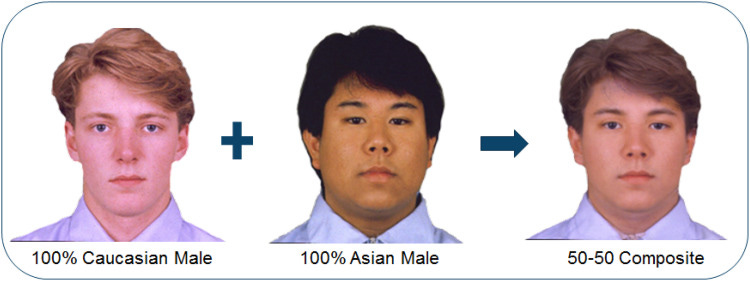
That demonstrable preference for biracial individuals in the social domain, or at least a more favorable view of such people compared to those of the same race or of another race, can be best understood, reason Wang and Miller, from an evolutionary perspective. Their coalition-signalling hypothesis contends that biracial features broadcast a wealth of adaptive information to perceivers, namely that this “ancestral admixture … [reflects] a possible historical alliance between members from the two races, and thus increase[d] cooperative potential.” From the unconscious view of the observer, the authors explain, this translates as:
The biracial person represents an “existence proof” that my group and the outgroup are genetically compatible for raising offspring and perhaps did cooperative parenting and some other forms of familial, social, and tribal cooperation.
The biracial person is seen as an ideal social (perhaps even reproductive) partner, as they signal opportunities for access to limited resources beyond the intensely competitive confines of the ingroup. Also, with their presumed mixed-group allegiances, biracial people may indicate a lower threat of warfare and mate-raiding. Facial cues suggesting a disproportionate genetic admixture (beyond 50/50) are effectively human ripples of intergroup harmony, their very being suggesting generations of parents and grandparents from both groups cooperating and raising children together. “Biracial faces cues are unique,” write the authors:
…because they are not only a collage of different racial features, which may highlight the differences and incongruence between races. Instead of competition and discrimination, biracial cues indicate seamless assimilations.
If exposure to biracial people is an antidote to racism, or at least among the most effective deterrents, wonder Wang and Miller, shouldn’t they feature more in public-facing initiatives for reducing racism? Diversity is great, in theory. But take ‘media representation,’ for example. “Promoting racial harmony and reducing prejudice through ‘media representation,’” they write, “might be better for TV, movies, and ads to include more biracial people rather than just trying to get a representative mix of different prototypical races.”
Perhaps nature will eventually run its course anyway. Biracial populations are among the fastest growing demographics, with more people now than ever dating and mating “outside their race.” If humans are still around ten thousand years from now, our old-fashioned, simpleminded brains will no doubt have found fresh new markers of outgroup status to instantaneously affix stereotypes about others. But race? That may be just prehistorical.
Like what you read? Toss a tip in the jar—any amount that makes sense for you—so I can keep overthinking things on your behalf.