



Masturbation. What is it good for? For human males, at least, the most compelling argument—put forward by British evolutionary biologists Robin Baker and Mark Bellis in 1993—is that it expels old, rapidly deteriorating sperm cells in favour of fresh, healthier ones.
It’s classic sperm competition theory, a concept Baker unpacked a few years later in his book Sperm Wars. Fresher sperm, the evidence suggests, are simply better swimmers than their arthritic, geriatric counterparts, and therefore better able to reach a secure position in the reproductive tract. Once those vigorous flagellating gametes land there, it’s a win-win-win, adaptively speaking. For men in monogamous relationships, more recently produced spermatozoa are more fertile than those that have grown stale. For men having sex with women who recently had sex with another male—or multiple males—it’s sending in one’s best talent to square off with the competition. Finally, younger sperm live longer in the female tract, so any enhanced fertility and competitiveness advantages will also last longer. Not to be gross (oh, who am I kidding, I love being gross), but in one clever study, the contents of women’s “flowback,” which is just what it sounds like, were analysed after intercourse with their partners. The longer it had been since he’d last ejaculated, the more sperm in her flowback, showing that women’s bodies favourably retain fresh sperm.
Anyway, back to masturbation. And now that I’ve finished that, back to the article. (The French, by the way, have a rich vocabulary for the act; my personal favourite is “marrying the wrist widow.”) So, considering that the shelf-life of spermatozoa is five to seven days, and given that human males produce a whopping eighty-five million sperm cells per day, per testicle, that’s a lot of low-grade elderly sperm to be toting around. Masturbation therefore becomes a sort of adaptive flushing—out with the old, in with the new. Quality over quantity.
The numbers line up, too. In the original Baker and Bellis article, male university students reported masturbating to ejaculation about once every three days, a frequency that has never really wavered, even in the porn-saturated present. It’s worth remembering also that we’ve always had virtual porn theatres in our heads. One of my favourite early sex researchers, the Austrian psychologist Wilhelm Stekel, described masturbation fantasies as a kind of trance or altered state of consciousness, “a sort of intoxication or ecstasy, during which the current moment disappears, and the forbidden fantasy alone reigns supreme.”
Much like how AI is now encroaching (dangerously, I believe) on human creativity and critical thinking, porn has likely atrophied our erotic imaginations. This is definitely true for males, whose sexual arousal, compared to that of females, is so strongly linked to visual cues. I’m sure there are data on this somewhere, but I would not be surprised if the majority of the modern male population masturbates only to porn.
Spilling seed through masturbation, however, is as old as time. Or at least, human time. Non-human primate hands are just as capable as our own in this arena, but surprisingly, evidence of “deliberate” masturbation to ejaculation in monkeys and apes in the wild is scarce, at best. Over an observation period totalling more than 8,500 hours, one primatologist who was following a troop of colobus monkeys observed only five incidents of males masturbating to the point of ejaculation. And even then, it wasn’t that the monkeys were pleasuring themselves alone in the treetops. These rare incidents occurred only when nearby sexually receptive females were exhibiting loud courtship displays and copulations with other males.

At the risk of being overly speculative, I’d wager that so much masturbation in our species co-evolved with an advanced cognitive capacity to mentally represent (i.e., picture) scenarios divorced from our immediate surroundings. This could be true for both sexes. But among our male ancestors, especially, this unique ability to simulate intercourse mentally would have helped—not solve the problem, clearly, but helped—alleviate sexual conflict among in-group members, fostering social coalitions that were central to our species’ mysteriously rapid rise and proliferation across the planet. Sure, you might fancy Urg’s hot wife Ugga, but if you act on those libidinous impulses, you can forget about Urg helping you build that shelter tomorrow, or any other day. However, having sex with Ugga in your head, well, that’s two birds with one stone. Think of the “spank bank” as underappreciated driver of our species’ success.
Porn has arguably rendered the spank bank obsolete. What that means, only time will tell. It is interesting, though, how a growing number of young males, especially, see masturbation as a “scourge of the human race … destructive of that perhaps most important thing in the world, the potency of good heredity … causing offspring with persistent infantilism or overripeness.” Actually, my mistake, those were the words of G. Stanley Hall in 1904, the father of adolescent psychology, who had a major thorn in his side when it came to teenage masturbators.
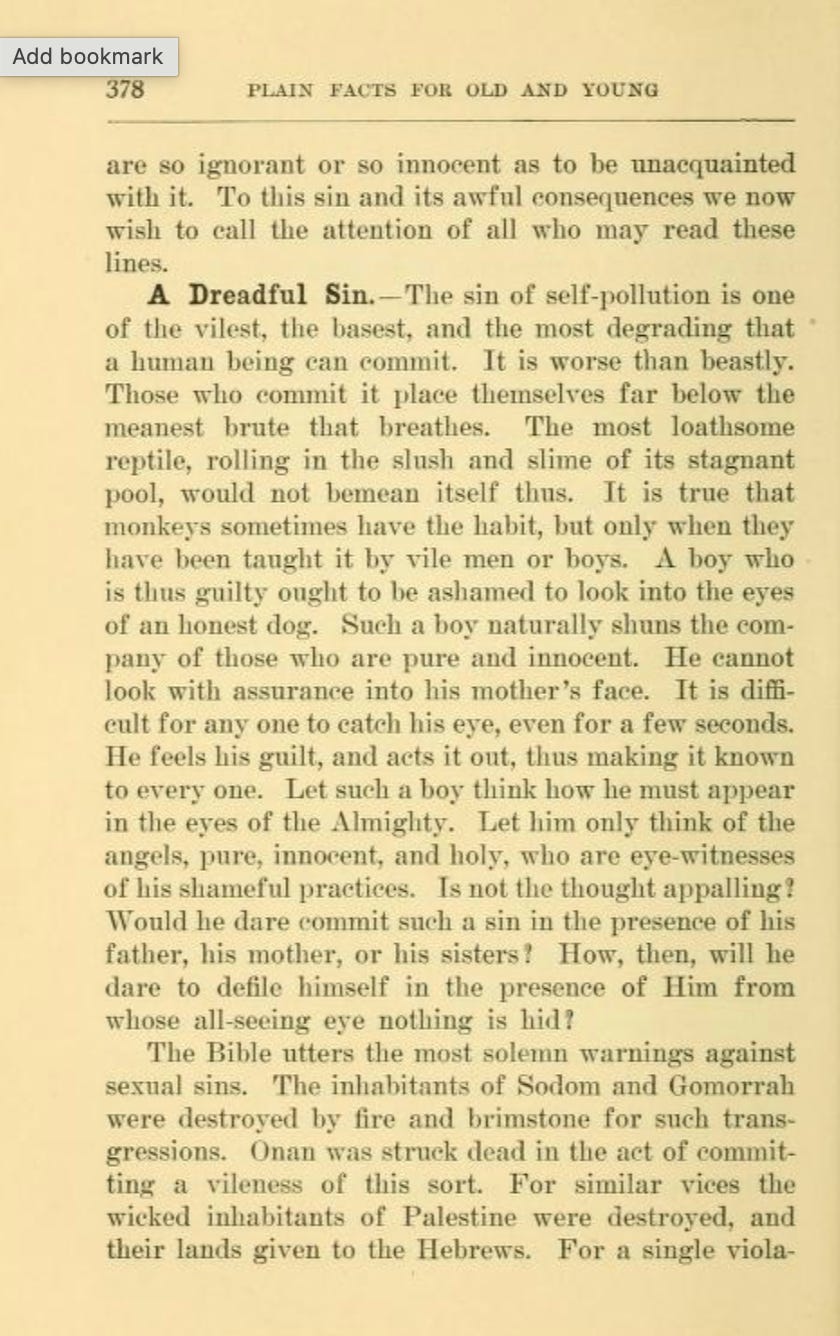
Hall’s views on fapping were merciful compared to those of Dr. John Harvey Kellogg, who, back in the 1880s, recommended that serial—sorry—offenders be circumcised without an anaesthetic, because the pain and soreness would further discourage the act. For parents who hesitated to lop off their child’s foreskin, he suggested stretching it as tightly as possible over the glans and suturing it shut with a needle and wire. He apparently thought this was more humane than the alternative. Not only did such boys go blind, insane, or have deformed or mentally impaired offspring, Kellogg explained in his wildly popular Plain Facts for Old and Young, “such a victim [of masturbation] literally dies by his own hand.”
It’s not quite that strident, but questionable messaging appears in different packaging these days, with names like NoFap and No Nut November (followed by the more carnally festive Destroy Dick December). They are a response to problematic porn use—and there is no doubt that is a real problem for many males—but often involve restrictions against masturbation entirely. There are limitless online testimonials, podcast pseudoscience, and bro-culture anecdotes, but the salubrious virtues of “holding back” have yielded little in the way of actual clinical evidence, and in fact plenty of counterevidence. One recent study published earlier this year in the journal Psychology & Sexuality featured a content analysis of the top 100 posts to a “semen retention” Reddit subforum. The authors define semen retention as “the act of preventing or avoiding ejaculation by refraining from any sexual activity altogether, ceasing sexual activity upon reaching the point of ejaculation, or achieving orgasm without ejaculation” (I still have no idea how that last one works in someone with a functioning prostate, by the way). The r/Semenretention subreddit is a community of likeminded no-cummers dedicated to this practice.”
The researchers—a Canadian team led by sexual health professor Caroline Pukall from Queen’s University—identified recurring themes in these subreddit posts. A common topic was the conceptualization of semen as a sort of mystical or vital life force, one whose depletion diminishes masculinity, keeps men weak and subordinated, drains their moral fibre and resolve, and has cascading negative effects on everything from career performance, to health, to relationships. In fact, the investigators suggest that such growing anxieties in Western males about the loss of semen closely resemble what has, until now, been treated as a psychiatric South-Asian “culture-bound syndrome” known as Dhãt syndrome. That disorder manifests in young males from rural backgrounds in India and Pakistan with limited education, who become anxious and hypochondriacal about losing Dhãtus (considered a spiritually powerful bodily fluid in the Vedic tradition of Hinduism, concentrated in semen).
Actually, there’s stronger evidence that semen retention affects the wellbeing of women who are inseminated than men whose bodies reabsorb it. Only about 3 percent of the average human ejaculate consists of sperm cells. The rest is seminal plasma. Semen is highly chemically complex, containing over 50 different functional compounds like hormones, neurotransmitters, and endorphins. Most surprisingly, it acts as a natural cocktail of anti-anxiety and mood-boosting chemicals—when you give it to others.
Perhaps the real threat to our species isn’t the loss of a mystical life force but forgetting that having sex with Ugga in your head was probably what helped us conquer the globe in the first place.
The intensity of concentration that is natural to erotic arousal is what meditation seeks to achieve through contemplation of the divine. Given that libido is the most efficient driver of virtually automatic flowing attention, dhyana, is it any wonder that the yogis disdain concupiscence and attribute the energy In the brain to semen rising through the spine?