



This article was originally published in French at my Le Point column 28.06.2026
Back in the aughts, women’s sex toy parties were all the rage. I could only picture in my head small giggling gatherings of blushing ladies in the suburbs. While the attendees fawned over a coffee-table spread of the latest vibrators, lubes, and feather ticklers, some tipsy, bespectacled mom would be holding a plastic anatomical model of the female reproductive system in one hand and a mimosa in the other, urging the more uptight women to liberate their inner goddesses. Often likened to the previous generation’s Tupperware parties, these were harmlessly naughty, “sex-positive” gossip venues for normal middle-class housewives.

It’s curious, is it not, that such an innocuous thing somehow becomes grotesquely darker when applied to male sexuality. Just imagine a group of men huddled over their neighbor’s pool table, bonding over this season’s fleshlights, cock rings, and anal vibrators while sharing tips about their foreskins and mind-blowing ejaculations.
Unless I missed it, men’s sex toy parties never had their cultural moment. But even at trade shows, company reps say that products for men (such as penile masturbators, or “strokers”) are often required to be kept out of sight, whereas vibrators or other products for women are prominently displayed. Men’s use of sexual technology—or sextech—is seen as being less acceptable, or at least is more stigmatized, than women’s use of such erotic products.
That’s a head-scratcher, point out the psychologist Madison Williams and her colleagues in a recent study in The Journal of Sex Research. After all, in most other areas—sex before marriage, relationship age disparities, number of sex partners, having orgies or threesomes—it’s women who are stigmatized or judged more harshly. Yet in the case of sextech, men’s use of such products seems clearly to inspire more visceral aversion than does women’s. Why?
Williams and her team had a hunch. They suspected that the emotion of disgust is probably driving this creepiness differential. It’s not that people aren’t grossed out at all by women using dildos, vibrators, or other feminine whatnots. In fact, previous research indicated that, regardless of the user’s sex, people tend to view those who use sextech as low-grade social lepers—and this ostracism increases as the product becomes more “human-like,” such as hyper-realistic sex dolls and robots. (That earlier study wasn’t flawless, however. One of the items in the survey was “Would other people in your community avoid a person using a(n) [insert technology here].” Like, using it right now? Of course. Who’d want to disturb them?)
Indulging in sextech, suggest Williams and her co-investigators, hits the unholy trifecta of disgust—pathogen disgust, moral disgust, and sexual disgust—right on the D-spot. “Sextech use has the potential to elicit all three domains, positioning it as a particularly salient area for study,” write the authors. “For instance, concerns about the cleanliness of sextech may evoke pathogen disgust, the perception that its use violates social norms may elicit moral disgust, and its inherently sexual nature may trigger sexual disgust.” And when you throw into this mix detached, lifelike silicone body parts with monstrous perturbations—do yourself a favor and do not, I repeat, do not, Google “foot fleshlights”—that can take it to a new level.
In any event, Williams and her co-investigators went deeper than ever before into these meaty issues. A sample of 371 adults—men and women between the ages of 18 and 81—were given scenarios depicting sextech use and, for each one, they were asked “how disgusting” (1=not at all disgusting to 7=extremely disgusting) they found it to be. There were six scenarios:
· A man using a sex toy (e.g., fleshlight)
· A woman using a sex toy (e.g., vibrator)
· A man conversing with an erotic chatbot
· A woman conversing with an erotic chatbot
· A man having sex with a robot
· A woman having sex with a robot
The results were telling, and mostly unambiguous. First, across the board, male users of sextech were judged more harshly (i.e., seen as being more disgusting) than were female users of sextech. “This is the first study to empirically demonstrate that people perceive men who use sextech more negatively than they do women,” summarize the authors, “highlighting a striking double standard.” This was true regardless of the type of sextech being, er, deployed and was especially pronounced in women’s disgust ratings of men’s sextech use. Female participants saw men who used such devices to be grosser than women who did so.
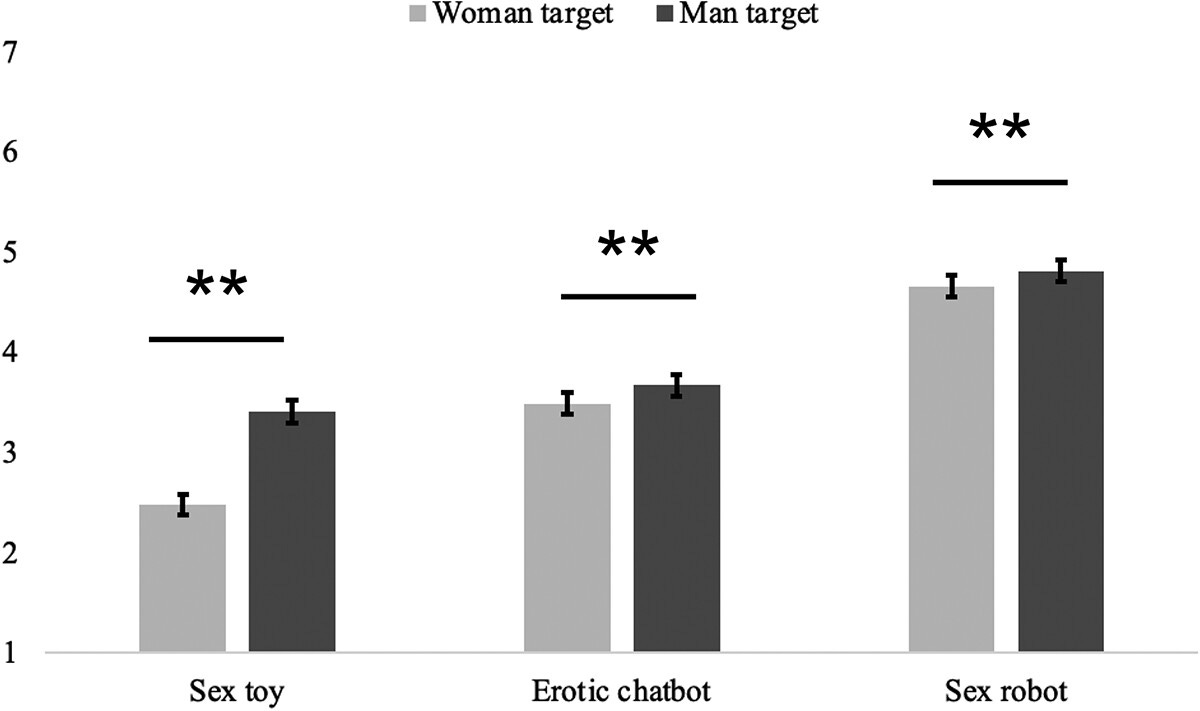
However, the more “humanlike” the sextech—in terms of appearance, movement, behavior, artificial intelligence, and so on—the more these sex differences dissipated. The use of humanlike sextech (especially sex robots) was seen as being more disgusting—for men and women—than more traditional sex toys.
Considering the large swaths of people who are apparently using such objects either for masturbation or during partnered sex—roughly half of the Western human population, according to self-reports—these findings of an anti-male, sexual double standard are unsettling, say the authors. After all, they note, a “prejudice that penalizes men more strongly for using sextech—especially sex toys—than it does women … is unfortunate in light of the many [established benefits], including presenting new avenues for sexual experience among those with disabilities, enhancing sexual well-being, improving intimacy between partners, addressing sexual dysfunction, and providing heightened arousal and pleasure.” While women are often lauded for embracing their erotic nature through such toys, men are shamed.
Also, given that the sex industry is always at the vanguard of technological advancement, it would be foolish to think that this ostensibly disgusting issue of humanlike sex—with robots, avatars, or whatever else our species’ libidinous imaginations are likely to conjure—will be going away anytime soon. “In spite of mainstream moral panic or concerns that technology may interrupt or replace human intimacy,” Williams and her coauthors point out, “little research has examined the actual implications of sextech use, especially in its more advanced forms.” With the extraordinary pace of technological development, we had better hold onto our virtual knickers. Even in our wettest dreams, I’m guessing we haven’t seen anything yet.