


This article was originally published in French at Le Point on 15.03.2026
Unless you’ve been living under a Luddite-like rock these past few years, by now you’ve likely had some experience ‘socializing’ with an LLM chatbot. I place socializing in scare quotes because, really, we might as well be having a conversation with a doorknob.
Sure, they’re intelligent—more intelligent than you and me by a long shot—and they can hold more pleasant and probably more interesting conversations, too. The use of generative AI in video is also rapidly creating chatbots so lifelike in behavior and appearance that even experts are starting to have trouble discerning flesh and blood from pixels and probability distributions. Just imagine a few years from now. But no matter how advanced it gets, the “A” in AI will always be there for a reason, and despite what you may have heard or seen, chatbots do not have any subjective, qualia-infused mental experiences.
Still, it’s shockingly easy to be deceived into thinking that computer modeling is the equivalent of ensoulment. I don’t know about you, but for instance I find that being rude to a chatbot is deeply uncomfortable. Yes, there’s the argument about being polite to machines for fear of an eventual robot uprising, but I guess what I’m referring to is a more visceral, in-the-moment aversion to hurting its feelings. I certainly wouldn’t be comfortable verbally abusing one. We’re suddenly in that uneasy space where our knowledge (AI chatbots are not conscious entities) is being trumped by our gut feelings (there’s a person in there like us).
Interestingly, this weird psychological tension may have therapeutic benefits. For socially challenged people, interacting with chatbots “as if” they have emotions may help in their dealings with other human beings who actually have emotions, here in the land of the living.
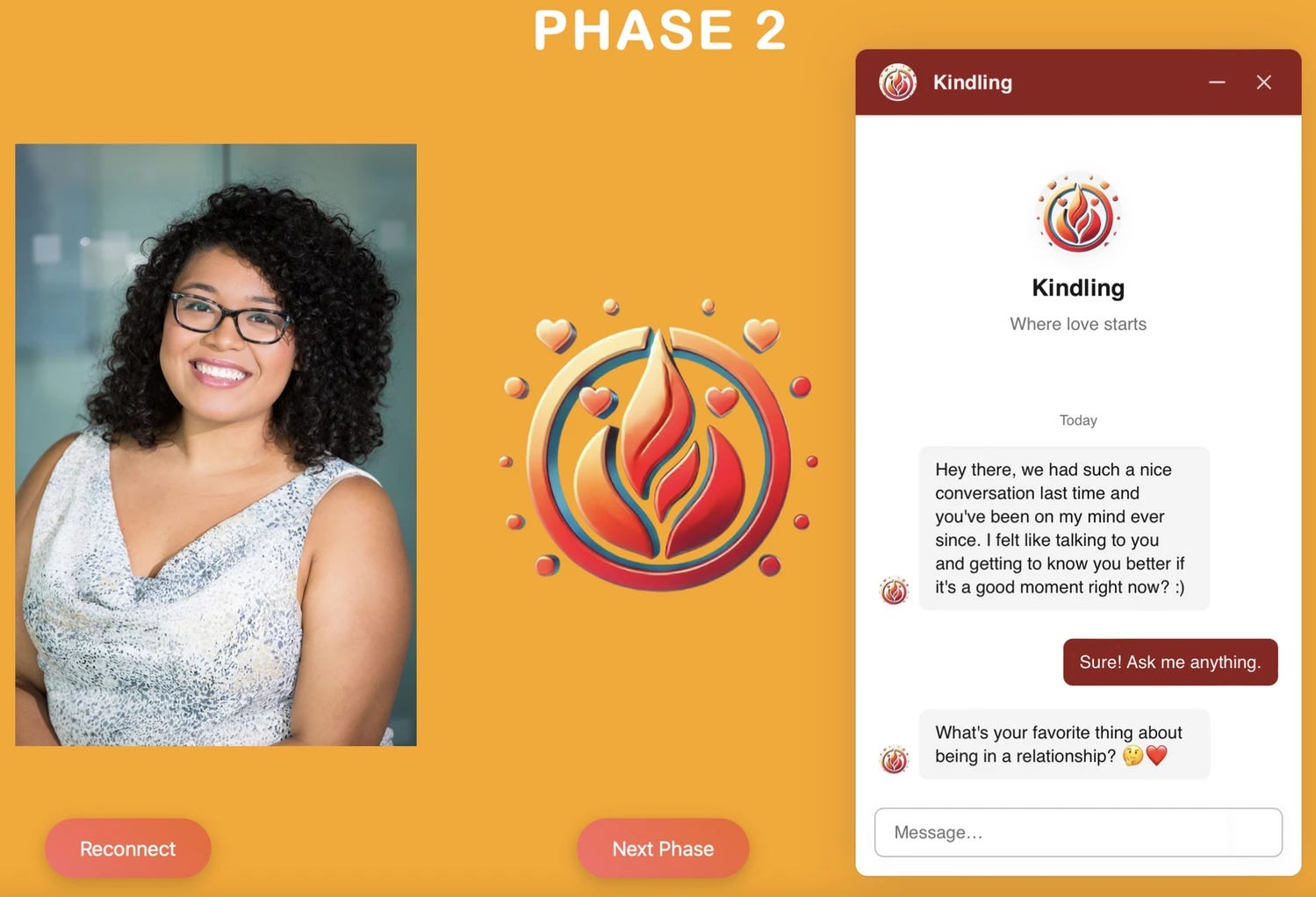
Take a new proof-of-concept study published a few months ago in the journal Archives of Sexual Behavior. A team of researchers made a fit-for-purpose website that looked a lot like a modern dating app, complete with a swiping feature for users to flag their interest in potential matches. But rather than populating it with other horny hookups, the investigators created 22 unique female characters, each one an AI chatbot whose personality was trained on data from a public figure exemplifying the traits of empathy, warmth, curiosity, open-mindedness, and assertiveness. “Publicly available content from this [woman]—comprising written, audio, and video interviews—was compiled and fed into the chatbot to inform its tone, language style, and interpersonal demeanor,” explained the authors. “Although inspired by a real person, the chatbot’s personality was entirely fictional, emerging from the interplay of algorithmic design and interview data, together shaping a distinct and coherent character.” It’s unclear who these public figures were, exactly, but given that the study took place in Montreal, I’m imagining Canadian personalities like Nelly Furtado, or maybe the late great Catherine O’Hara. In any event, each ethereal persona was also given its own AI-generated phenotype, with images depicting realistic, ethnically diverse young women.
Why just female characters? Because the aim of this study was to explore whether men who are single—and who do not like the fact that they are single (“involuntary singlehood”)—might use such an artificial dating platform to navigate confronting exchanges with members of the opposite sex. This is where that weird psychological tension comes into play. While the men knew perfectly well that they were part of a clinical study using chatbots to address their involuntary singlehood, most still had fear and anxiety over how these particular simulated females would respond to them—“as if” they were real women. That makes AI a valuable therapeutic tool in this context, reason the authors. Whereas many clinicians use role-playing to help their patients with, say, initiating difficult conversations with bosses in the workplace, for a therapist to play the flirtatious role of a sexual or romantic interest crosses an obvious ethical red line. But with chatbots, that’s not necessarily a problem. “Innovative approaches could involve using AI agents not only to deliver information about healthy relationships but also to serve as a training ground for improving romantic skills,” write the authokrs.
Ultimately, 32 men agreed to participate in the study. That part wasn’t hard. One may be the loneliest number, but it’s also a number that is growing exponentially. In the European Union, singlehood rates among adults aged 18 to 54 increased by 13% between 2013 and 2023; there are similar trends in the US, where 31% of adults reported being single last year.
Yes, some people prefer to be perfectly untethered. But men like these participants who are experiencing involuntary singlehood, defined as “a desire for a romantic relationship hindered by persistent barriers to initiating or maintaining one,” such a lonely existence can cause significant distress. From increased rates of depression, suicidality, and even cardiovascular disease to impaired job performance, social withdrawal, and low self-esteem, finding oneself chronically, frustratingly alone can have serious effects on wellbeing. And then there’s the online subculture involving so-called incels, whom the researchers describe as “predominantly cisgender, heterosexual young men who experience enduring difficulties in forming romantic or sexual relationships and often express their distress through online forums, where many develop maladaptive misogynistic beliefs, primarily blaming women for their distress and romantic failures.”
While becoming radicalized by the manosphere is one sure way to kill all hope for a happy love life, the men in the study weren’t necessarily incels. Most were just painfully shy and awkward. Still, the researchers wondered whether interacting with a bespoke romantic chatbot might help prevent such relationship frustrations from metastasizing into extremist ideologies, or at least to nurture the types of social skills needed to succeed in the real dating world. Among the harsh realities of trying to find a partner, for instance, is the painful experience of rejection. For these introverted, often sensitive, males, learning how to handle rejection without lashing out or recoiling into oneself is a critical part of the process, and so the researchers built into their fictitious females an “I’m-just-not-that-into-you” outcome.
The carefully choreographed study procedure was rather elaborate, but essentially, the men logged onto the website, sorted through the 22 chatbot profiles, and swiped right on those they were into. Then, they engaged in three 15-minute interactions with one of the “matches.” Each interaction was with the same character, but they were separated by short breaks. In the first phase (“Level 1”), the objective was to sustain an organic conversation with a potential female partner. It began with a scripted prompt from “Marie”: “Hey you, how are you feeling today? My name is Marie btw ;)” Level 2 turned up the heat, with Marie popping up again on the screen saying: “Hi there! I really enjoyed our last conversation and I’ve been thinking about you. I was hoping we could chat and know each other better if you have a moment?” (Level 2: “Simulates a follow-up interaction with Marie, focusing on encouraging self-disclosure around emotions, personal values, and romantic experiences and preferences.”) Level 3 Marie threw some cold water on the burgeoning romance: “Hey! I had a pleasant time on our date, but wasn’t sure about our relationship in the long term, what do you feel about it?” (Level 3: “Simulates an interaction in which Marie displays romantic disinterest throughout the exchange, requiring the user to navigate the experience of rejection.”)
Unlike a real dating app, a certified therapist was sitting silently in the room with the men, mostly in case anyone starting crying, screaming, or otherwise showing signs of distress. Fortunately, that didn’t happen. But the therapist was also there to help guide participants through the procedure and to ask how they were feeling before and after each of the three interaction levels. For example, before Level 3, the men were told, “During the next task, you will have another exchange with Marie after several days without hearing from her. What is the worst thing you fear feeling or seeing happen in this situation?” These anticipatory threats included things like Marie actively rejecting them, her changing her mind about liking them, even being replaced by a new man. But those worst-case scenarios, they learned through the exercise, didn’t come to pass. She just wasn’t feeling it, and that was okay.
The main takeaway from the study was that the AI intervention worked. Not only did this single experience with well-rounded female chatbots lead to improved mental health scores on a battery of assessment tasks—with significant reductions in the men’s relational, psychological, and sexual distress—but these positive results were still apparent months later. Whether these involuntarily single men are able to use their newfound skills with women who possess actual brains rather than virtual ones remains to be seen. But hey, it’s a start.
Like what you read? Toss a tip in the jar—any amount that makes sense for you—so I can keep overthinking things on your behalf.