


This article was originally published in Le Point on 02.02.2026
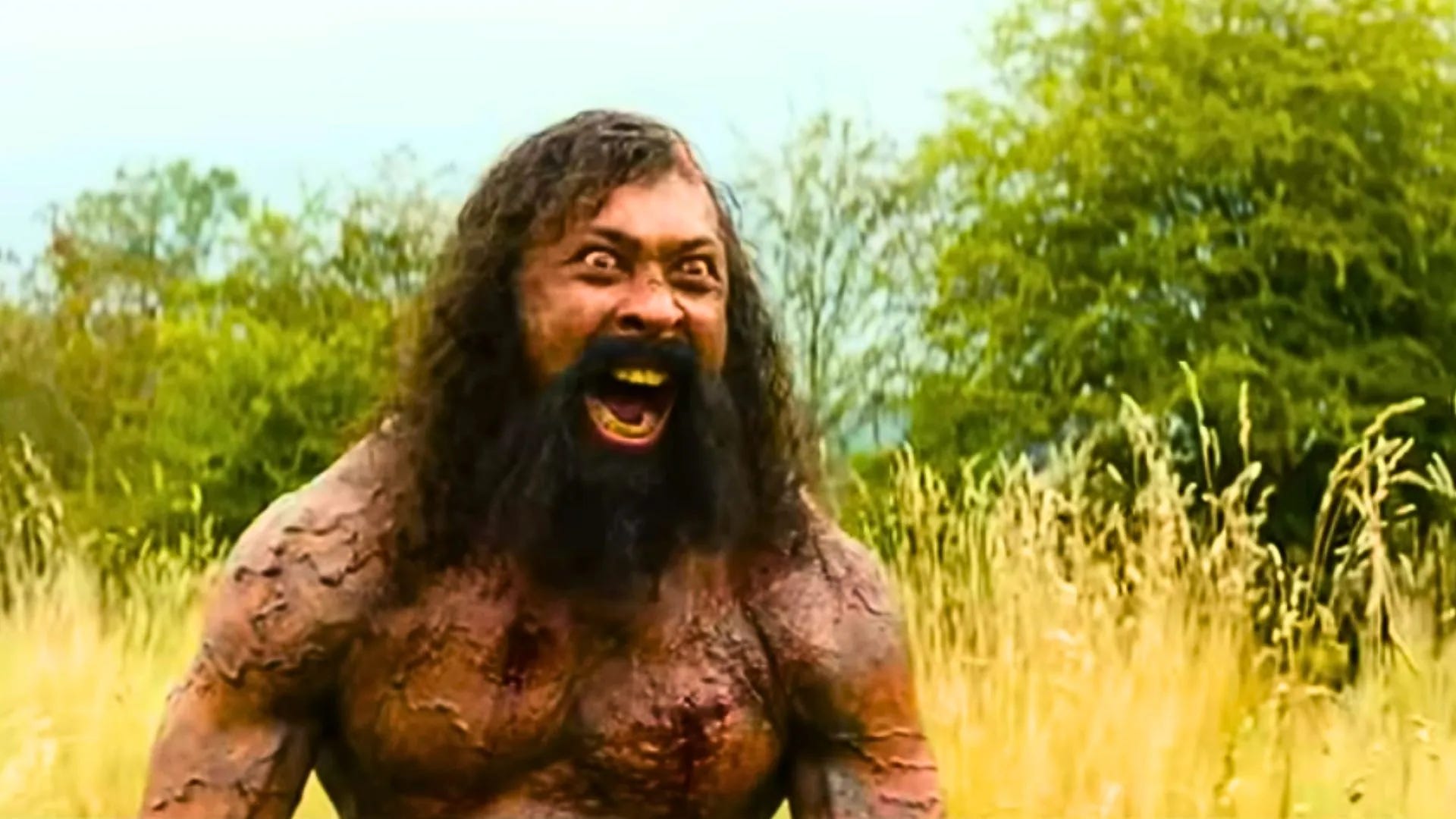
If you’ve seen The Bone Temple, the latest gore-splattered release from the 28 Years Later post-apocalyptic horror film franchise, you’ll know that one member of the cast really stands out. Sure, Ralph Fiennes is a spellbinding lead, and Jack O’Connell plays the hyena-like sociopathic villain to a tee, but it is the massive, pendulous penis of “Samson”—the alpha zombie played by heavyweight MMA-fighter-turned actor Chi Lewis-Parry—that transfixes.
I’m sure I’m not the only one who was disappointed to learn it was a prosthetic (required for legal and practical reasons, the actor tells us). If it’s any consolation, Lewis-Parry implies that the baby-elephant-trunked appendage seen on screen is an accurate representation of his real anatomy. “Well, I’m 6’8,” he told curious reporters. “I’ll say no more!”
Silicone or flesh, this depiction of such a formidable organ attached to an equally impressive frame begs the question: why do we link large phalluses with physical prowess? (In one early scene, we see Samson literally rip the head and spinal column from a man with his bare hands.) It may seem like one of those ‘obvious’ things, but when you stop to think about it, it’s not so obvious at all. There is surprising natural variation on this trait, with flaccid penis size ranging from 5 - 13cm in adult human males (at least, in an Italian sample). And although penis size is positively correlated with body size—and thus brute strength—it’s not perfectly so. Louis Peltzer muses playfully in Vulture, “Is [Samson] the alpha because he has a big dick, or does he have a big dick because he’s the alpha?”
As luck would have it, a timely new study just published at PLOS Biology gives some insight into these phallic matters. Led by the biologist Upama Aich from the University of Western Australia, the researchers homed in on the evolutionary puzzle of why human penises are dramatically larger than those of other primates. I once spent a summer studying a 450-pound silverback gorilla that, if push came to shove, would have made mincemeat of Samson the zombie, but he was also hung like a gnat. Also, unlike other great apes, human males are unique in that our reproductive organs lack a penis bone (baculum), with sexual penetration being dependent solely on erectile blood flow.
Aich and her coauthors aren’t the first researchers to investigate the evolution of the human penis. But most of that earlier work, they point out, involved post-copulatory sexual selection factors, namely how these distinctive external organs were designed over eons to scoop out the sperm cells of rival males who’d inseminated the same woman before them. In a nutshell (pardon the expression), the coronal ridge beneath the umbrella-lipped glans extracts a competitor’s deposits with each thrust. The larger the genitalia, the deeper it can go inside the female reproductive canal to physically displace the seminal competition. In fact, there’s a whole dynamic genital ecosystem at play here. Longer penises—covarying closely with girth—are also more likely to stimulate and induce orgasms in women, which in turn helps to retain any freshly deposited “replacement” sperm, thus increasing the chances of fertilization.
Aich and her team, however, had something of a different angle on the evolution of human penises. They were less interested in reverse-engineering the architecture of these organs as semen-scraping, inseminating tools to be used inside of women, and more interested in what their size signals, especially to other males. Just like the suddenly self-conscious males in the audience eyeballing Samson’s junk, they wanted to know, among other things, if men make inferences about the fighting ability of another man based on what’s between his legs. This signaling function implies Darwinian forces of precopulatory selection, in tandem with those postcopulatory factors above.
It’s admittedly strange to think that the human penis grew, at least in part, because men were looking at each other’s dicks—and making fateful decisions based on this information. But that’s precisely what the hypothesis here implies. Loin cloths don’t fossilize, so archeologists can’t pinpoint the moment in our species’ history when we began covering up. But it’s safe to say that clothes are a relatively recent invention on the hominin clock, and for most of our past, our ancestors would have been letting it all hang out. For a species like ours in which intrasexual competition is the engine of genetic replication, deriving relevant information about potential sexual rivals—fighting ability, social status, attractiveness to females, and so on—is hugely tactical. One such measure of man may be the size of his penis.
Why, exactly, would this anatomical detail betray anything useful about a sexual competitor? Well, think about it. “It is certainly plausible that male genitalia could function as status signals that affect the likelihood of rivals initiating a fight,” reason Aich and her coauthors:
For example, genital size could reflect the circulating levels of hormones that affect the development of primary and secondary sexual characteristics, as well as traits that increase fighting ability (e.g., musculature or aggressiveness). In mammals, testosterone affects genital development, musculature, and aggressiveness, thereby providing a plausible link between penis size and fighting ability. In humans, it has been speculated that a larger penis is viewed as a signal of social dominance and might therefore influence male assessment of a rival’s fighting ability.
Some niche porn aside, it’s not that human penises have evolved as direct weaponry to be used in heated conflicts with other men, as is the case for males of other species bearing horns, antlers, or tusks. But perhaps a similar logic of ornamentation applies. Just as most men are smart enough to avoid picking fights with towering hulks like Samson because of what their hyper-manly features (e.g., height, broad shoulders, V-shaped frame, beards, deep voices, and so on) convey about probable outcomes, maybe, reason the authors, something similar is happening when men evaluate each other’s genitals.
Designing a scientific experiment in which this hypothesis can be tested, however, is tricky. After all, as mentioned earlier, large penises tend to go hand in hand with large bodies, so the challenge is experimentally modifying male genital size to isolate its effects on viewers. And so that’s precisely what Aich and her team set out to do. In a rather busy pair of studies, participants were exposed to images of men with every possible combination of three physical attributes: height, body shape (pear to V-shaped), and penis size. Each of these three traits had seven “value” points (or levels), reflecting natural human variation on these aspects as derived from a large general male population. Thus, there were seven values each for height (ranging from 1.63 – 1.87m), body shape (1.13 – 1.45), and penis size (5 – 13cm). (Because longer penises were also wider—with a 1.2 cm width difference between the shortest and longest—the authors refer to the trait as “penis size.”) Mixing and matching these three traits to capture every configuration (7 x 7 x 7) generated 343 distinct images of male body plans.
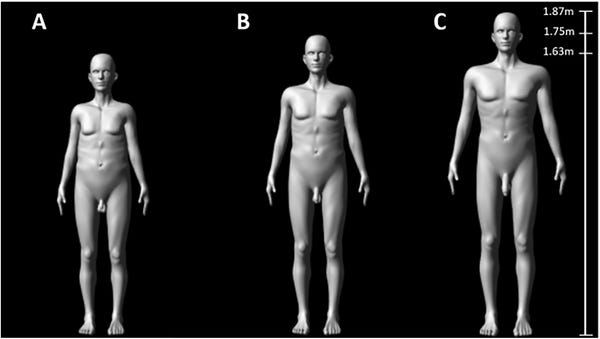
In one study, a representative sample of these life-sized images was then projected onto a blank wall for male and female judges. The scientists even left a tape measure in the room for those who wanted to investigate the image up close. For each blank, mannequin-headed projection, women were asked to rate the male physique before them in terms of sexual attractiveness. Male participants, meanwhile, were asked one of two questions: “How jealous would you feel if you saw this man talking to your partner?” or “How threatened would you feel if this man wanted to pick a fight with you?” The former question, reasoned the authors, tapped into men’s perception of a rival’s sexual attractiveness to women, and could therefore be compared to women’s actual attraction to that figure. (In case you’re wondering, gay male participants were excluded from the study.)
For the women, the overall pattern of results on male sexiness wasn’t particularly shocking—surprise, surprise, ladies found taller, V-shaped, well-hung men to be more attractive. However, there were also “diminishing benefits” to these attributes, which is to say that, after a certain value on each of the three traits, they become negligible in terms of women’s attraction. For male raters, by contrast, there was a clear linear trend on the jealousy question for each of the target attributes: when it came to how sexy they thought women would find the male figure on the screen, every centimetre mattered. Thus, while women are indeed into the big-dicked Adonis look, the effects of height, body shape, and penis size plateau toward the upper ranges. Yet men don’t perceive the threat that way. Basically, men seem to think these traits matter more to women than they do in reality, at least to a certain degree.
The most interesting result of the study, however, was that the size of another man’s penis alone—separable from everything else—influenced the male participants’ views of a competitor’s fighting ability. “Males were more likely to feel threatened if they had to imagine being challenged by a rival with a large penis,” write the authors. “We infer that this translates into males being less likely to initiate an aggressive interaction with a rival with a large penis. We therefore provide the first robust experimental evidence that penis size is under precopulatory sexual selection in humans because it can be used as a signal of male fighting ability.” Again, given that testosterone levels influence male genital development at puberty, and higher levels of this hormone in adult males also correlate with greater muscle mass, increased aggression, risk-taking, and competitiveness, penis size may be a fairly honest signal of who not to mess with. I say ‘fairly’ because, all else being equal, height and body shape are far better clues, and indeed, statistically they had a much stronger effect on the men’s ratings of fighting ability than did penis size. Still, that the researchers found a significant effect of male genitalia dimensions on fight threat at all, even when wholly isolated from those other traits, is notable.
According to the researchers, the data suggest two evolutionary selection pressures converging to favor large penises in ancestral humans. First, those postcopulatory mechanisms of greater semen displacement and likely female orgasm gave big-dicked men a clear advantage in the genetic lottery. Second, the precopulatory factors involved in social signaling, with large genitalia serving to intimidate or scare off potential rivals while simultaneously advertising one’s reproductive, pleasure-inducing utility to females, would have also driven size.
You might be wondering where erect penises, rather than the limp ones used in this study, fit into the equation. While there’s a grain of truth to that old saw about growers versus showers, there’s still a nonnegligible positive correlation between flaccid and erect penis length. Also, it’s really the former that communicates the meat of the matter to other males. “Flaccid penis length functions as an indicator of a male’s physiological state,” explain the researchers. “Flaccid penis length can shorten in response to stress or anxiety as adrenaline redirects blood flow from the genitals, a response that may function to reduce injury during ‘fight or flight’ situations. Therefore, participants may interpret a flaccid penis that is longer as a signal of rival confidence, lower stress, or the relative absence of perceived threat.”
Besides, if the other guy has a throbbing hardon while you’re facing off buck naked, that might be a sign that he wants to do something other than fight you. And if that’s the case, he may not be much competition at all when it comes to the ladies, no matter his size.
This newsletter is free. But it’s a lot of work! Like what you read? Toss a tip in the jar—any amount that makes sense for you—so I can keep overthinking things on your behalf.
Fascinating! So, (self-disclosed, presumably) gay males were excluded from the study. Did the researchers also manage to exclude (self-disclosed) bisexual males, I wonder? And what's the chance of truthful disclosure, anyway, given that the participants didn't know the researchers from Adam, Eve or Steve ...
I'd also be interested to know the results of a similar study with participants chosen from a nudist, or clothing-optional, community, such as may be found at several of Australia's beaches, for example. Is genital size a factor influencing pre-copulatory mate selection in such a setting? The null hypothesis is that it's irrelevant; my guess is that that would be fairly readily disproved with an adequate sample size.