


This article was originally published in Le Point on 12.10.2025
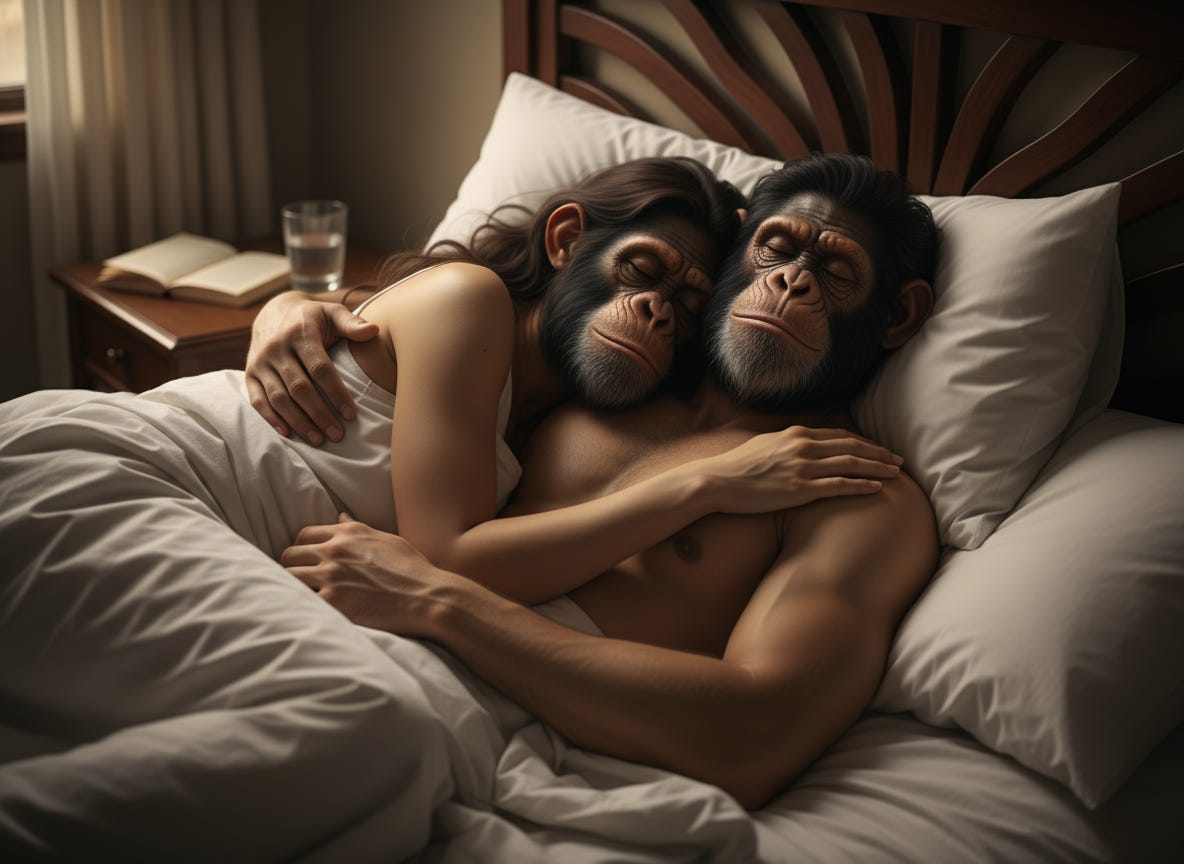
In this age of encroaching theocracy and malignant moralism, I think it’s incumbent upon those of us who know better to point out, again and again, that we are but one peculiar species of ape. Even granting a more generous taxonomic framing—that we are humans and not apes—the question then becomes, ah, but which humans? Within the past 7 million years, and with life on this planet beginning over 3 billion years before that, there have been at least twenty other species of human.
We are only the latest, and obviously the stickiest, variety. Unless being made in God’s image somehow refers to this long line of hairy hominins, it doesn’t make any sense at all to think that we are the final teleological point of mindful perfection, especially as our species body plan (as we’ll see momentarily) is imperfect, if not riddled with design flaws.
So, in the present era, where, say, the US Secretary of Homeland Security holds prayer services for ICE agents, children and the elderly are murdered with an industrial proficiency powered by the delusion of having God on one’s side, and the ineffable, complicated whole of an individual’s existence gets reduced to some rabid meme in an ankle-deep homily on good vs. evil, remember that you—yes, you, and your mom too—are a talking, adipose-laden, perishable primate carved out over eons like a wind-whipped tree. They may be problems of the current age, but all the above are, at their core, beastly psychological vestiges explainable by Darwinian logic.
For me, nowhere is the arrogance of ignorance exposed more bluntly, and embarrassed more spectacularly, than in examining the evolution of human sexuality. Perhaps that’s why I write about it so much. Consider, for purposes of illustration, the seemingly simple question, why does sex make us sleepy? Now, a scientifically incurious, god-fearing person might say something along the lines of, well, because it relieves tension. And they would leave it at that. Yet that only begs the question, why does it relieve tension? Here, a slightly more probing thinker would easily discover that orgasms increase blood pressure and heart rate, resulting in the release of oxytocin and prolactin, hormones postulated to induce sleep. This sort of neuroendocrinological understanding of the phenomenon, however, is by itself rather hollow.
The real wonder is that orgasm—and as we’ll see for women, just being inseminated, even without orgasm—so predictably causes sleepiness and improves sleep quality in our species. Here, then, is where we finally arrive at the sort of adaptationist interrogation that can truly tilt the axis of our human-centric worldview, triggering genuine existential reevaluation. As Jane Goodall (RIP) would say, the worst of us, but the best of us as well, are animals.
In a recent study led by the legendary evolutionary psychologist Gordon Gallup, whose works include the famous mirror self-recognition test in primates, among many others, male and female college students were asked a series of questions about their sex and sleep habits. The authors point out that, while it’s long been understood that “sex is nature’s sleeping pill,” actual hypothesis-driven research in this area has been surprisingly scarce. Their starting point, by contrast, was predicated on several key facts involving the evolution of human morphology, especially the pelvic anatomy of females. If we go back far enough in the hominid lineage, they remind us, modern humans share a common ancestor with chimpanzees, gorillas, and orangutans. What really marked our point of departure—going from hominid (ape-like) to hominin (human-like)—was our adoption of an upright, bipedal posture, which had enormous adaptive payoffs, such as freeing our hands for carrying and more dexterous uses.
But this watershed moment came with some drawbacks too, among them a “dramatic departure” from the typical orientation of the female reproductive tract, so that it was now in a perpendicular orientation. With gravity doing its job, note the authors, a woman’s vagina “is poorly suited for sperm retention.” To put it more coarsely, semen is far more likely to leak out when the female of the species stands up after being inseminated than when she ambles away on all fours, as happens with most other animals. (This fact of ‘leakage’ has been empirically demonstrated.) In response to this introduced problem of gooey physics, ancestral humans evolved a closely articulated set of novel sex adaptations. For example, while upright intercourse is a thing, and other, even contortionist, approaches are of course possible, that ‘godly’ missionary position became the go-to style of heterosexual positioning.
The shift from patterns of dorsal-ventral copulation that characterizes most quadrupeds, including nonhuman primates, to ventral-ventral or face-to-face sex among humans with the woman in a supine position and the man on top brings the woman’s reproductive tract back into a more primitive parallel orientation with gravity, where it is more conducive to sperm retention.
What’s more, because bipedalism shifted the angle of the human vagina, lying on her back during sex tilts it more amenably at a 45-degree angle, “which allows semen to collect at the upper end of the vagina and pool in closer proximity to the cervix,” thus increasing the chances of fertilization. Male anatomy, too, speculate the authors, likely underwent selection to accommodate these remote, leakier nether regions of the female reproductive canal. The human penis is suspiciously longer than that of all other primates, who in comparison to man are hung like gnats. (You can learn more about Gallup’s hypotheses regarding the evolution of the human penis here.) But going back to women, the central idea behind Gallup’s and his colleagues’ study on sex and sleeping now becomes crystal clear:
Anything that postpones the resumption of an upright posture after insemination would function to increase the likelihood of sperm retention and impregnation as a consequence.
Unlike most previous studies, their survey with college students focused not simply on whether orgasm leads to drowsiness. Instead, they homed in on that critical question of “postcopulatory somnolence” specifically after heterosexual intercourse, since penile-vaginal intercourse, of course, is the only intercourse that leads to reproduction (i.e., gay or bisexual respondents were excluded). After factoring in use of condoms, masturbation, sexual history, and time of day when people usually have sex—day sex isn’t exactly rare, but nocturnal sex is by far more common—the results confirmed the authors’ hypotheses. While both men and women reported drifting off to sleep quickly after having nighttime sex, the effect was more pronounced in women. What’s more, whereas men needed to ejaculate to benefit from this sleep-induction effect (in fact, in the rare cases that didn’t happen, this failure to finish had a disruptive effect on men’s sleep quality), women didn’t need to have an orgasm for the same sedative result. What they did need for this to occur, however, was unprotected sex. That is, those women whose partners wore condoms didn’t fall asleep any faster than those who didn’t have sex with a man at all. What this suggests, rather astonishingly, is that seminal fluid may have literal sedative properties that help put women to sleep. (Gallup’s argument here is in line with his notorious claim from two decades ago, that the chemical confounds in human semen have antidepressant effects for women who are in long-term relationships.)
Thus, when it comes to human males, orgasm in whatever form it takes induces sleep, which may explain why men are more likely to masturbate before bed than are women, using it as a rather, erm, handy sleep aid. Interestingly, though, prolactin release following intercourse is five times higher than going it alone. Yet while women don’t require an orgasm to help them fall asleep after sex—just semen inside them apparently does the trick—having one enhances the sedative effect. Not coincidentally, female orgasm also increases the odds of conception, with vaginal and intrauterine contractions helping to push sperm further into the reproductive tract. The likelihood of female orgasm during intercourse, in turn, is positively correlated with signs of the man’s ostensible mate value and genetic fitness (women are more likely to climax when having sex with a man who has a good sense of humor, symmetrical physical features, a high shoulder-to-hip ratio, and, somewhat scandalously, a high income).
And I haven’t even mentioned yet another postulation of Gallup’s sexual sedation theory, which is that snoozing together after sex served a “mate-guarding” purpose. Not only is the woman more likely to remain in a prone position, helping those sperm cells land, but also:
[for] couples who slept together in the ancestral environment … [this] may function as a mate-guarding strategy that enables men to minimize insemination of their partner by rival men at night and reduce the risk of being cuckolded. Sleeping together might also enable women to reduce the risk of being abandoned by their potentially philandering partner for other women.
If nothing else, Gallup and his colleagues’ findings put a fresh new spin on “getting laid.” Yet to me, it’s deeper than that. Their insights into our most intimate acts and most private of parts are another example of how science is still revealing answers about ourselves we hadn’t even thought to ask. Cumulatively, by chipping away with the tools of reason and evidence at those granite illusions about what exactly we are in this purposeless universe—animals, like all the rest—such research knocks us humans off our pedestals. We need that more than ever.
Like what you read? Toss a tip in the jar—any amount that makes sense for you—so I can keep overthinking things on your behalf.
So, question: I am male, but sex does not make me sleepy. It actually invigorates me. I am more likely to masturbate in the morning because I find it gives me the focus and get-up-and-go to, uh... get up and go. When I masturbate before bed, it actually takes me longer to fall asleep because I feel energized...
Obviously, there will alway be outliers in any situation, but what does it mean for me biologically? Hormonally? Am I wired weird? Am I immune to oxytocin and prolactin? Or is this "energizing" effect a narrative I've created that I've come to believe through confirmation bias, but I actually probably function just like everybody else?
Obviously, only my hairdresser knows for sure...
But I've heard that "sex makes you sleepy" throughout my life and I've always been curious as to why I don't seem to work that way...