


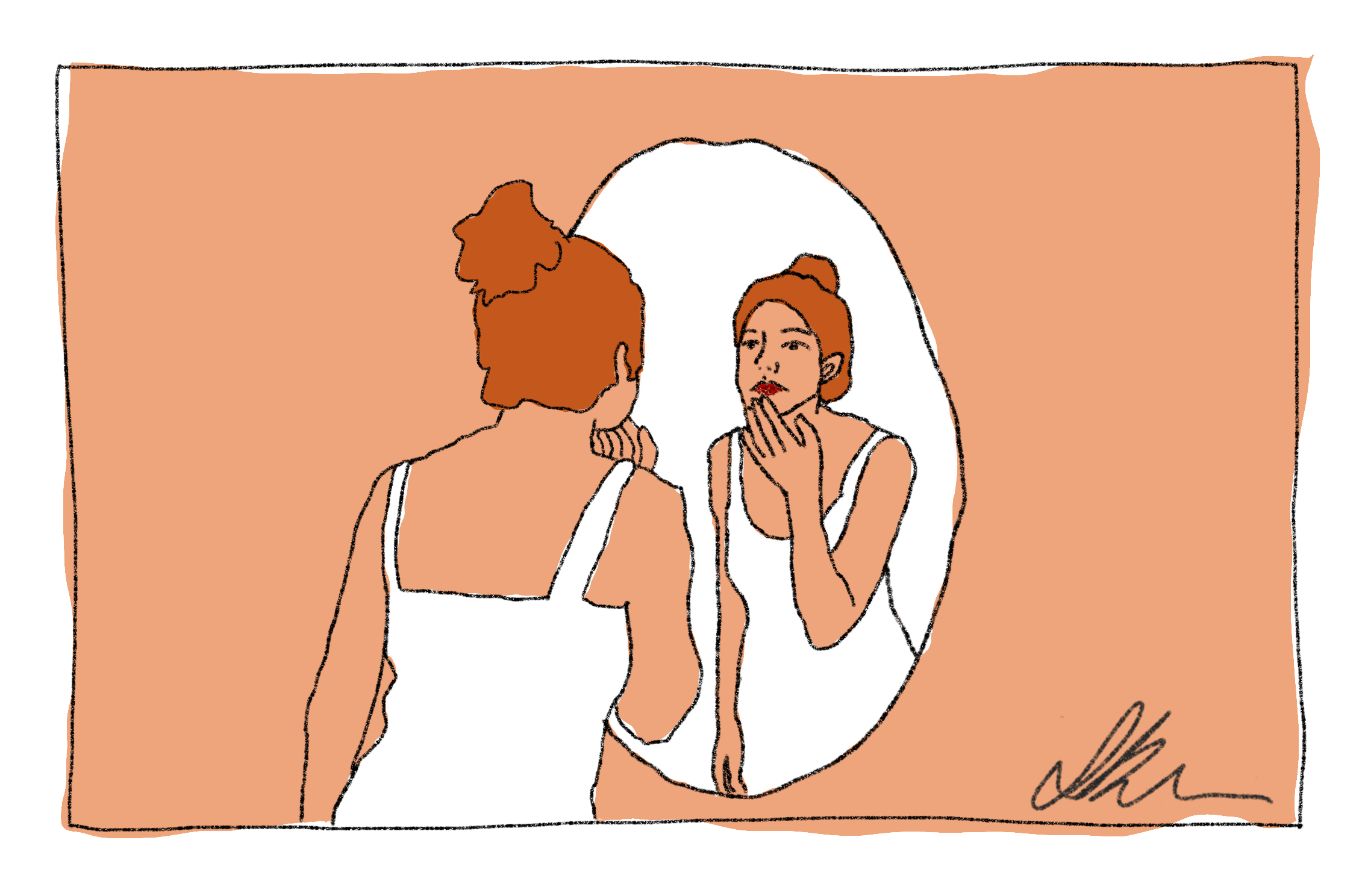
Let’s say, hypothetically, you sign up to be a participant in a study on first impressions. You’ll be given a certain set of facts about a target person, the experimenter explains to you, and from that limited information, you’ll be asked to make a series of inferences about them. This could be about, say, other aspects of their personality, their race, income, education, and so on. In other words, you’ll read mini-bios about a handful of strangers, and from these brief descriptions, your job is to guess various other details about each individual.
Got it? Good. Now, meet “Sarah,” your first target. Here’s what you read about her:
Sarah is a young adult who has recently finished college, and she has put in a few years at her new marketing job. She just turned 28 last month. In the last few years, Sarah has had a lot of casual hook-ups and no-strings attached sexual partners—she has sex with these men, but isn’t in a committed relationship with any of them. In fact, she has now lost count of how many different sexual partners she has had.
If you’re asking yourself what sort of study you’ve really signed up for, it is, in fact, an investigation into people’s, erm, lay beliefs (i.e., stereotypes) about gender and casual sex. All that other stuff was just part of the cover story. And if you’re like most of the actual participants who read about “Sarah” in this recent study led by UCLA psychologist Jaimie Arona Krems, one irrepressible assumption you’ve already made about this promiscuous young woman is that she has low self-esteem.
Poor Sarah, you’re saying to yourself, so sad.
Over the course of six impressively controlled, clever experiments published in Psychological Science, Krems and her coauthors revealed a “pervasive, persistent, but seemingly unfounded stereotype” that women who engage in frequent casual sex must have self-esteem issues. When the target character is a man, people make no such assumptions. In fact, even when participants are explicitly told that Sarah enjoys her adventurous sexual lifestyle, this sticky belief about her having deep personal insecurities remains unmoved.
If she wanted to, Sarah could have a long-term, monogamous relationship with some of the men that she has hooked up with, but that’s not what she wants. Instead, Sarah wants to keep playing the field and enjoy lots of no-strings attached sex with a lot of different men.
When compared to the monogamous “Mary”, who had the exact same backstory as Sarah but was said to be in a committed sexual relationship, it was always Sarah seen as having the low self-esteem. This happened even when participants were told that it was Mary who was the one who was unsatisfied, and that she secretly wanted to be a player like Sarah. In other words, it didn’t matter what Sarah claimed that she wanted, people seemed to be reasoning, because she was just fooling herself about liking things the way they were, penises galore.
Now, I know what you’re thinking. It must be mostly clueless men judging Sarah the libertine this way. Or maybe judgy other women. Or religious people. Or conservatives. Or maybe participants’ own sexual histories and self-esteem were coloring their views. Actually, no, none of those factors mattered. Everyone appeared to be operating with this same stubborn stereotype. What’s astonishing, Krems and her coauthors point out, is that the stereotype doesn’t have much, if any, basis in reality. Despite its cultural ubiquity—media, movies, anecdotes, pop psychology, etc.—there’s no equivocal evidence that sociosexuality (“individual differences in willingness to engage in sexual relations without closeness, commitment, and other indicators of emotional bonding”) is either a cause or consequence of low (or high) female self-esteem. Oddly enough, although you might think that men who have lots of casual sex have higher self-esteem, the authors actually found the opposite: there was an unexpected marginal link between the male participants’ own promiscuity and lower self-esteem. That correlation was entirely absent for the female participants.
The big question, of course, is why this stereotype about female sexuality endures, despite considerable progress in other areas of gender equality—at least in the Western world, and note these were all American participants in Krems et al.’s study. As with my last two pieces, which showed a similar mismatch between modern environments and ancestral problems, it may be, the authors conjecture, a holdover of our evolutionary history. In the Darwinian scheme of things, reproductive technologies such as birth control are extremely recent innovations. For the vast majority of human existence, there were far greater risks and “costs” for women when it came to casual sex than men. “Owing to biological differences obligating women’s greater investment in offspring (e.g., gestation, calorically expensive lactation),” the authors explain, “and thus allowing for men’s greater net benefits from casual sex (e.g., more offspring), people might possess default assumptions that women pursue casual sex only when committed sex is unavailable to them, whereas men pursue casual sex because of its possible benefits . . . people may [therefore] assume that women who have casual sex are pursuing behavior they would ideally eschew.”
Since it’s a suboptimal female mating strategy, goes this tacit line of thinking, no woman could possibly prefer casual sex over committed sex; she’s not so much playing the field as she is slogging her way through auditions to land the “right” man, and the whole thing must be taking an emotional toll.
Again, in reality, having casual sex doesn’t cause women to have low self-esteem, even though many people believe that it does. The use of birth control, and the practice of safe sex in general, means that any obvious cost differences between the sexes in this area of human behavior have become largely negligible. But tell that, surmise the authors, to our Pleistocene-hewn brains, a disconnect leading to benevolent sexism. “There exists a cottage industry of authors, journalists, some researchers, and professional advice-givers,” the researchers note, “voicing concern for and about women who have casual sex . . . [these concerns] might also affect practices and policies regarding female sexuality that caregivers, schools, or even legislatures enact . . . perhaps lead[ing] to well-intentioned but misguided attempts to protect girls and women—attempts that ultimately restrict women’s freedoms and agency.”
The insidious problem of “slut-shaming” aside, the sexual double-standard in perceived self-esteem and sociosexuality may itself be harming women. Prospective employers, voters, or romantic partners, for instance, might not have any moralistic qualms about women enjoying unrestricted sex. They may even be feminists. Still, if they’re wrongly assuming, even implicitly, that such behavior goes hand in hand with women’s low self-esteem, this may be biasing attitudes and decisions about female competency in totally unrelated domains. Sure, you might not care one curly-haired iota that Sarah had sex wth a half-dozen strangers over the weekend (get it girl), and you’re all for gender equality in the workforce, but would you want someone you perceive as having low self-esteem to, I don’t know, manage your venture capitalist firm, or be your therapist, pilot, or mom’s cardiac surgeon?
“Future work,” write the authors, “should explore the concrete disadvantages that women who have (or are thought to have) casual sex might face and the extent to which some of these disadvantages might be mediated by stereotypic beliefs regarding these women’s self-esteem.”
Krems, J. A., Ko, A., Moon, J. W., & Varnum, M. E. (2021). Lay beliefs about gender and sexual behavior: First evidence for a pervasive, robust (but seemingly unfounded) stereotype. Psychological Science, 32(6), 871-889.
Questions? Concerns? Ideas? Email the corresponding author directly: Jaimie Arona Krems jaimie.krems@ucla.edu
Like what you read? Toss a tip in the jar—any amount that makes sense for you—so I can keep overthinking things on your behalf.