


This article was originally published in French at my Le Point column 22.06.2026

I suppose both are better than being wedged between strangers—usually at least one of them snoring away like a stertorous boar on tranquilizers—but having to choose between the aisle seat and the window seat on a long-haul flight from New Zealand is like being asked whether you’d prefer to have your left incisor removed, or the toenail of your pinkie toe. Both are unpleasant propositions. Choose the window seat, and at least a few times during the journey, you’ll be forced to rudely awaken one of those peacefully slumbering boars in order to use the toilet. Choose the aisle seat, and prepare to have your own heady dreams disrupted repeatedly by the impatient bowels and bladders of your seatmates.
And so it was for me the other day on a thirteen-hour excursion to Los Angeles, with a kind but apparently bursting couple communicating their frequent lavatory needs through the man’s brusque tap tap tap on my shoulder. I didn’t need to see his apologetic smile to discern his intent; I simply knew—before I even shook off the fog of an altitudinous sleep—exactly what his index finger on my shoulder meant. Now, if he had caressed my knee, that would have held a different meaning altogether. But I’ll save that for another column.
It may seem obvious, but in fact it’s mysterious: Where and how, exactly, have we human beings learned the many covert, unspoken meanings of such “social touches”? The term is just what it sounds like. Like that middle-aged pisseur tapping my shoulder to signal his need to void the endless Diet Cokes he’d imbibed during the flight, social touch can be everything from a mother absently raking her child’s hair as he watches television, to the gentle squeeze hidden in a handshake, to pinching someone’s derriere. Be prepared for the consequences of that last one. “Social touch can be defined as intentional physical contact between two individuals that can give rise to changes in the disposition and subjective state of one or both individuals and can ultimately influence their behavior,” explain the psychologist Juulia Suvilehto and her colleagues in an article published in Nature Reviews Psychology.
Although the importance of interpersonal touch in human lives has been the subject of research for many years and from many interdisciplinary angles—from its role in attachment, to child development, to healthy brain development, and hormone production, to name a few—it is only recently that investigators have asked whether there may be an innate lexicon of social touch. In other words, do those being touched simply know what the toucher is trying to convey to them through tapping, stroking, tugging, rubbing, squeezing, slapping, picking, poking, patting, and all the other expressions from the handsy human repertoire? Or, alternatively, is our ability to extrapolate meaning from such manual messages due to social learning, perhaps even being unique to the idiosyncratic dynamics of particular relationships?
Such questions were at the center of some intriguing experiments conducted by a team of investigators led by sensory neuroscientist Sarah McIntyre of Linköping University in Sweden. In an initial study, pairs of adult participants who had a preexisting relationship—married couples, parents and grown children, friends, neighbors, and so on—were asked to guess what the other was trying to tell them through touch alone. “We required only that participants were sufficiently acquainted to be comfortable touching each other,” clarified the authors. One member of the dyad (the receiver) was situated behind a curtain, with just their arm extended onto the other side. Meanwhile, the other party (the sender) was shown one of six randomized words (attention, love, happiness, sadness, calming, gratitude) and instructed to communicate that message to the receiver by touching their arm. Just touch them in whatever way comes most naturally to you, they were told. Also, silence, please: you must be completely quiet—no verbal emissions such as giggles or sighs allowed during the sessions.
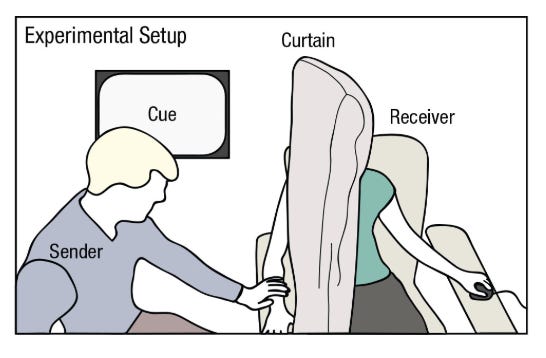
Each word came with instructions. For gratitude, for instance, senders were told: “Your partner has just helped you solve a problem. Try to communicate GRATITUDE through touch.” For love: “Think of all the wonderful qualities that your partner has and how they enrich your life. Try to express LOVE through touch.” The receiver’s job was to choose from the six words whichever sentiment they felt a given touch was meant to convey. They were also given an “other” option if they thought the intended message wasn’t among the choices.
Rather astonishingly, receivers were “well above chance rate” when it came to interpreting what the sender was trying to communicate. When the roles were swapped, with the senders now acting as receivers, the latter’s performance increased further still. (A second study replicated these findings, this time while the receiver was lying in an MRI scanner.)
These initial findings were intriguing, reasoned the authors, but still, because they’d occurred within the context of a close relationship, it remained unclear if they reflected a genuine universal grammar of touch that could be understood even between strangers.
A video camera had been closely trained on the receivers’ extended arms during all of the sessions, enabling the researchers to try to decode an exact language of social touch, and even to quantify those touch features using 3D hand tracking. For each cued word, they studied the precise locality at which the touch occurred (e.g., hand, wrist, lower forearm, upper forearm), the intensity of the touch (e.g., light, moderate, strong), and the touch type (e.g., stroking, lifting, pulling, and so on). “We found that successful strategies for touch communication in a close relationship shared common features across senders,” wrote the authors:
For attention, the best features were moderate tapping and shaking. For calming, it was light holding at multiple locations on the arm as well as moderately stroking the whole arm or lightly stroking part of the arm. Gratitude was associated with light stroking or holding, or squeezing the arm. Happiness was best conveyed by light tapping across the whole arm. Love was successfully signaled by light stroking across the whole arm. Successful communication of sadness was most strongly associated with lightly holding or stroking one part of the arm. Touching the hand and using high intensity were generally unsuccessful strategies.
If a research assistant can be trained on this exact language of touch, wondered McIntyre and her colleagues, could they use such scripted tactile gestures to “talk” clearly to complete strangers via touch? After all, those earlier studies involved people in close relationships. Perhaps their previous experience in being touchy-feely with each other, or general familiarity with one another’s presence, explained how they passed that message test.
Not only were these skilled touch communicators able to successfully convey the intended messages to total strangers using the same arm-only technique as before, but the receivers’ scores were even better than they were when the two people knew each other.
Together, these findings are suggestive of an intuitive language of social touch. It remains to be seen, the authors are careful to point out, whether such a language is truly ubiquitous. Would indigenous peoples from Papua New Guinea or East Africa have performed the same as the Swedish participants in this study, or are such haptics somehow being shaped culturally? Nevertheless, the findings are a fascinating display of our species’ preternatural sense of social touch, one that is, arguably, even more advanced than spoken language.