


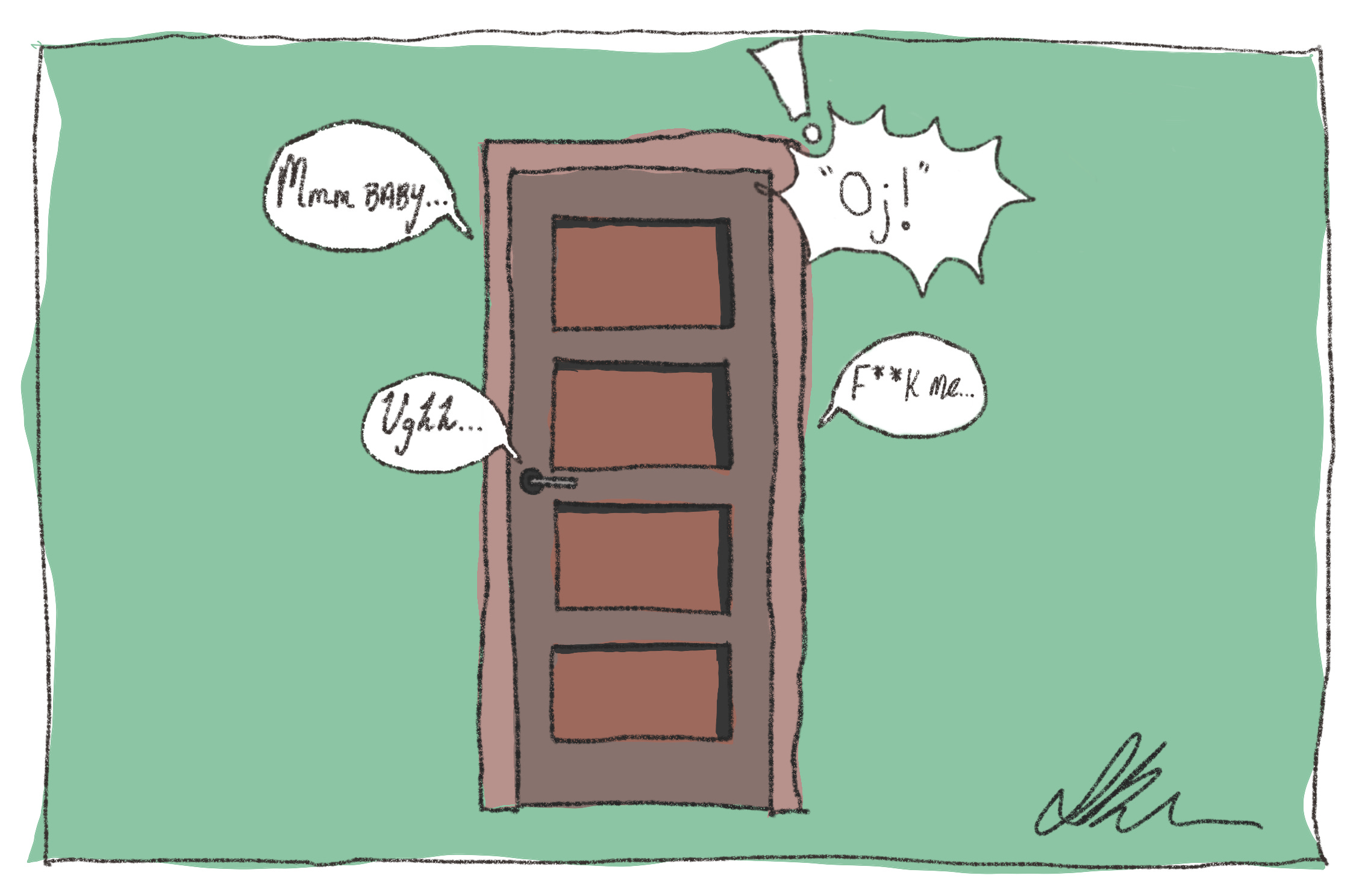
There are few more jarring reminders of our bestial natures than the various grunts, moans, pants, and other limbic vocal outbursts that accompany our copulatory gyrations and orgasms. Fine. Maybe you’re the silent type. But if you’ve seen pretty much any porn clip, ever been on the wrong side of a cheap motel wall, or had the traumatic misfortune of overhearing your parents going at it back in 1987 (sorry, that may be a little too specific), our species’ noisy carnal repertoire should be all too familiar to you.
Given the everyday nature of these very human sounds, it’s surprising, then, that it wasn’t until very recently that anyone bothered to investigate the acoustic features of authentic human sexual activity. That challenging task was finally taken up by the cognitive scientist Andrey Anikin from Lund University in Sweden, whose 2024 article in Evolution and Human Behavior is a fascinating microanalysis of not only the sounds we make in bed, but also how these sounds are perceived by (it turns out, quite skeptical) listeners.
When you really think about it, he tells us, sexual noises are something of a puzzle. “Copulation is moderately demanding metabolically,” he writes, “costing about 100 kcal per intercourse and driving peak heart rates up to 145-170 bpm. Without a pressing need to communicate, the physiological priority should be to focus on efficient respiration, keeping the airways wide open. Yet, people vocalize.”
We’re not the only primate to emit “copulation calls.” In fact, the sexual screams coming from non-human primates, especially females, has long been the subject of debate. One leading evolutionary hypothesis is that the female is advertising her fertility to other nearby males. This would increase sperm competition through multiple inseminations, ultimately attracting the fittest male while confusing paternity and reducing the risk of infanticide. Then there’s the matter of whether female monkeys and apes deliberately use their copulatory calls for strategic reasons, which is to say, have any voluntary control over these sounds. There does seem to be evidence of “audience effects”—for example, female chimps make more sounds when copulating with high-status males—suggesting some degree of tactical utility.
Despite all that work in primatology, Anikin writes, “in humans so far there are no studies of sexual vocalizations ‘in the wild.’” No proper studies, anyway. There’s been plenty of qualitative When Harry Met Sally-level stuff, but not much in the way of (sorry) hard science. “Human sexual vocalizations are often cast as little more than conscious attempts by women to please, guide, or manipulate their partners,” he writes. “However, no one has yet analyzed recordings of actual human sex.” There’s been almost no interest at all in men’s sex sounds.
It’s a tricky research area. Relying on porn soundtracks generates ridiculous data, and self-reports on such sensitive topics are notoriously problematic. Even if you set up a sex pod in a controlled laboratory, the fact that participants know that they’re being listened to in real-time would skews things too, and it’s ethically unacceptable to capture these sounds covertly.
Fortunately for Anikin, there’s a website called the Orgasm Sound Library, a vast repository of user-uploaded sound files of people engaging in sex acts. It’s not a perfect solution—one might question whether the type of person who uploads such anonymous material represents the average sound-maker, and who knows if the moaning is real or just a dumb prank. Given the aforementioned empirical constraints, though, it was a good compromise. So, Anikin downloaded all 3,528 files, closed his office door, and got down to business. (I don’t actually know about the office door part; maybe it would actually be worse if the door was closed.)
Anikin had two main goals. The first was “to describe the variety of human sexual vocalizations, comparing them at different stages of the sexual response cycle and between men and women.” He guessed women would be louder than men. “The second objective,” he tells us, “[was] to identify predictors of perceived authenticity in human sexual vocalizations. Self-reports indicate that women routinely fake orgasm and vocalize in an exaggerated manner to please their partner or quickly terminate a sexual encounter,” he writes:
This does not imply that all sexual vocalizations are fake, and there may be detectable differences between spontaneous and volitional affective expressions. Cultural expectations may also affect the form and prevalence of sexual vocalizations . . . The key prediction is that self-control should be hardest to maintain at the moment of peak arousal, which means that orgasmic vocalizations should be less culture-specific and less verbalized compared to the build-up phase. Namely, while speaking or repeating short profanities is reportedly common during sex, speech should hypothetically give way to predominantly nonverbal expressions as sexual arousal peaks.
Not every file on the site was suitable. The final sample excluded any muffled files that couldn’t be improved no matter the audio tech clean, as well as those with weird noises in the background (e.g., “music, computer-generated speech, a few seconds of exaggerated moaning followed by a fit of giggles, or other obvious spoofs instead of genuine sexual content”). Also, anything too short (<10 sec) or too long (>10 min) was deemed unsuitable.
Clips with “multiple vocalizers” were omitted as well. Based on the file names and after hearing the recordings, Anikin assumed most were just onanists pleasuring themselves. (Unfortunately, the website didn’t have any descriptive meta-data for the files, so all we know for sure is that one voice could be heard distinctly.) That presumed masturbatory slant was OK, the author reminds us, because what he was really interested in were the vocalizations of single individuals—men and women—throughout a full sexual response cycle, from first touch to crescendo to silent juicy aftermath. And you don’t need a partner for that.
In the end, a total of 2,249 files made the cut, most being an entire start-to-finish episode of satiated desire. That was over 34 hours of unadulterated aural emissions to process—not exactly a listening pleasure, but a lot of pleasure to listen to. Anikin further diced each of those files up into segmented units—or “syllables”—of vocalizations within recordings. These discrete units, which totaled 74,422 syllables, were anything from unvoiced sounds like heavy breathing, to tonal grunts, to pretty much any filthy utterance you can think of.
Anikin, who is a specialist in the nonverbal sounds made by humans and other animals, regularly uses sophisticated computer algorithms to isolate the most ephemeral aspects of voice expression. So, his acoustic analysis of this auditory trough was nothing if not precise.
Still, this surgical dissection of human sex sounds was a little, well, anticlimactic. In general, the sounds were quite meek. “The high-pitched and extravagantly ecstatic screams associated with pornographic films were conspicuous by their absence,” the author explains. “Instead, a great majority of vocalizations were sighs and relatively mild moans, even at orgasm.”
For both sexes, however, approach to orgasm was “acoustically detectable,” with a dramatic intensification of vocalizing (becoming “longer, louder, more high-pitched, more frequent, and more unpredictable”). Men and women squealed equally at orgasm, but women produced more sounds overall throughout the sex act. Actual words were scarce. It was mostly just short “voiced moans or grunts” (71%) and “unvoiced sighs” (28%). Women used very little speech in general, and if men did, it tended to occur just as the release neared, about 15 s before—but importantly not during—male orgasm. “A typical pattern was to utter simple exclamations or expletives (Oj, Yeah, F***, I’m cumming, and analogous expressions in other languages) as the excitement mounted,” Anikin writes, giving some dirty color to the scene, “but vocalizations were overwhelmingly nonverbal during and immediately after orgasm.”
The fact that we’re unable to speak intelligibly during an orgasm—while this is also the very time in the sexual response cycle when we’re at our noisiest—betrays the same neurological mechanisms as spontaneous copulation calls in non-human primates. At that very animalistic moment, reasons Anikin, “cortical control over vocal production is passed on to limbic structures directly involved in both hedonic experience and vocal response.” Like a sneeze or a guffaw, it just kind of happens. “Female orgasmic moans may be temporally correlated with muscular contractions,” he writes, “while men may groan at each ejaculatory spurt.” Compared to other species, human beings do have unrivaled vocal control. This may help us to modulate our sounds of pleasure. Yet “spontaneous emotional vocalizations, including sexual moans,” notes Anikin, “can be hard to suppress or fake at will, even for humans.”
Again, though, just because the pleasure sounds authentic doesn’t mean it is authentic, even if it’s being analyzed by fancy computer algorithms. Anikin was also interested in the acoustic features of a sex act that signal to listeners whether the person is having genuine mind-blowing sex or is more likely to be faking it (i.e., communicating intentionally to deceive). So, in a complementary perceptual experiment, he recruited 109 participants of both sexes to listen to a random sample of 200 clips. In addition to using a slider tool to rate the degree of the vocalizer’s lust throughout the clip (“How aroused does this person sound, from Relaxed to Orgasm”?), they were asked whether they thought the person was putting on a show.
Ratings of perceived arousal lined up neatly with the acoustic analysis (i.e., peak slider ratings of arousal closely matched the algorithm’s temporal demarcation of when the person was about to blow). But the participants didn’t buy that everyone they heard was as horny as they ostensibly sounded. In fact, only 62% of all sampled files were judged as conveying authentic pleasure, at least to the degree being expressed. Interestingly, there was a sex bias in perceived exaggeration: female participants found the male vocalizers to be more convincing, whereas males heard more authenticity in the female sexual sound-makers. In all cases, however, what raised the listeners’ suspicions was “excessive vocalizing”—basically, the noisier the sex, the more inauthentic it all came across. The person was “overdoing it.”
“Putting all these observations together,” Anikin summarizes:
…what emerges is a picture of two distinct vocal behaviors: effortful grunts or strategically deployed controlled moans at low arousal and spontaneous vocal bursts once arousal exceeds a certain threshold. Men mostly sigh and grunt until the arousal becomes very high; women either have a lower threshold for vocalizing (producing phonated moans) or perhaps are used to exaggerating their expressive behaviors. Of note, the common interpretation that women moan merely to stimulate or guide their (male) partners does not hold because, in this corpus, often there is no partner.
Comparing the noises made by masturbators to those produced by people actually having intercourse would seem pretty important, though. Then there’s that sticky matter of authenticity. If you could somehow have people agree to insert a rectal pressure sensor, Anikin suggests boldly, this “could validate the acoustically estimated arousal dynamics and ensure that we are not missing an entire class of acoustically atypical or even silent orgasms.”
Perhaps. But after Googling “rectal pressure sensor,” which does not appear to be an insignificant contraption, I can’t help but think that having one of those things dangling from your anus while chasing an orgasm would itself affect those very arousal dynamics.
Anikin, A. (2024). Why do people make noises in bed? Evolution and Human Behavior, 45(2), 183-192.
Questions? Concerns? Ideas? Email the corresponding author directly: Andrey Aniken andrey.anikin@lucs.lu.se
Like what you read? Toss a tip in the jar—any amount that makes sense for you—so I can keep overthinking things on your behalf.