


Brace yourself. Things are going to get weird.
I’m about to walk you through what is arguably one of the strangest, most squirm-inducing psychology experiments ever to appear in a peer-reviewed scientific journal… if not this century, then at least within the past year. Let’s just say phrases such as “penile thrusts” and “scissoring” and “rear entry” are used not as smutty colloquialisms, but as proper academic jargon. That’s not even to mention the horny budgerigars and the women inserting vaginal probes and the Pornhub clips.
But fools rush in—I’m getting ahead of myself. And the truth is, if you can get past the salaciousness, the questions at the heart of this bold experiment—what turns us on as human beings, and why?—are not only theoretically important, but of significance to our understanding of ourselves as the sexual animals that we are.
The inspiration behind this study appearing in Archives of Sexual Behavior and spearheaded by Lucie Krejčová of Charles University in the Czech Republic, was a series of now-classic sexology experiments. Across multiple studies, most of them led by the Canadian sexologist Meredith Chivers, human males and females (I’ll call them “men” and “women,” to avoid any confusion with the other creatures ahead) show very different patterns of sexual arousal. Men’s arousal response appears to be “category-specific,” meaning that when you hook their penises up to a device that measures subtle changes in tumescence (a penile plethysmograph), and then expose them to a range of stimuli, what makes them, erm, most tumescent, is specific to whatever they’re subjectively into. That’s intuitive enough. Straight men get erections at seeing naked women, for instance, and gay men at seeing naked men. In other words, men’s arousal is—at the risk of confusing this with a completed unrelated word—highly circumscribed, concordant with their preferred “erotic target.”
Women, by contrast, display a pattern of genital arousal that has been labeled as “category-nonspecific.” If you use a similar tool designed to gauge genital arousal in females (e.g., a device measuring vaginal pulse amplitude), vaginas respond sexually even to material that their owners are not attracted to… not in the least. So, whether you show heterosexual women clips of straight porn, or lesbian porn, or gay male porn, or—most scandalously of all—of bonobos having sex, their genitals nevertheless seem to register all of these as equal sexual stimuli. Unlike with males, then, there appears to be a disconnect between what turns a woman on, and how her body is responding to things that don’t. (Although data with lesbians suggest more of a category-specific response, similar to that of men.)
The evolutionary interpretation is that ancestral women were subjected to sexual coercion and rape, acts of violence that could cause serious bodily injury and negatively affect reproductive potential (thus, genetic fitness). The so-called preparation hypothesis contends that women’s liberal vaginal response—to any sexual stimuli—facilitates preemptive lubrication, as these cues would have signaled a looming threat of unwanted intercourse.
Yet although this vaginal response is indeed elicited in many different sexual contexts, certain sexual stimuli are more potent than others once the contextual features are isolated (e.g., erect penises over flaccid ones or exposed vulvas). So, it’s not always clear what is serving to flip that sexual switch in women’s implicit perceptions. Regarding those notorious bonobo results, for instance, was it the apes’ genitals, or their vocalizations, or their “copulatory movements,” or maybe the whole bestial carnal panache, that triggered the participants’ vaginal response? Even more to the point, Krejčová et al. wondered in their 2024 study, if female sexual arousal is indeed as category-nonspecific as it has long been assumed, then shouldn’t women show the same genital response to all overtly sexual cues, even at the sight of, say, guinea pigs having sex? “For men,” they write, “the most important features may be cues to gender, while for women, the most important features may be linked to sexual activity, even when the actors are of the non-preferred gender or species.”
Therefore—and we can only imagine the look on the faces of the ethics committee members reviewing this study proposal—the researchers decided to run an experiment. They would systematically expose participants to clips of human and animal sex while measuring genital responses, comparing what was happening “down there” with any conscious feelings of lust.
The research advertisement simply read that the study sought “sexually active heterosexual men and women aged 18-45, who had not been diagnosed with any sexual or gynecological/urological issues and use no drugs that could affect their sexual functioning, for a study of psychophysiological responses to visual stimuli.” Those visual stimuli featured 60-sec. video clips from 12 different categories, with each participant seeing all of them in a randomized order (and each video separated by a 30-sec non-sexual distractor picture task).
There were 11 carefully chosen clips of a discrete act of within-species sex for the following:
Heterosexuals (Homo sapiens)
Lesbians (Homo sapiens)
Chimpanzees (Pan troglodytes)
Western lowland gorillas (Gorilla gorilla gorilla)
Guinea pigs (Cavia porcellus)
European hares (Lepus europaeus)
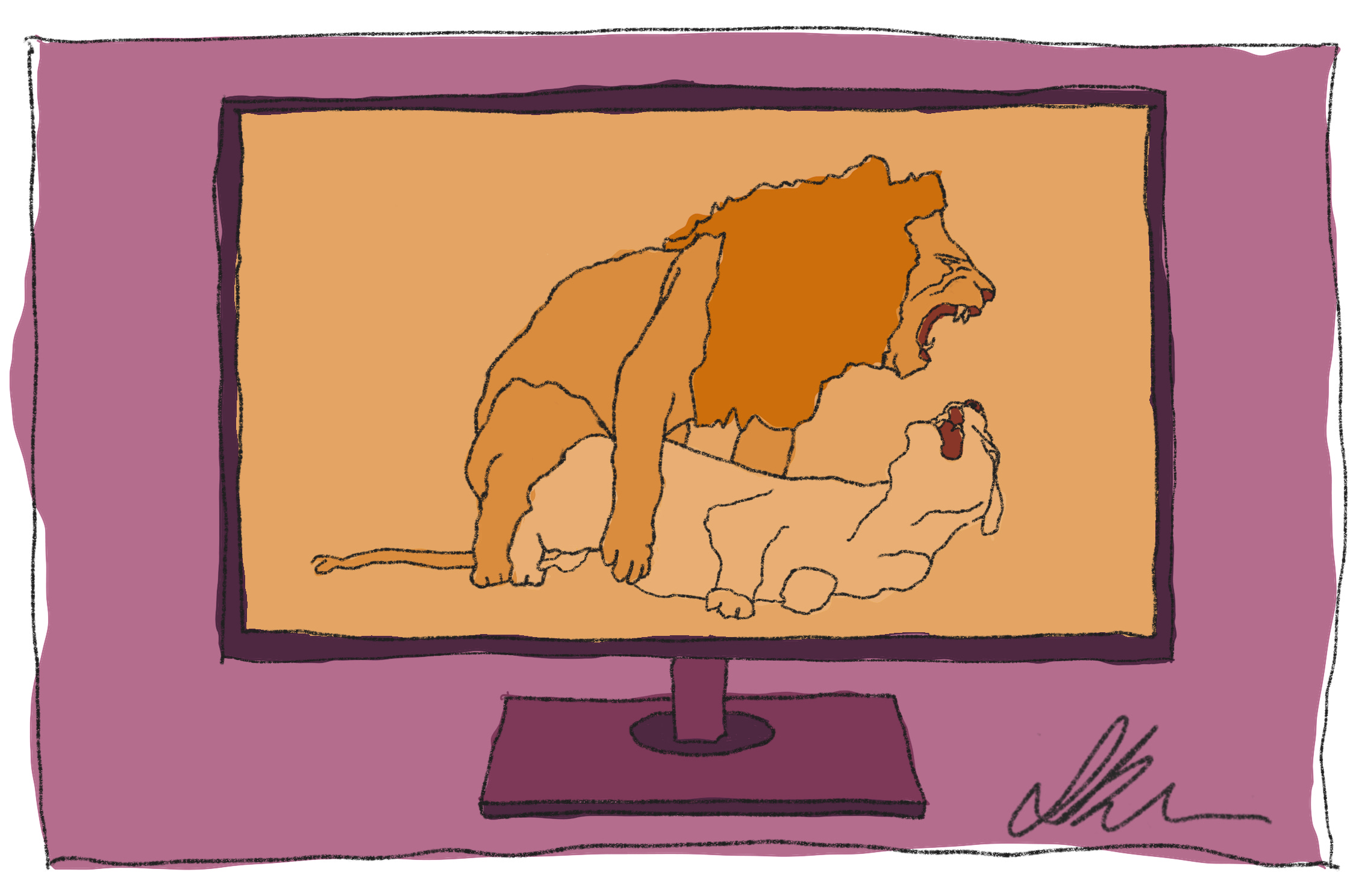
Lions (Panthera leo)
Mountain zebras (Equus zebra)
Budgerigars (Melopsittacus undulatus)
Common five-lined skinks (Plestiodon fascinates)
Bush crickets (Metaplastes ornatus)
All showed penetrative sex (face-to-face, rear-entry, side-by-side, depending on anatomical affordances), and it was the animals’ copulatory movements that featured most prominently. There were no closeups of the sex organs, nor was there any sound in the clips, to control for vocalizations. The two clips with humans—a straight couple and lesbians “scissoring”—came from Pornhub and had been judged by an earlier group of participants as being especially steamy. Meanwhile, as can be seen above, the 9 other species used in the study strayed further and further in phylogenetic distance from our own, while still displaying coital behaviors broadly resembling human penile thrusts. For those doing the deed more quickly (ahem, crickets), the content was looped to standardize the 60s-clip length. Oh, the 12th clip was a lovely little nature vid—leaves rustling on a tree—to control for the possibility that the genitalia were so trigger happy that even something that nonspecific would do it for them.
After being ushered to a private room, each participant (28 straight women and 30 straight men, most of them twenty-somethings) watched the clips while their genital activities were monitored. After viewing each clip, they were then asked how lascivious it had made them: “On a scale of 1 (“not at all”) to 9 (“very”), how sexually arousing did you find the video?”
The results? Well, you’ll probably be relieved to know that the main hypothesis—that women’s vaginal response would show arousal to any sexual stimulus, including nonhuman sex—was not supported. In fact, while both women and men’s junk responded to the two human clips (hetero and lesbian porn), the animal clips failed to induce any stirrings at all.
As for the participants’ expressed conscious awareness of being turned on, this subjective sexual arousal was similarly limited, mostly, to the human footage. I’m afraid I must use that qualifier “mostly” here because, while the human clips elicited significantly more subjective sexual arousal than did the non-human clips, the latter also wasn’t quite at floor levels. “From the other videos,” the authors clarify, “the largest subjective arousal was elicited by lions, followed by gorillas, and zebras. The smallest subjective arousal was elicited by budgerigars, lizards, chimpanzees, hares, bush crickets, nature, and guinea pigs.” Yes, watching guinea pigs humping was even less of a turn-on than watching leaves blowing in the wind. Anyway, we’re talking, fortunately, scores in the 1-2 range on that 1-9 scale of perceived sexiness (“not at all” to “very”), whereas the human porn hovered more around a 6 or 7 level. Still, the nonhuman scores were enough to yield significant differences between species categories.
In short, Krejčová and her team’s findings don’t entirely square with the blanket preparation hypothesis of female sexuality. Or at least, they add important empirical clarity to just what is (and is not) perceived by women as “sexual.” It’s not just any old overt sexual stimuli, such as the sight of generic copulatory movements. Species category seems to matter… a lot. Just seeing a zebra thrusting, it turns out, isn’t enough to “prepare” the vaginas of human females for intercourse. That said, female sexual arousal isn’t category-specific, either, at least with respect to preferred gender. The heterosexual women’s aroused genital response to the lesbian porn was indistinguishable from their response to the straight porn. Yet, consciously, they reported being significantly more turned on by seeing a man and woman having sex.
As for why the current data failed to align with those high-profile findings of bonobo sex activating human vaginas, the authors could only speculate that it may have something to do with their use of silent clips in the current design, whereas sex vocalizations were included in the original studies. That seems like a bit of a stretch to me, as does the fact that the present study featured chimpanzees (Pan troglodytes) rather than the closely related bonobos (Pan paniscus), although the latter are of course well-known for their hypersexual social lives. Those earlier vaginal responses to bonobo copulation don’t appear to hinge on our species’ close evolutionary ancestry with them. After all, in the current study, watching chimps having sex left everyone’s genitals completely cold, and in fact the participants (both males and females) were significantly more turned by the lions than they were the chimps. “From an evolutionary perspective,” Krejčová and her coauthors write, at long last stating the obvious, “it is unlikely for women to have sexual intercourse with males of a different species. It is thus not adaptive to develop an automatic protective genital response to depictions of non-human sexual acts given that human-animal sexual behavior is not reproductively motivated.”
Anyway, can’t say I didn’t warn you. But it could have been worse, right? If men were getting hard-ons at the sight of crickets f*cking, and women got wet from the mere glimpse of skinks screwing, I bet you’d feel the urge to take that shower even more than you do now.
Krejčová, L., Vaníček, O., Hůla, M., Potyszová, K., & Bártová, K. (2024). Genital and subjective sexual arousal in androphilic women and gynephilic men in response to the copulatory movements of different animal species. Archives of Sexual Behavior, 53(8), 2977-2986.
Questions? Concerns? Ideas? Email the corresponding author, Lucie Krejčová, directly: lucie.krejcova@fhs.cuni.cz
Like what you read? Toss a tip in the jar—any amount that makes sense for you—so I can keep overthinking things on your behalf.
Thanks for another interesting piece, Jesse. One hole in the preparation hypothesis that you kind of nod toward but don't really unpack here involves lesbians' non-response to the bonobos in Chivers' research. After all, lesbians are women and if the response is due to natural selection and genetic transmission, why would it be transmitted to female infants who turn out to be straight but not female infants who turn out to be gay? In the Hobbesian sexual past upon which that theory rests, all women would have been subjected to rape, not just the straight ones. And presumably, all lesbians have straight mothers (or raped lesbian mothers), so I don't see why or how natural selection could have resulted in the situation we currently have.
Another point worth considering, bonobos often have sex face to face, with eye contact and kissing, whereas chimps are rear-entry only. If Chivers used images of bonobos that featured eye contact, perhaps it was the intimacy straight women were aroused by, rather than the thrusting?