


This article was originally published in French at Le Point on 05.04.2026
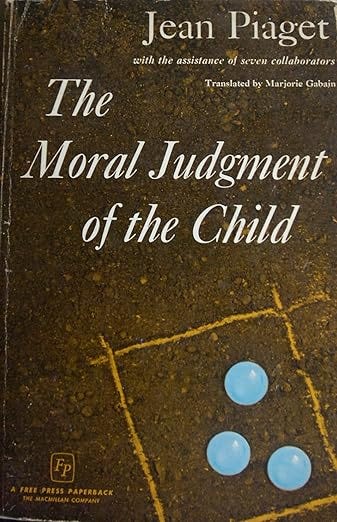
In his 1932 book The Moral Judgement of the Child, the famous Swiss developmentalist Jean Piaget wrote about how a colleague of his, a mysterious-sounding “Mlle Rambert,” administered a series of stories to a large group of schoolchildren. Here’s an example:
Once there were two children who were stealing apples in an orchard. A policeman comes along and the two children run away. One of them is caught. The other one, going home by a roundabout way, crosses a river on a rotten bridge and falls into the water. Now what do you think? If he had not stolen the apples and had crossed the river on that rotten bridge all the same, would he also have fallen into the water?
Kids under the age of eight said definitely not, explaining that the bridge had collapsed only because the boy had stolen the apples. Older children saw what Rambert was getting at. They answered in terms of “mechanical chance.” The worn planks would have given way, they said, no matter who was on the bridge. Piaget didn’t entirely trust these rational answers, however. Rather, he believed that instinctual superstitious thinking is often “justified by a cloak of words” in science-savvy children and adults. One of the reasons Piaget suspected this was that some of the older children told Rambert that of course it was simply coincidence that the boy had fallen into the river after stealing the apples; they couldn’t help themselves from adding, however, that all the same, it was punishment for what he had done.
Since Piaget’s day, researchers have found compelling evidence that human beings operate with an innate sense of immanent justice. Basically, this is the idea that good things happen to good people, and bad things happen to bad people. This intuition can be overridden by our more rational, scientific understanding of the world. Life isn’t fair. But it isn’t unfair, either. It just is. But like those older kids in Piaget’s example, that doesn’t mean we’ve grown out of this cognitive bias of immanent justice thinking entirely. I once read about a guy who murdered an elderly woman and, in a desperate bid to escape the police, jumped into a Florida canal, where he was promptly consumed by a giant alligator. It works the other way around too. Back in 2008, not long after being released from prison for raping a thirteen-year-old girl, a sex offender hit the jackpot in his state’s fifty-seven-million-dollar lotto. If you’re logically minded, chances are you would say that these things just happen. But I bet you’d nevertheless feel that the murderer got what he deserved in that canal, and that something came undone in the fabric of the cosmos when a level-three sex offender won the big lottery.
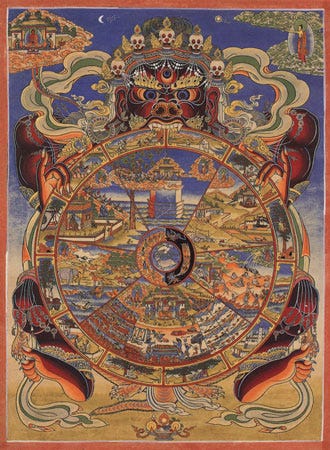
When this powerful psychological tendency for immanent justice is co-opted by religion—as it is in Dharmic traditions such as Hinduism and Buddhism—it becomes fully expressed as a belief in karma. It’s rather shadowy, and you can tell me why this description is naive and wrong in the comments below, but the central logic appears to be that people get what they deserve not because other human beings intervene to exert justice, but because the universe itself is a great moral leveler, and our social deeds are, somehow, always being calibrated.
According to cognitive scientist Cindel White of York University, who is quickly emerging as one of the world’s foremost authorities on the psychology of karma, this makes it distinct from belief in God. After all, God is usually a personified agent who, much like Santa Claus, knows when you’ve been good or bad and doles out the gifts accordingly. You can always ask for forgiveness, just as you would with another person, and you might get your presents in the end regardless. By contrast, karma is a faceless, cosmic comeuppance that doesn’t involve any human-like mind, but instead treats good fortune almost as a limited natural resource; it’s always in a state of flux based on individual human actions but moving toward a lawful equilibrium of fairness. There’s no personal god to thank or appeal to for mercy.
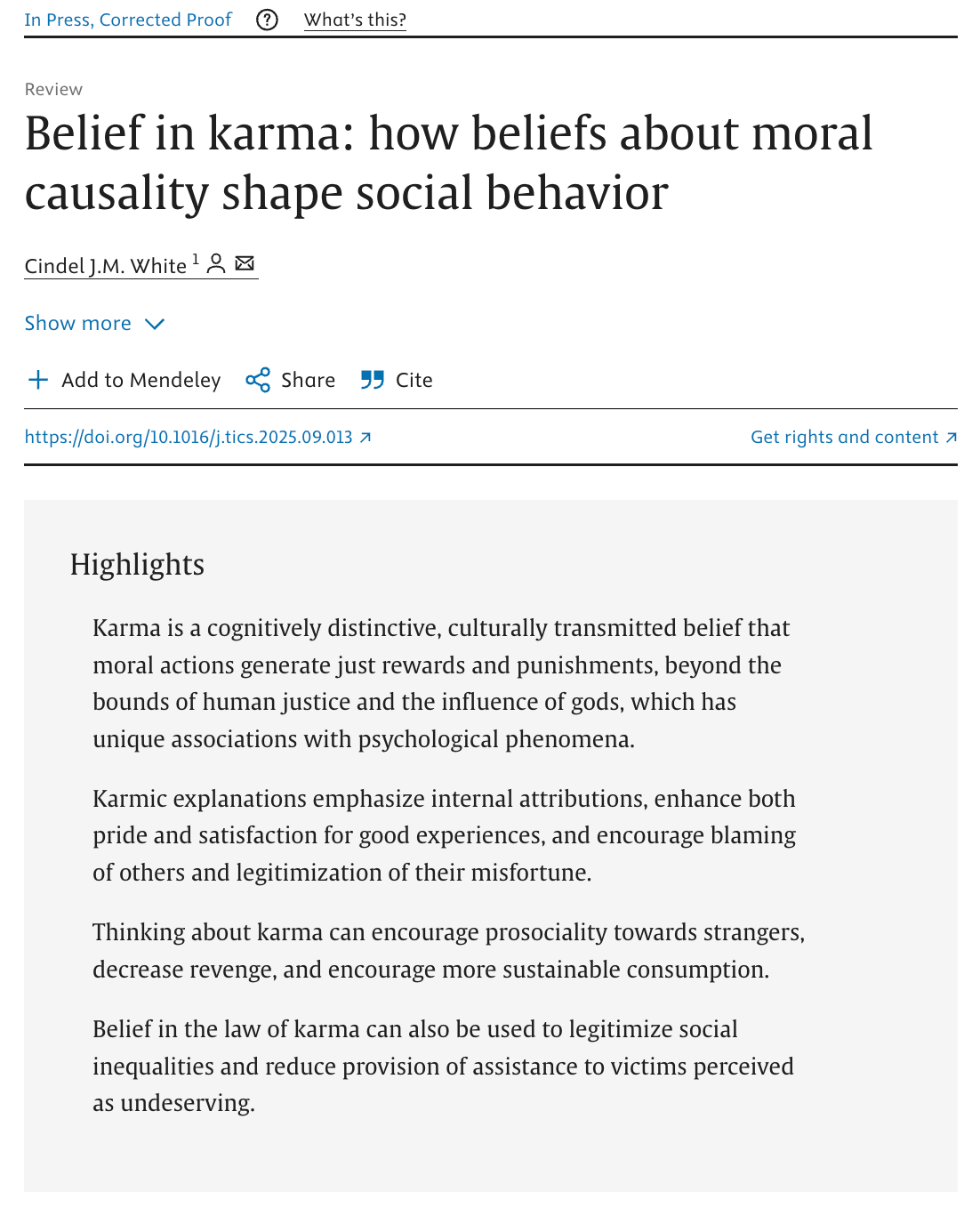
In a new article in the journal Trends in Cognitive Sciences, White summarizes how belief in karma has real-world effects, both for the believer’s own mental well-being, and for how they treat others. It turns out it’s a double-edged sword. Let’s look at the positives first.
The Good.
When good things happen to us, karma implies that we must have earned it. Somehow. Maybe in a previous life?
In one series of studies, people were asked to reflect on their own happy life experiences. Compared to positive events believed to be caused by God—which induced feelings of indebtedness, submission, and gratitude to that external agent—people thinking in terms of karma made more internal attributions, taking personal credit for their own good fortune. The karmic believers felt pride and feelings of entitlement. “Belief in karma can predict greater well-being by reassuring people that they deserve the blessings in their life,” White writes. They must be good if they’re reaping life’s rewards. What more evidence do they need?
Karmic beliefs also lead to a more positive outlook about the future. The person can act now to ensure good outcomes later, White explains, giving them a sense of control over their own fate. This “forward-looking karmic optimism,” as she calls it, has even been experimentally demonstrated under laboratory conditions. In one study, participants who were asked to think about a desirable but uncertain future outcome that was now out of their hands (i.e., receiving a job offer, getting positive medical results back, etc.) donated more time and money to a totally unrelated cause, essentially investing in their karmic merit to influence the outcome.
Also, with karma, people are motivated to be nicer and more generous to each other. In behavioral economics studies, for example, asking participants to think about karma before playing the dictator game causes them to make less selfish money decisions. (It’s all ultimately for selfish reasons, like Christians giving tithing to stay in God’s good books. But still prosocial at a behavioral level.) Relatedly, thinking about karma tends to make people less vindictive. After all, if “what comes around goes around,” believers can outsource punishment and retribution—a high-risk and all-consuming response—to mindless, automatic karmic forces. Experiments have found that reminding people of karma causes them to be less likely to exact revenge on those who have wronged them. Whether that’s good or bad is debatable, but overall, karma beliefs can make for a more cooperative and tolerant society.
Reincarnation is of course often tied up with karma, with karmic credit scores spanning across multiple lives. Intriguingly, there’s evidence that belief in karma is associated with more long-term, sustainable patterns of consumption, including environmentally friendly attitudes and behaviors. If you believe that man-made damage to the earth today is going to eventually have direct consequences for you—not in this life, but maybe in the next—then things like climate change, deforestation, biodiversity loss, and so on—feel more tangible than a hypothetical future generation facing problems that you’ll never personally experience.
The Bad (and the Downright Ugly).
For every positive, prosocial attribute it may offer, belief in karma also has a darker side. For example, that tendency to believe that our good fortune must reflect our good selves also means that our misfortunes must be about something rotten we’ve done—or maybe just thought. Whereas there is salubrious pride in happy events, there is deleterious shame and self-blame in tragic ones. One vivid example of this is that belief in karma predicted greater depression and post-traumatic stress disorder in survivors of the 2004 Sri Lankan tsunami.
In general, however, there’s a self-serving bias: believers are more likely to think about good karma when it comes to themselves, and more likely to think about bad karma when it comes to others. And that, not surprisingly, leads to more victim-blaming. Like that bridge collapsing under Piaget’s little apple thief in the Swiss orchard nearly a century ago, one study showed that today’s karma believers explain that a person’s random bad luck (e.g., losing their phone in a café) must be about something bad that they’ve done. “Applying karmic thinking to understand the misfortunes of others can provide a satisfying way to maintain the belief that the world is just,” White writes. Not only that, but belief in karma is also associated with more disparaging attitudes toward victims, even the withholding of help. And while believers may be less motivated to punish those who wrong them, this detachment can mean transgressors are seen as irredeemably bad people beyond social redemption.
Stepping further back, there are also ugly political implications of moralistic karma and reincarnation, including a shoulder-shrugging tolerance—even support—for obvious social inequities. In many parts of India, being born into a lower caste still means that you’ll never enjoy the same socioeconomic opportunities or privileges as those born into a higher one. Individuals with stronger karmic beliefs are also more likely to endorse right-wing authoritarianism and to have a more pronounced social dominance orientation.
Karma’s not really a bitch. She’s not even real. But as empirical evidence continues to mount, there are very real effects of such beliefs on people’s prosocial—and antisocial—attitudes and behaviors.
Like what you read? Toss a tip in the jar—any amount that makes sense for you—so I can keep overthinking things on your behalf.