


This article was originally published in Le Point on 09.02.2026
There’s a popular belief that the vagaries of romance are best left to poets and artists, not hardnosed scientists to poke and probe, propped up lifeless on a cold slab. When it comes to the alchemy of interpersonal attraction, for instance, most people are happy to wax lyrical about “love at first sight” or “the look of love” without feeling compelled to dissect the psychology of eye gaze. In fact, the cloudier and more inscrutable such mysteries, the better.
I disagree. Given that flirting and courtship are such powerful forces in our species, with mate choice (who ends up with whom) the arbiter of our being, investigating the significance of direct eye contact in romance is very much a research subject worthy of scientific scrutiny. After all, for you and nearly everyone alive—or whoever has been or one day will be alive—that precise moment in time when two particular people in the universe first “caught each other’s eyes” launched the arrow of your existence. Before sex, there is attention.
Surprisingly, points out the psychologist Alexandra Hoffman and her colleagues in a recent study in Archives of Sexual Behavior, researchers had never actually studied eye gaze in a naturalistic dating context. Measuring how perceived attractiveness affects mate choice is one thing; indeed, scientists have toiled in this area for decades, studying everything from facial symmetry to body odor to voice pitch and the vicissitudes of many other phenotypic factors in triggering lust and love. But attractiveness aside, is it possible to predict who will end up together based solely on whether they are making eye contact?
Possibly, reasoned the authors. It’s an empirical question, and there’s good reason to think that eye contact, especially when both parties know that the other is single and on the market, betrays mutual interest. Social gaze has a dual function. It gathers information about others while also signaling information to others. Eyes are like tiny social magnets. Wherever they point, our attention tends to follow. If you have any doubts, go outside and stare at a distant rooftop, and notice all the passersby who instinctively stop in their tracks to follow your gaze. So, when someone’s eyes land on you, that means you’re interesting enough for them to pay attention to, and if they stay there, well, you must really be transfixing them.
Context matters here: being stared at can certainly be a negative social signal, or even a hostile display that threatens looming danger. That’s the sort of squirm-inducing beam of attention you don’t want on you (e.g., see rape and the “male gaze”). But in affiliative social encounters or romantic situations, being looked at is generally the aim, producing a warm glow. Something as simple as our pupils being aligned can have a surprisingly potent positive effect. We know from previous studies that people who meet our eyes tend to strike us as more likable, more charismatic, and even more attractive. It’s as though our self-flattering brains conclude: anyone who is finding me this attention-worthy must be all of these things, and maybe more.
If that’s the case, reason Hoffman and her coauthors, you can see how this might play out in a dating scenario. “We argue that the duration of simultaneous attention toward each other’s eyes is a predictor for individual mate choice,” they reasoned. “We hypothesize that the more mutual eye contact between two individuals during a speed-date, the higher the probability of choosing the encounter as a potential mate. We also test whether giving and receiving eye contact [separable from mutual gaze] predict mate choice.”
In other words, would you go out with them again? Yes or no.
Procedurally, this speed-dating study was easier said than done, though. When it came to studying the fluctuating visual dynamics of two strangers meeting for the first time in a strange room, examining eye gaze in statu nascendi was not a simple task. It meant putting an unchoreographed dance between two very busy sets of eyes under the microscope. Here’s where modern technology came in handy. It wasn’t very sexy, but by having the participants each don a wearable pair of advanced eye-tracking glasses, the researchers could video-record the scene from each wearer’s point view, generating unique gaze data and mapping the person’s eye fixations onto the real environment. This still produced two separate five-minute video recordings (one from each date’s perspective), but the videos could be synchronized to show any matching eye contact. Critically, the glasses were sensitive enough to discern whether the person was looking at, say, their date’s chin or that embarrassing piece of cilantro stuck between their teeth, or more importantly, their eyes or their forehead.
The study included 60 young adults, 30 women and 30 men, each going on four five-minute speed-dates. That generated an enormous amount of data (the setup meant a total of 480 videos, and we’re told each one took about an hour to manually code). Now, I know what you’re thinking. Again, making eye-contact with someone when you’re both wearing some nerdy oversized spectacles doesn’t exactly spell romance. It might also alter people’s natural gaze behaviors. But it’s important to remember that the participants were naïve to the mutual eye-gaze hypothesis. Also, any weirdness of the situation was arguably canceled out by the fact that the weirdness was perfectly standardized, which is to say, everyone got the same eye-tracker treatment.
As far as the participant was concerned, their only job was to go on four successive dates, and after each one, to answer a series of questions. First, would you like to see this person again? Second, how attractive did you find them, on a scale of 1 to 10? And finally, how much mutual eye contact did you feel existed between the two of you?
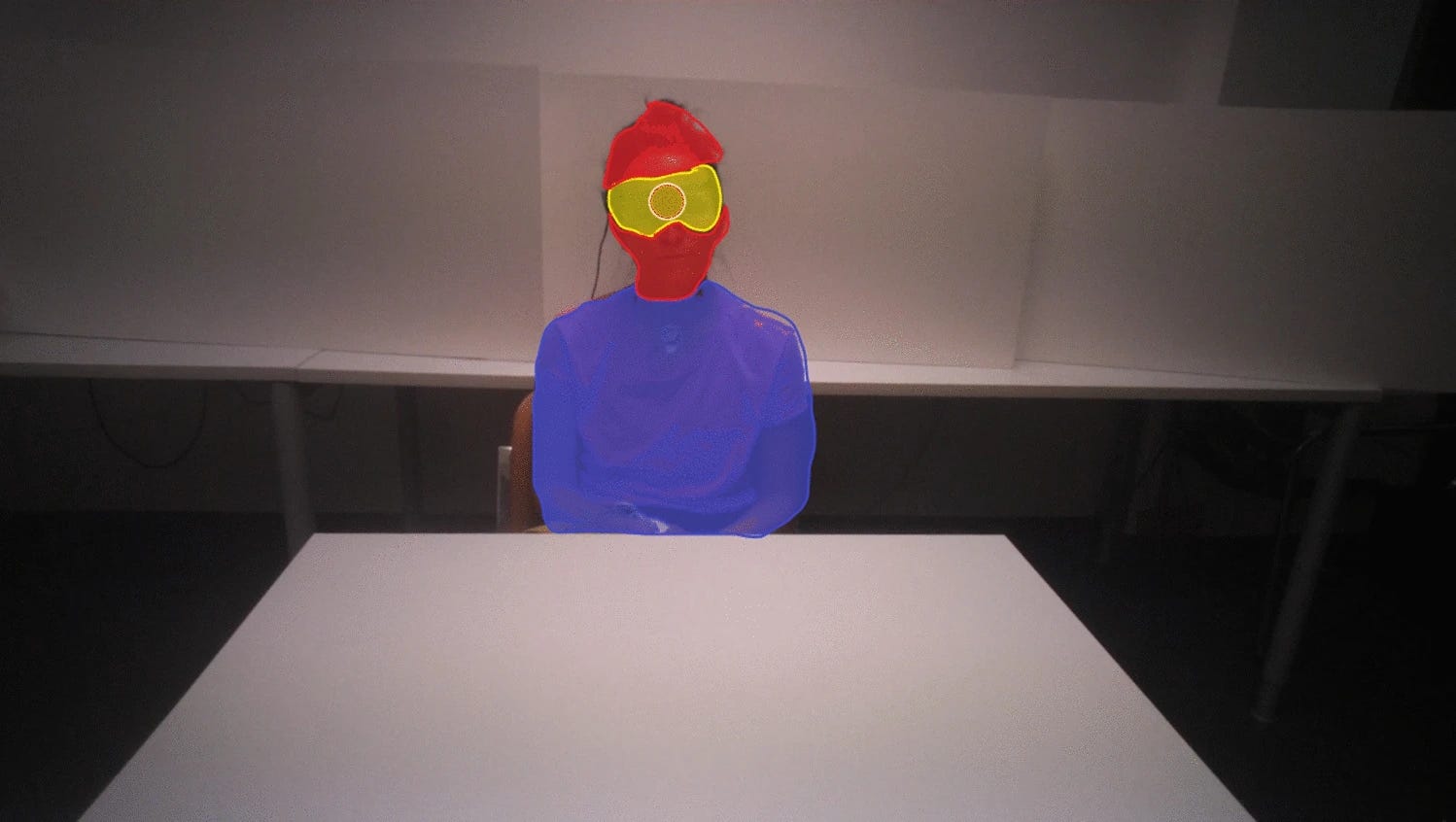
The results were mostly as expected. Participants who shared more eye-contact with their partners were indeed more likely to want a second date with that person. It was only eye contact that had this effect. Just looking at the other person’s face, or their body, wasn’t enough to do the trick. It certainly didn’t bode well for those whose partners fixated on the dead fly on the windowsill. Also, this result was entirely separate from ratings of attractiveness. And it was distinct from people’s subjective estimates of how much eye contact occurred (they overestimated it dramatically). Instead, it really was all about how much actual mutual eye gaze took place.
“When being looked at we feel ‘touched’ by those who are looking at us,” reason the authors. “Indeed, eye gaze acts like a pointer, just as calling someone’s name. Thus, if an individual receives more eye-contact from their dating partner, they might feel more involved and create a more personal bond with their counterpart.” I suppose it’s the sense of “feeling seen,” which is why, in English at least, we speak of looking “into” someone’s eyes rather than looking “at” them, when in fact the latter is a more accurate description. (There’s a terrible pun somewhere in here about blind dates.)
An even more interesting finding than the mutual eye-gaze result, in some ways, was that receiving eye-contact, but not giving it, independently increased people’s interest in seeing the person again. This made me think of the Victorian-era coquettish flirt. A young woman looks away coyly on becoming aware of a male suitor’s gaze, but both parties know perfectly well she is very much interested. Yet in contemporary Western culture, where such a romantic script has become a relic of the past, this technique may fall flat. The receiver knows the other party is interested, but the giver is left guessing, and so is more inclined to move on. Although there weren’t very many sex differences in the gaze data, the fact that women spent less time looking at the eyes of their partners overall may reflect this sort of failed courtship tactic.
There may also be important cultural differences at play, of course, so we should be cautious before generalizing. After all, these were European young adults on speed dates. Whether eye contact works the same way in, say, dalliances in Afghanistan may be an entirely different story. Speed dating probably isn’t very popular there anyway.
This newsletter is free. But it’s a lot of work! Like what you read? Toss a tip in the jar—any amount that makes sense for you—so I can keep overthinking things on your behalf.