



This article was originally published in French at my Le Point column 15.06.2026
Years ago, psychologists Kathleen Vohs and Jonathan Schooler showed that when people are told that free will is an illusion, they’re more likely to lie, cheat, and steal. For example, after reading a passage from Francis Crick’s The Astonishing Hypothesis, in which the eminent author described “you” as “nothing but a pack of neurons” suffering the erroneous belief that you have any actual control over your decisions, participants were more likely to cheat on a math test than were those who read a different passage.
Another study—this one by social psychologist Roy Baumeister and his colleagues—found that people exposed to similar deterministic statements (e.g., “Like everything else in the universe, all human actions follow from prior events and ultimately can be understood in terms of the movement of molecules.”) acted more aggressively and selfishly compared to those who saw statements endorsing free will (e.g., “I demonstrate my free will every day when I make decisions.”) or neutral statements (e.g., “Oceans cover 71 percent of the earth’s surface.”).
Both sets of researchers came to a startling conclusion. “If exposure to deterministic messages increases the likelihood of unethical actions,” wrote Vohs and Schooler, “then identifying approaches for insulating the public against this danger becomes imperative.” Insulating the public against this danger is the key phrase here, as it connotes that, sorry, you people can’t handle the hard scientific truth. Baumeister and his coauthors, meanwhile, put it in slightly different terms, but they land similarly. “Some philosophical analyses may conclude that a fatalistic determinism is compatible with highly ethical behavior,” they wrote, “but the present results suggest that many laypersons do not yet appreciate that possibility.”
As someone who writes often—some say gratuitously—about unpalatable aspects of human nature, and who endeavors to explain such things in reductionistic, evolutionary terms, this gave me pause. In fact, when I first covered those free-will-as-illusion studies back in 2010 at Scientific American, I alluded to their unsettling implications for our judgments of human sexuality, in particular. I offered the following hypothetical example:
A middle-aged man hires a prostitute, knowingly exposing his wife to a sexually transmitted infection and exploiting a young drug addict for his own pleasure. Should we hold him accountable? Most people, I’d wager, wouldn’t hesitate to say yes.
But what if you thought about it in the following slightly different, scientific terms? The man’s decision to have sex with this woman was in accordance with his physiology at that time, which had arisen as a consequence of his unique developmental experiences, which occurred within a particular cultural environment in interaction with a particular genotype, which he inherited from his particular parents, who inherited genetic variants of similar traits from their own particular parents, ad infinitum. Even his ability to inhibit or “override” these forces, or to understand his own behavior, is itself the product of these forces! What’s more, this man’s brain acted without first consulting his self-consciousness; rather, his neurocognitive system enacted evolved behavioral algorithms that responded, either normally or in error, in ways that had favored genetic success in the ancestral past.
Given the combination of these deterministic factors, could the man have responded any other way? Attributing personal responsibility to this sap becomes merely a social convention that reflects only a naive understanding of the causes of his behaviors. Like us judging him, this man’s self merely plays the role of spectator in his body’s sexual affairs. There is only the embodiment of a man who is helpless to act in any way that is contrary to his particular nature, which is a derivative of a more general nature. The self is only a deluded creature that thinks it is participating in a moral game when in fact it is just an emotionally invested audience member.
In other words, how can we fault this “pack of neurons” for acting as his nature dictates, even if our own nature would have steered us otherwise? What’s more, shouldn’t we be more sympathetic to our own moral shortcomings? After all, we can’t help who we are either.
Right?
Of course, that was all just a thought exercise. I don’t believe—even if there were no such thing as free will in any strictly materialistic, recondite sense—that people shouldn’t be held accountable for their actions. But there is also the very real possibility that such causal biological explanations have the power to shift perspectives about blame and autonomy in significant ways when it comes to sex. And now, sixteen years later, a new study by the British psychologists Sofia Persson and Thomas Hostler, published in the journal Royal Society Open Science, has apparently found just that. The investigators asked, essentially, whether exposure to an evolutionary psychology explanation of male sexual aggression makes people more sympathetic to rapists and less sympathetic to their female victims.
This longstanding fear, about the social dangers inherent to evolutionary psychology, particularly when it comes to “normalizing” misogyny and so-called rape culture due to its central message of immutable sex differences, has been around for decades. (Many see the 2000 publication of the book A Natural History of Rape by biologist Randy Thornhill and anthropologist Craig Palmer as a lightning-rod moment in these heated debates.) But Persson and Hostler’s study is, as far as I’m aware, among the first experiments to interrogate what has otherwise been just a feminist talking point. It’s hard not to detect the authors’ own intellectual aversion to evolutionary psychology, but what I do find commendable is their teasing apart the scientific veracity of evolutionary psychology from its psychological effects on audiences. This is a critical distinction: not if it is true, but if it is dangerous. And they’re also very much aware of the counterarguments that stress exactly the opposite, writing:
Although evolutionary psychologists argue that findings can be used to prevent sexual violence (for example, by identifying those at risk of being victims), critics argue that evolutionary psychology’s negative consequences for gender equality outweigh any potential value from findings in this area (i.e., regardless of whether the results can be considered scientifically valid or not), and that the significance of evolutionary psychology does not lie in whether the theories themselves are correct, but rather in its contribution to a wider meta-narrative on female-male differences, as reflected in attitudes of laypeople more generally.
The study design itself was rather involved, as the British say, but here are the highlights. Persson and Hostler first showed all of their participants (over 600 people) a set of factual, data-driven infographics. The graphs used UK crime statistics to visually depict how men are far more likely to be perpetrators, and women more likely to be victims, of sexual violence.
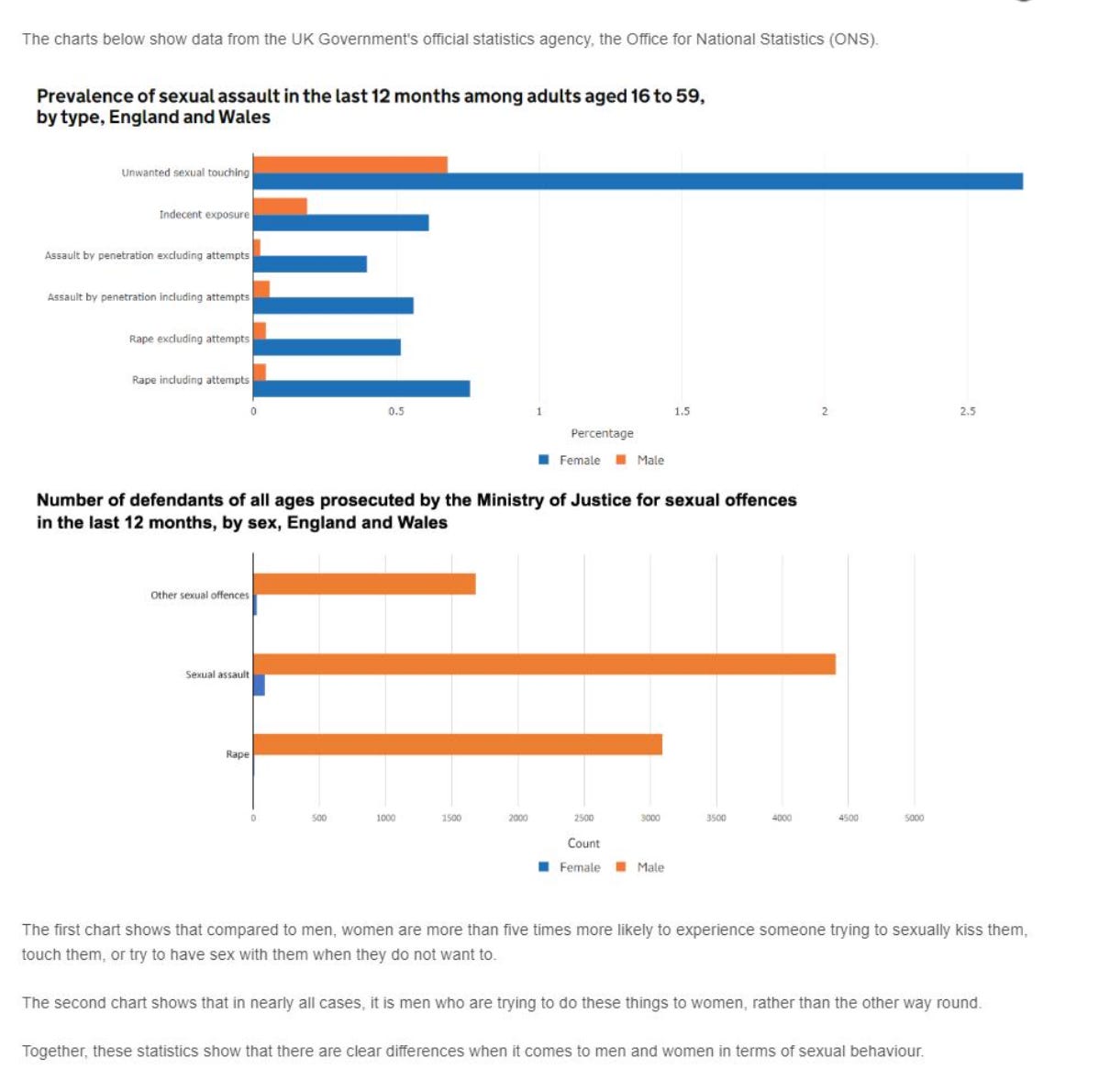
After seeing this obvious disparity, participants were randomly assigned to watch one of three short videos (~7 min), basically edited clips from YouTube. Two of the videos were titled “Why is this behavior mostly done by men towards women?” and featured either a social explanation or an evolutionary explanation. A third group of participants—the controls—viewed an unrelated video about the benefits of being outdoors in nature. (The full original videos from YouTube are below, but click here to watch the trimmed versions actually shown to participants in the study.)
For the social explanation condition, the researchers used a TED Talk by Jackson Katz, who argues that violence against women is primarily a men’s issue: male leaders need to be willing to stand up against sexism and to challenge socially ingrained gender norms. It’s a toxic, permissive male culture that is to blame. Biological factors? What are those? Male sexual aggression, he surmises, is a learned social response.
By contrast, the video used for the evolutionary explanation condition featured evolutionary psychologist David Buss, who espouses the view that sexual violence against women can only be understood through the lens of biology. Namely, men’s and women’s evolved mating strategies are often in conflict, with men seeking quantity and women more selective about their reproductive partners. Like Katz skipping over biology entirely, Buss glosses over the role of social influences.
Finally, the control video—about the healing properties of nature on the brain—was by cognitive neuroscientist David Strayer. There was no talk of sexual aggression in that one.
The experimentalist in me must pause to quibble over the obvious confound of having different people giving different messages (ideally, the speaker would be held constant and only the message changes), but the authors note that they were all white, middle-aged men. Hmm. Anyway, participants were then asked to read the following description of a sexual assault:
Nick and Joanne study the same course at University, and have attended a party hosted by someone they both know. They spend the evening drinking beer, flirting, and kissing. Towards the end of the party, Joanne says she wants to chill out and goes upstairs to one of the bedrooms. Nick joins her a short while later and finds Joanne lying on one of the beds. Nick enters the room, closes the door behind him and lies down next to her. After a while he has sex with her. During this, Joanne does not say anything, and appears to be unconscious. When Nick is finished, he leaves the room and goes back down to the party.
The researchers explain that they wanted to portray an event that met the legal definition of rape (unconscious people cannot give their consent), yet also contained features known to make such incidents seem ambiguous to outsiders (she’d previously shown interest, there was a lack of physical restraint, both had consumed alcohol). Participants were asked, in a series of Likert-type questions, how much Nick was at fault, and how much Joanne herself was to blame. Thus, there were two separate scores: perpetrator culpability and victim culpability.
There were no differences across the three video groups when it came to people’s views of Nick’s culpability. However, the participants who’d just watched Buss speaking about evolutionary psychology judged Joanne to be significantly more responsible for her rape than did those who’d watched Katz speaking about the social causes of male sexual aggression. (Further analyses revealed that the effect was mediated by belief in gender essentialism; basically, seeing the evolutionary explanation video increased people’s beliefs in innate and immutable sex differences, and this in turn drove people to see Joanne as more accountable.)
Similar to those free-will-as-illusion studies turning people into all-around assholes, Persson and Hostler’s study is certainly uncomfortable. I, for one, don’t want anyone using my articles or books to justify something truly heinous. Still, should we shy away from describing and explaining some harsh scientific reality because the underlying message leads laypeople to minimize or normalize serious moral transgressions? “Based on our data,” they write, “we can conclude that by describing the causes of male aggression as anchored in evolution, evolutionary psychology may prescribe an increased tendency to hold victims of rape more culpable, at least when compared to social explanations for male aggression.”
Well, maybe. But now what? I read recently that parents who believe in reincarnation are more accepting of their gender-nonconforming children, which is helpful for these families. But that doesn’t make reincarnation true. And as we’ve seen, telling people that they have free will makes people behave better. But that doesn’t make free will real, either. I’m not saying that social explanations for rape are in the same category as those examples, but the point is, should we really favor communicating one scientific theory over another, even if it does have more positive social effects?
To borrow the authors’ prescription metaphor, science communication, in my opinion, is simply medicine for ignorance. That makes it humane, ipso facto. There may be occasional side effects of this communication, or even outright abuse. But through responsible practice, it can also be done with great clinical utility.
“Based on our data,” they write, “we can conclude that by describing the causes of male aggression as anchored in evolution, evolutionary psychology may prescribe an increased tendency to hold victims of rape more culpable..."
"Prescribe"?!!
As Donald Symons wrote in The Evolution of Human Sexuality, evolutionary theories of sex differences may be especially problematic for people who have difficulty distinguishing between a description vs. a prescription, as do these authors.
The issue should not be whether the truth is "problematic" -- the problem is the erroneous thinking of those folks who make the description / prescription fallacy (naturalistic and moralistic fallacies). That erroneous thinking is what needs to be challenged. Attempts to suppress or conceal actual facts are far worse in the long run.
I wish your last two paragraphs were longer. I want to see more discussion.
I agree with you that science communication is more humane.
But if responsible practice in science communicating was adhered to by everyone, 99.99% of the internet wouldn’t exist.
*Who* does the science communicating? Where, when and how? How is it regulated?
This is ultimately a political question though. And since, if I recall correctly, you don’t like writing about politics, we won’t see you writing about this…
Unrelatedly, I’d like to see you write about pedophiles in your next book. I’d read it. You like writing about controversial topics, right?