


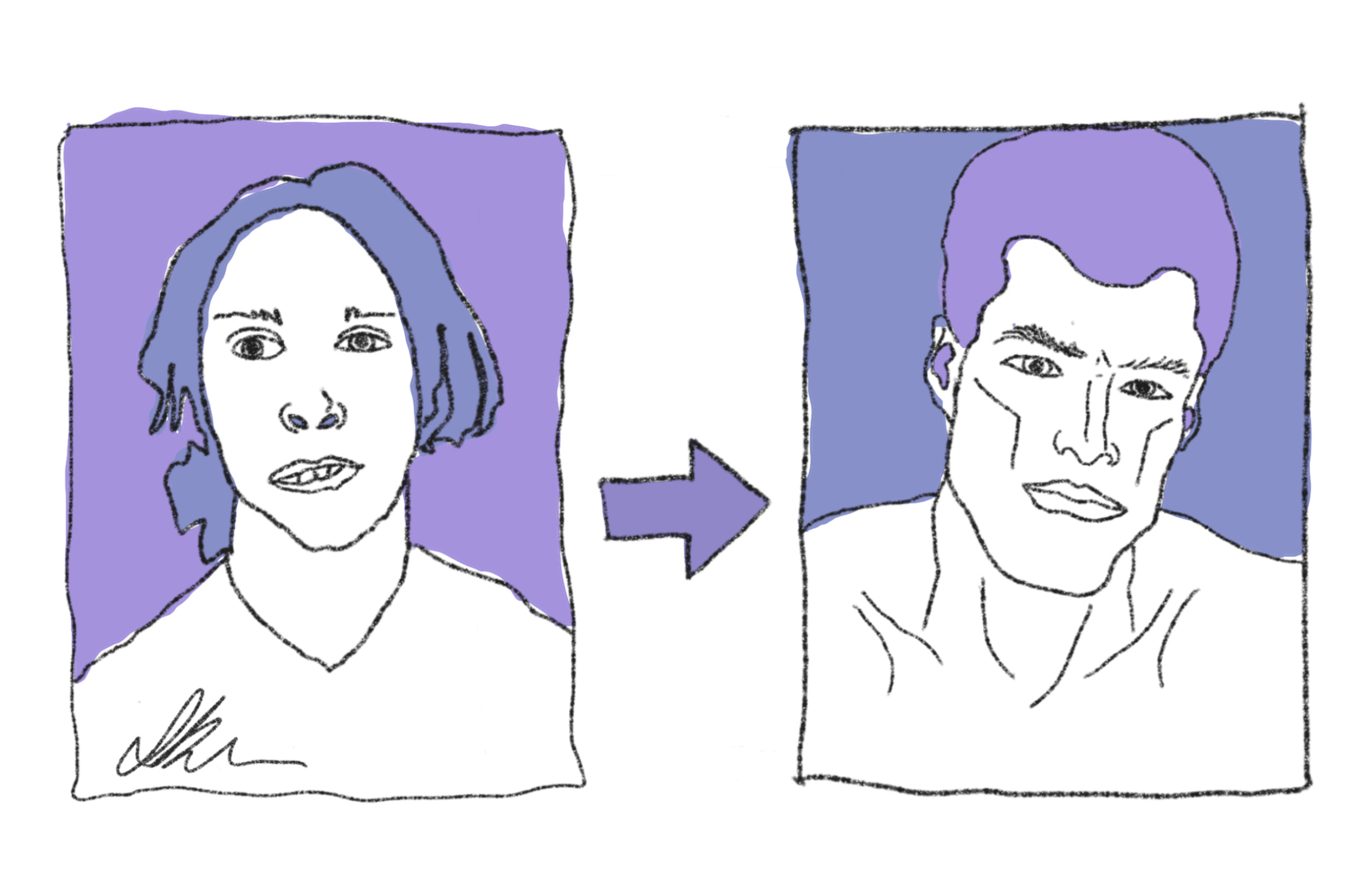
There’s good news for those of us who are, let’s say, aesthetically challenged in the face department. In fact, it’s good news for anyone with any kind of face at all. The more you see a person’s mug, the more attractive you find it. Granted, this might be stated more correctly as “less unattractive,” but that’s the ruder slant. The point is that our subjective beauty impressions are kindly disposed toward faces we encounter often. It’s like an inborn iPhone filter in our heads, one that just needs enough individual face data to do its flattering job.
This mere exposure effect isn’t specific to faces. Experiments from the 1960s showed that the repeated exposure of any stimulus—even nonsense words and symbols—generates positive feelings toward it. The generic but perfectly cogent evolutionary explanation is that novel objects are inherently strange and unfamiliar, presenting a possible threat. Thus, the more we’re exposed to a stimulus without incident, the more comfortable we feel approaching it.
In the domain of faces, this adaptationist framework is especially salient, as strange faces mean, well, strangers, and with strangers comes the implicit threat of intergroup violence, among other hazards. Still, the underlying mechanisms driving this psychological phenomenon haven’t been entirely clear. We might like familiar faces more than we do unfamiliar ones, but why would this affect our perceptions of the person’s attractiveness?
In a 2023 article published in Current Psychology, a team of Chinese investigators led by Shangfeng Han from Ningbo University attempted to pick apart how this mental beauty enhancer for other people’s faces works. Note that Han and his coauthors were examining attractiveness in the broader, non-carnal sense. This wasn’t a Tinder app study where participants swiped through physiognomies of prospective hookups. Think more along the lines of your dad just saying “he’s a goodlooking man” about a political candidate on the debate stage. True, that doesn’t rule out your dad’s secret fantasies, but you know what I mean. Here’s how Han et al. defined facial attractiveness: “the subjective evaluation and feeling that a target face induces in an observer, causing a concomitant pleasure and positive affective experience that drives the observer to approach the owner of the target face.” To speak of someone as the “owner of a face” sounds a bit like a horror movie, but it’s this general sense of attraction toward faces that we find pleasing that featured in the study.
Certain static facial characteristics, such as symmetry, averageness, and sexual dimorphism, tend to signal health and genetic quality (and hence perceptions of beauty). However, Han and his colleagues weren’t so much interested in these objective markers as they were in how faces differing in attractiveness were being evaluated by observers. Beauty may be in the eye of the beholder, but the lens of that eye adjusts to dynamic psychological conditions. For example, being in a good or bad mood colors our subjective views of others’ attractiveness.
As a first step, the researchers needed to gather enough stock faces to use as target images in their experiments. That part was easy enough. “This stimulus set was created by querying an online search engine with the search term Chinese people,” the authors explain. Narrowing it down to young adult face-owners who were looking forward, the authors gathered hundreds of such images. These were then “cropped to remove hair and ears without glasses and other trimmings” and cut and pasted as black-and-white images onto a white background. Next, the earless images were rated for attractiveness by an independent group of beauty raters. Basically, 32 college students (16 men, 16 women) looked at each photo and judged how attractive the face was on a scale of 1 (very unattractive) to 9 (very attractive). Based on their rating agreements, the investigators were able to discern three face types, or “categories of facial beauty,” you might call it: high, moderate, and low attractiveness. The three types were made up of 72 different faces each (36 male and 36 female faces), and the total set of 216 images was used as face fodder for the actual experiments. (We can only hope those random face-owners from the internet who were rated as “low attractiveness” were none the wiser.)
In their first experiment, Han and his colleagues randomly assigned a fresh batch of participants (e.g., they hadn’t done the initial attractiveness ratings) to one of the three prejudged face types. That’s to say, a third got the pretty faces, a third got the meh faces, and a third got the unfortunate-in-the-looks-department faces. Participants were told to stare at a fixed spot on the computer screen for 500 ms, whereby a face would then pop up either on the left or right side of the screen. Your job, the participant was told, is simply to press the correct button on the keyboard matching its spatial location (“F” for left and “J” for right).
A collection of 8 random faces from the participant’s assigned face-type category (again, high, moderate, or low attractiveness) popped up 40 times throughout the procedure, and another group of 8 random faces appeared 5 times. Once the spatial task ran its course, the evaluation phase began. Here, a random face appeared at the center of the screen and participants were asked three questions about the person on display, again on a scale of 1 to 9.
How attractive do you find that individual? (attractiveness)
How much do you like that individual? (liking)
How familiar do you find that individual? (familiarity)
Faces in the evaluation phase were from the repeated exposure task above (i.e., participants had seen them either 5 or 40 times before), or an entirely new face (i.e., seen 0 times before).
As a whole, the more that people had seen a given face, the more attractive they found it, just as expected. The more interesting findings were in how the other two variables (liking and familiarity) varied by face type, and their role in participants’ attractiveness ratings.
The “liking” score ostensibly measured the participant’s emotional state (their feelings toward the face), whereas the “familiarity” score involved cognition (their processing of the face). For participants who’d been assigned to the most attractive faces, the increase in both variables after repeated exposure was cumulatively responsible for the observed bump in ratings of attractiveness: “Improved processing fluency [cognition] and increased positive affective attitude [emotion] make faces with high attractiveness even more attractive.” That’s to say, the prettier a stranger’s face is, the easier it is for our cognitive systems to handle that new face input and the warmer we feel toward the owner (wearer?) of that face. Both of these factors, in turn, make us see the person as even prettier than the first time we saw them.
For less attractive faces, it was a different story. A second experiment confirmed that when it came to the average-looking faces, the cognitive factor alone (familiarity) was pushing up the participants’ ratings of their attractiveness. These meh faces simply became easier to compute the more they were shown on the screen, and this contributed to the observer’s perception of beauty. The emotional factor (liking them more) had nothing to do with it. Whereas people have strong feelings about very attractive and very unattractive faces, Han and his coauthors reason, “the emotional meaning of faces with moderate attractiveness may be ambiguous.”
The opposite pattern was found for the least attractive faces, which, to use the authors’ wording, were “negative stimuli” that initially evoked feelings of aversion. It took “large numbers of exposures,” they note, to produce the “mere exposure” effect for them (40 rather than 5 appearances), but eventually, people came to like the homely faces more than they did at the start, and those positive feelings also made them appear less homely. Familiarity (i.e., cognition) wasn’t playing a role for these more unattractive faces at all, though. “Studies have shown that the more symmetrical objects are,” explain Han et al., “the smoother the processing. Compared to faces with low attractiveness, there is higher processing fluency when processing faces with higher attractiveness.” Reading between the lines, the authors seem to be saying that, like a Picasso painting, these unfortunate visages required more cognitive effort to get one’s head around, regardless of how often they appeared on the screen. But perhaps also like a Picasso, the more people saw them, the more they liked them.
In short, although the end result for all faces was the same—repeated exposures boosted beauty ratings—the mechanisms underlying this effect were different depending on how attractive the face was to start with. Here’s how Han and his team wrap things up: “Faces with high attractiveness were processed with cognition and emotion, faces with moderate attractiveness were processed with cognition, and faces with low attractiveness were processed by emotion.” I know. It’s all very bizarre and raises more questions than answers. Personally, I’m still contemplating whether one can “own” a face or “is” a face or….?
Anyway, if you ever find someone’s face growing on you, you should probably see a doctor.
Han, S., Shen, J., Wang, X., Guo, Z., Liu, S., Gan, Y., Xu, Qiang, & Zhang, L. (2023). The impact of repeated exposure on facial attractiveness: The role of cognition and emotion. Current Psychology, 42(29), 25379-25390.
Questions? Concerns? Ideas? Email the corresponding author, Lin Zhang, directly: zhanglin1@nbu.edu.cn
Like what you read? Toss a tip in the jar—any amount that makes sense for you—so I can keep overthinking things on your behalf.