


This essay first appeared in Why Is the Penis Shaped Like That? And Other Reflections on Being Human, published by Scientific American/Farrar, Straus and Giroux, 2012.

What’s that famous quotation by Edna St. Vincent Millay? Oh, yes. I remember now: “I love Humanity; but I hate people.” It’s a sentiment that captures my normal misanthropically tinged type of humanitarianism well, but it roars apropos on some particular occasions. For example, while I was making conversation at the pizza shop in the small village in Northern Ireland where I once lived, the topic turned to what I did for a living. Now, this simple query was usually a hard question for me to answer; when I said I’m a professor, inevitably I was asked what I taught. When I said psychology, people giggled uncomfortably about their problems or replied—as if it were the most original line—that I’m in the right town for that. When I corrected them and said I’m not a clinical psychologist but a researcher, I had to explain what exactly I research.
“Evolutionary psychology” tended to conjure up some bizarre ideas in many people’s minds. And so it did on this occasion, as I struggled to articulate the nature of my profession in a cramped pizza parlor with about half a dozen locals eavesdropping as I did so. Somehow or another, as conversations with me so often do, homosexuality came up as an example of a complex human behavior that evolutionary psychologists are still trying to understand.
I wish I’d had a notebook in hand to scribble down the young employee’s comments word for word, so as to provide you with a proper ethnographic account. But here, in a nutshell, is what he very confidently said to me, flavored with the peculiar vernacular flourish found in this part of the world: “Aye. Don’t get me wrong, I’ve got nothin’ against gay people. But what I don’t get is why they’d choose to be selfish and not ’ave a family and kids-like which is what we’re here for, how’s you’s go against evolution by not continuin’ the line ’cause you’s can’t help the species without having kids. Just seems selfish-like to me.” I replied that as a gay man myself, it’s not quite as simple as “choosing” not to reproduce; since women are about as arousing to me as that half-eaten pepperoni pizza sitting on that table over there, I said, I couldn’t get an erection to inseminate a woman for the life of me. I do, however, I continued, get a mighty erection by seeing other men’s erections, so therein—I pointed my finger to the heavens for emphasis—lies the true Darwinian mystery! I then took my pizza and left. In haste. And now I’m writing this from Ohio.
But in any event, the exchange reminded me of the German sociologist Michael Blume’s research on reproduction and religiosity. And it occurred to me that religiously motivated homophobia may be at least partially rooted in this assumption that gay people are shirking their human reproductive obligations. I detected a strong whiff of religious residue in the employee’s comments about homosexuality, which given the churchliness of Northern Ireland probably wasn’t my imagination.
In evolutionary biological terms, where natural selection occurs at the level of the gene, not at the species level, there are serious flaws in this person’s conjecture about lineal reproduction. Modern technological methods helping gays to be parents aside, there are many ways that childless individuals can still be genetically successful, in some cases more so than simply being a biological parent, such as investing heavily in biological kin who share their genes. (In scientific parlance, this is known as kin selection or inclusive genetic fitness.) Having said that, I’ll acknowledge he was not entirely wrong about the prime evolutionary significance of reproduction either. People really do need to reproduce, either directly or indirectly, for nature to continue operating on their genes. This is not the “reason” or “purpose” we’re here, as that would insinuate some form of intelligent design for human existence, rather it’s just a mechanical fact.
But all of this gets really interesting, says Blume, where the illusion of intelligent design intersects with a reproductive imperative—essentially, the commonplace idea that God “wants” or “intends” or “demands” us, as faithful members of our communities, to have a litter of similarly believing children. You’ve been blessed with your pleasure-giving loins for a reason, so the logic goes, and that’s to get married to the opposite sex and to breed. By God, just look at the Old Testament. “Be fruitful and multiply” is the very first of 661 direct commandments. God seems to be not merely making a suggestion here but issuing a no-nonsense order.
Blume has found that those religions that actually put this issue front and center in their teachings are—for rather obvious reasons—at a selective group advantage over those that fail to endorse this stern commandment. He reviews several religions that are either already extinct or presently disappearing because they strayed too far from this reproductive principle. The Shakers, for example, hindered and even forbade reproduction among their own followers, instead placing their emphasis on missionary work, proselytizing, and the conversion of outsiders. But this turned out to be a foolish strategy, evolutionarily speaking. “In the long run,” Blume points out, “mass conversions happen to be the historic exception, not the rule. Most of the time, only fractions of populations tend to convert from the religious mythology handed to them vertically by their parents and they convert into different directions … [c]ommunities who start to lack young members also tend to lose their missionary appeal to other young people. Therefore, the Shakers overaged and deteriorated.”
Some religious splinter groups have also tinkered a bit too much with God’s reproductive imperative, even exploring eugenics by attempting to “perfect” communal offspring. Such a calculated, deliberate scheme of human breeding may backfire, however, if it also means preventing couples from reproducing at their own personal discretion. This was part of the downfall of the Oneida Community of upstate New York, a nineteenth-century Christian commune that had a very practical—almost too practical—view of human sexuality. Reproduction was tightly regulated by a eugenics system known as stirpiculture. Over several generations, Oneida Community physicians mated men and women who were carefully selected for their genetic health (I saw some of the handwritten medical records while going through the archives at the Kinsey Institute in the summer of 2010 and I can assure you that the breeding system was real and meticulous). Children born through this process of artificial selection were raised communally, and maternal bonding was discouraged.
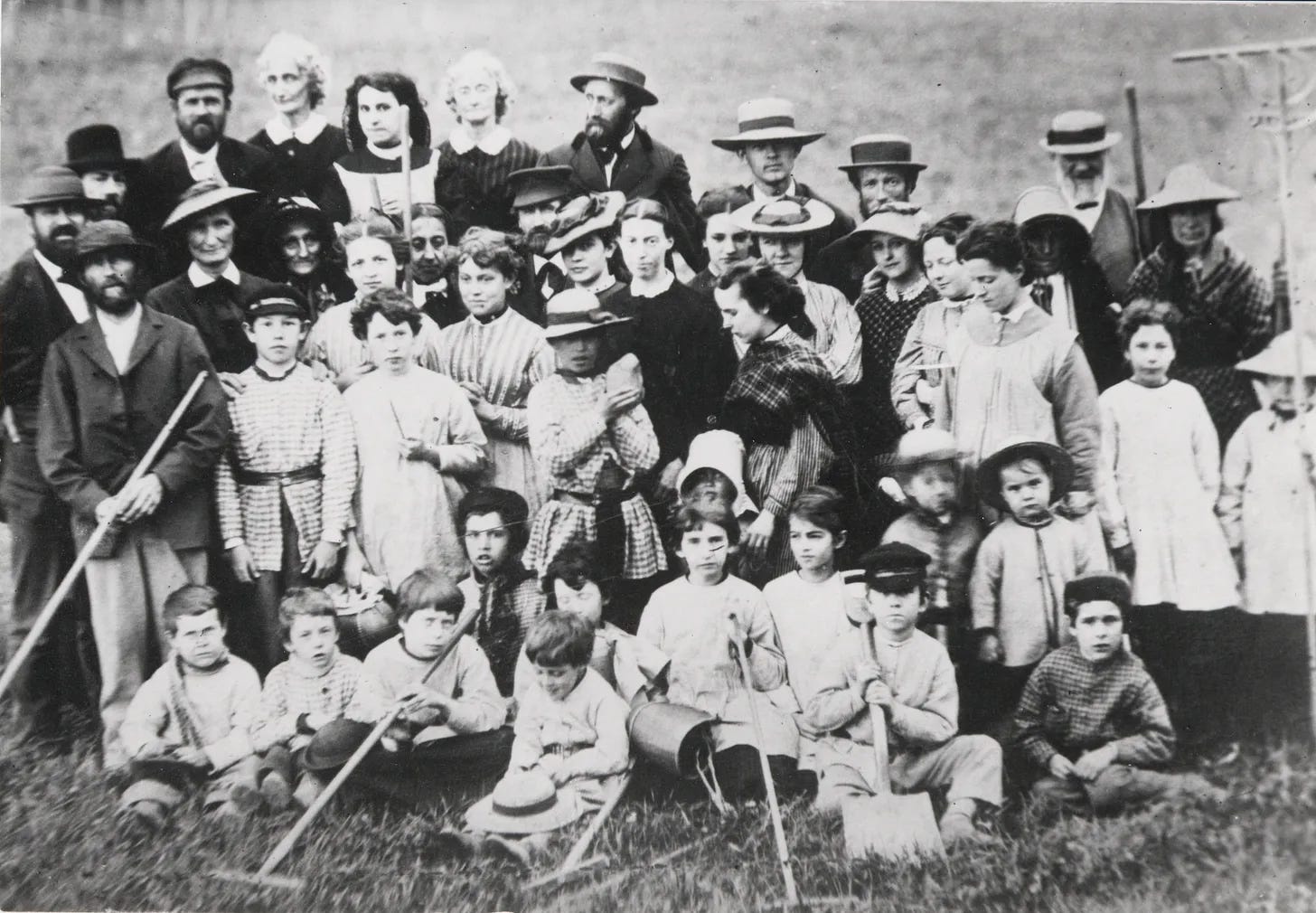
To prevent unplanned, non-engineered children, the Oneida members implemented a variety of controls, including encouraging teenage boys to have sex with postmenopausal women. This simultaneously stemmed both parties’ libidos and, in forging personal alliances between the two, provided important ecumenical tutelage to the youth by the very devout older women. Adult men practiced male continence, a sexual “technique” in which males do not ejaculate during intercourse; given that Oneida also had polyamorous relationships, this was key for stirpiculture purposes.
All of this may sound logical in theory, even unusually rational as far as religions go, but the tight regulations meant a quick death for the Oneida Community. After only about thirty years and peaking at just a couple of hundred members, the religious commune officially dissolved in 1881. Its members, presumably of good genetic stock but scanty in ranks, went into the silverware trade instead; today the Oneida Community is known as the hugely successful company Oneida Limited.

By contrast, similarly insulated, non-proselytizing religions that encourage their members to proliferate alleles the old-fashioned way—such as Orthodox Jews, the Hutterites, and the Amish—and also emphasize “homegrown” faith in which members are born into the group and indoctrinated, are thriving. The story of the Amish is particularly impressive, having seen an exponential explosion in their numbers over a very short span of time. The Amish emerged as a branch of the Anabaptist movement in the aftermath of the Protestant Reformation in Europe, and about four thousand of them fled Germany to avoid persecution and found refuge in the United States and Canada during the eighteenth and early nineteenth centuries. Most people know that the Amish are extremely insular, shunning almost all contact with the non-Amish world—except during the brief “Rumschpringe” (or “jumping around”) period, in which not-yet-baptized Amish youth flirt with the devilish goods outside before deciding whether or not to return to their family and faith. For boys, one incentive for returning to the community is that if you want to have sex with (that is, marry) a local Amish girl, you have to first be baptized, which is only for those who come home. Eighty percent do.
What you may not know is that the Amish population has been swelling since its New World inception. With growth rates hovering between 4 and 6 percent per year, their numbers double every twenty years or so. In 2008 they numbered 231,000; the year before, it was 218,000. Having children is a heavenly blessing, but it’s also an official duty. With an average of six to eight children born to each Amish woman, and with 80 percent of those returning to the group after Rumschpringe, this extraordinary growth rate is easy to understand. What’s especially ironic, Blume points out, is that the Amish’s original country of origin, Germany, has been succumbing to sharp population declines for decades: “The closing of churches has been followed by that of playgrounds, kindergartens, schools and whole settlements.” At least in sheer numbers, then, it seems that the Amish—long ridiculed by their European countrymen as the “dumb Germans” who wouldn’t give up their silly archaic beliefs—are getting the last laugh.
In fact, Blume’s research also shows quite vividly that secular, nonreligious people are being dramatically outreproduced by religious people of any faith. Across a broad swath of demographic data relating to religiosity, the godly are gaining traction in offspring produced. For example, there’s a global-level positive correlation between frequency of parental worship attendance and number of offspring. Those who “never” attend religious services bear, on a worldwide average, 1.67 children per lifetime; “once per month,” and the average goes up to 2.01 children; “more than once a week,” 2.5 children. Those numbers add up—and quickly.
Some of the strongest data from Blume’s analyses, however, come from a Swiss Statistical Office poll conducted in the year 2000. These data are especially valuable because nearly the entire Swiss population answered this questionnaire—6,972,244 individuals, amounting to 95.67 percent of the population—which included a question about religious denomination. “The results are highly significant,” writes Blume: “Women among all denominational categories give birth to far more children than the non-affiliated. And this remains true even among those (Jewish and Christian) communities who combine nearly double as much births with higher percentages of academics and higher income classes as their non-affiliated Swiss contemporaries.”
In other words, it’s not just that “educated” or “upper class” people have fewer children and tend also to be less religious, but even when you control for such things statistically, religiosity independently predicts number of offspring born to mothers. Even flailing religious denominations that place their emphasis on converting outsiders, such as Jehovah’s Witnesses, are outreproducing nonreligious mothers. Hindus (2.79 births per woman), Muslims (2.44), and Jews (2.06), meanwhile, are prolific producers of human beings. Nonreligious Swiss mothers bear a measly 1.11 children.
Blume recognizes, of course, the limits in inferring too much from these data. It’s not entirely clear whether being religious literally causes people to have more children, or whether—somewhat less plausibly but also possible—the link is being driven in the opposite direction (with people who have more children becoming more religious). Most likely, it’s both. Nevertheless, Blume speculates on some intriguing causal pathways tied to the fact that religious people have more children. We know from twin studies, for example, that the emotional components of religiosity are heritable. “Religiosity” refers to the intensity of feelings about religion, not the propositional content of particular beliefs. (In other words, one identical twin might be a screaming atheist, while the other is an evangelical pastor, but they’re both hot and bothered by God.) So Blume surmises that any offspring born to religious parents are not only dyed in the wool of their faith through their culture but also genetically more susceptible to indoctrination than are children born to nonreligious parents.
The whole situation doesn’t bode well for secularist movements, in any event. Evolutionary biology works by a law of numbers, not moralistic sentiments. Blume, who doesn’t try to hide his own religious beliefs, sees the cruel irony in this as well: “Some naturalists are trying to get rid of our evolved abilities of religiosity by quoting biology. But from an evolutionary as well as philosophic perspective, it may seem rather odd to try to defeat nature with naturalistic arguments.”
As a childless gay atheistic soul born to a limply interfaith couple, I suspect, perhaps for the better, that my own genes have a very mortal future ahead. As for the rest of you godless hetero couples reading this, toss your contraceptives and get busy in the bedroom. Either that or, perish the thought, God isn’t going away anytime soon.
Like what you read? Toss a tip in the jar—any amount that makes sense for you—so I can keep overthinking things on your behalf.