


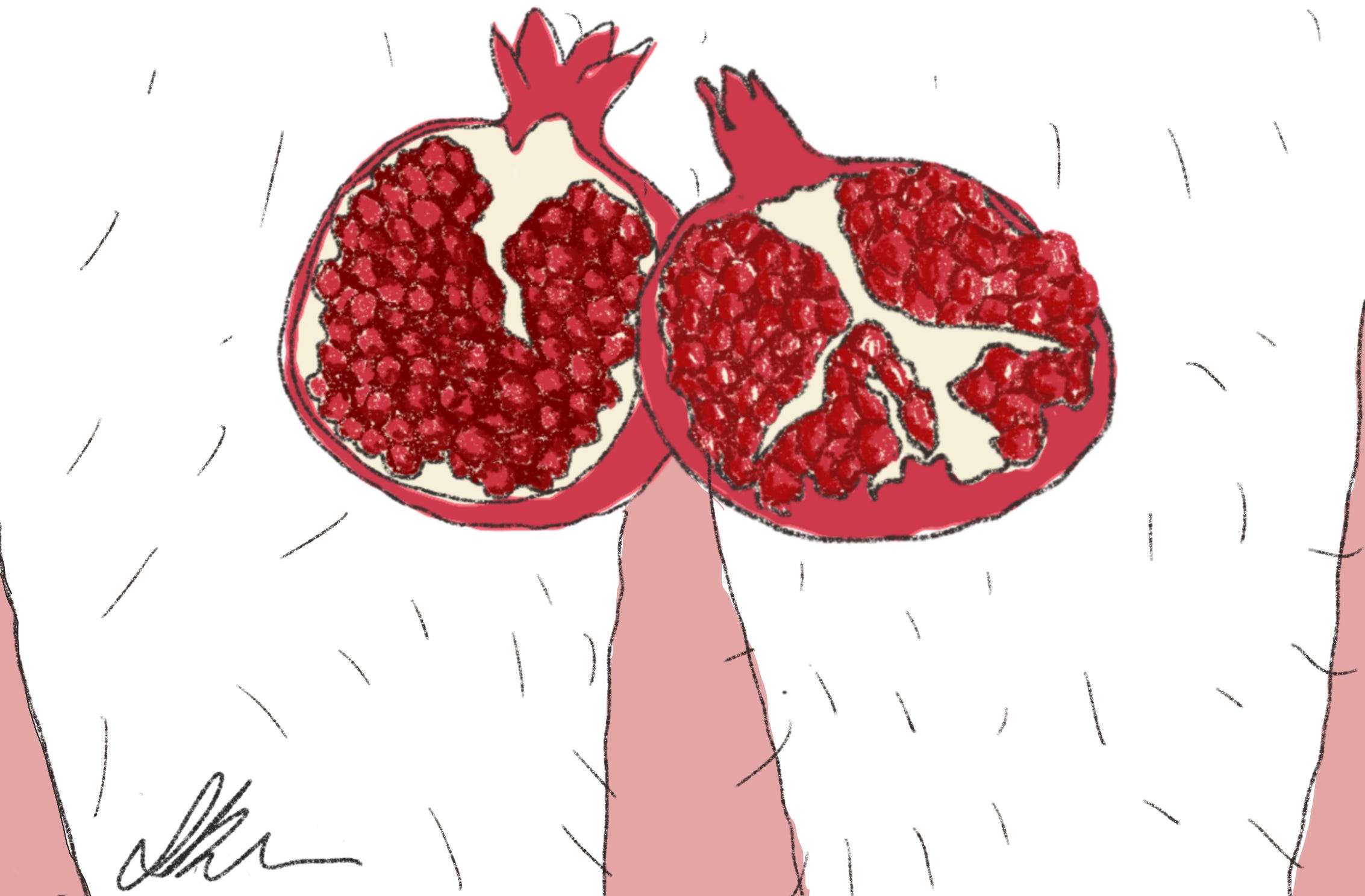
As a gay man, I can attest to being attracted to many things in other men, yet fertile isn’t an adjective I recall ever placing on my list of most desirable attributes. Try as we might, my partner and I will never reproduce, so if one of us has been shooting blanks for the past twenty years, we’d neither know nor care. We’re perfectly happy raising two beautiful terrier children. That said, if the results from a recent study led by Robin Rinn from the University of Würzburg is anything to go by, maybe I’ve long been lusting after males who my inverted sexual brain thinks are likely to impregnate me, or I them . . . that part is a little fuzzy.
In terms of evolutionary theory, Rinn’s logic isn’t quite as bizarre as it sounds. We know from previous research that homosexual males tend to display a mosaic pattern of sexual preferences and behaviors, most being characteristic of heterosexual males (e.g., prioritizing physical attractiveness over resources and status, youthful partners, interest in casual sex, etc.), and others resembling those found in heterosexual women (e.g., greater jealousy in response to emotional than sexual partner infidelity, derogating perceived romantic rivals through indirect rather than direct aggression, etc.). I hasten to add these are aggregate sex-based findings; we’re all “special” and obviously not everyone, gay or straight, can be painted with the same broad Darwinian brush. Still, the scientific consensus is that default human mating strategies are determined more by biological sex than by sexual orientation.
Ancestral males and females faced very different adaptive problems in the reproductive domain—one forfeiting a few coital thrusts, the other risking, potentially, their very life. Thus, men tend to lean into quantity over quality, whereas the opposite logic holds for women. In other words, we may be gay, but we’re still biological males, with brains shaped by natural selection in service to—shhh—propagating our genes. While biotechnology has changed the game for many same-sex couples, for 99.9% of our species’ history, fertile females were the one and only route to that end. In this light, Rinn’s argument begins to make sense. “The question arises,” he and his coauthors point out in their study in Personality and Individual Differences, “whether the urge of reproduction unconsciously also plays a role in homosexual’s mating behavior even though the sexual intercourse cannot result in offspring.”
The researchers conducted two experiments to get to the, erm, bottom of this queer question. In their first study, the authors recruited 124 men from homosexual (n = 64) and heterosexual (n = 60) internet dating platforms. [The small handful of self-reported bisexuals were grouped as one or the other based on their preferred gender; those who said they liked males and females equally were excluded from the analyses.] “Participants were told that they would see a profile from an online fertility clinic and that they should rate some characteristics of the person based on the present information,” explain the authors. “Furthermore, participants were instructed to imagine that they are (or a friend is) in need of a donation of genetic material, which is why they should evaluate a profile from a fertility clinic.”
In reality, everyone saw a nearly identical female profile, which was a head-and-shoulders image of the same smiling 22-year-old woman. Pretesting with a separate sample of straight males had determined that the woman shown (the so-called female stimulus person) was “in the middle of the attractiveness range” (i.e., she got an average rating of 4 out of 7 on those pretests). Her faux fertility clinic profile contained some basic filler info (e.g., European, brown hair, brown eyes, A+ blood type, and some generic personality traits, such as being caring, etc.). However, half of the participants were randomly assigned to the low-fertility condition (in which the woman was said to have a “3% likelihood of conception”) and half got the high-fertility version (“89% likelihood of conception”). Participants then rated the target on several factors, the most important of which, theoretically, was their perception of her physical attractiveness. Was the fertility information tweak alone enough to alter their subjective impression of her beauty, regardless of their sexual orientation? Results from a five-item attractiveness scale suggested it was. “Our manipulation worked,” Rinn and his colleagues write. “Both homo- and heterosexual male participants rated the female stimulus person in the high (in comparison to the low) fertility condition as more attractive, thereby supporting our reasoning that fertility appears to function as an adaptive cue for attractiveness.” Still, compared to their horny straight peers, the gays rated her as less attractive overall, which seemed to confirm that, well, they were indeed homosexual.
Study 2 added a twist. Or at least a penis. Here, the study design was mostly the same, but in addition to rating the fake fertility clinic profile of a woman, they were asked to do so for a man as well. As with her, this fictitious “moderately attractive” young man was said to have either “low fertility” (3%) or “high fertility” (89%). The gay (n = 124) and straight (n = 100) male participants were asked to rate the physical attractiveness of this male stimulus person after receiving those key fertility details. The investigators also added a control condition, in which no information was provided about the target’s fertility. The reasoning was that, if he’d signed up to donate genetic material, participants would assume he was probably fertile.
The data were revealing. From the perspective of the straight men, learning that the man in the photo was low or high in fertility had zero effect on their perception of his physical attractiveness. By contrast, the gays homed in on this genetic fitness information. Homosexual participants who got the low-fertility version judged the man in the photo as significantly less attractive than those who were randomly assigned to the high-fertility and control conditions (who saw him as equally attractive). What this suggests is that low fertility in other males is kind of a turnoff for gay men, whether we’re aware of it or not. Why that is so needs further sleuthing, the authors point out. But they have some thoughts. It may be, they reason, more a case of low fertility signaling possible poor health; if so, greater attraction or sexual arousal for fertile partners may be not so much a matter of increased approach, but an increased avoidance of potentially sickly people as mate choices. For the straight men, after all, it’s just another dude in a photo; for the gay men in the study, it’s someone who could, in principle, be at the other end of very intimate bodily contact.
Then again, it would be premature to rule out the immaculate anal conception hypothesis. “It may also be,” Rinn at el. reason, “that homosexual men have an unconscious, probably automatic attraction to fertility cues, even though—from a biological perspective—it is not possible for men to reproduce with their respective male partner.” Pfft. Now they tell us. Anyway, the authors conclude that the “current findings show [the] first evidence that for homosexual men, fertility is attractive irrespective of the sex of the stimulus person, even though there is no use of it at first glance . . . this work is a first fruitful step to extend evolutionary models by including the so far often neglected case of homosexual people.”
Snigger. Fruitful.
Rinn, R., Kirsch, F., Agthe, M., & Kayser, D. N. (2020). Fertility as a cue for attractiveness in homo-and heterosexual men. Personality and Individual Differences, 166, 110171.
Questions? Concerns? Ideas? Email the corresponding author directly: Robin Rinn robin.rinn@uni-wuerzburg.de
Like what you read? Toss a tip in the jar—any amount that makes sense for you—so I can keep overthinking things on your behalf.