


There comes a time in any young scientist’s life when they look around the proverbial room and realize just how little everyone around them actually knows. It’s an epiphany mixed with horror and relief, horror because the essential ignorance of others has suddenly become just as alarming as one’s own, and relief because smarmy people’s delusions, false beliefs, and lies can no longer masquerade as objective (and often oppressive) fact. We’ve become, in other words, detectors of everyday bullshit. And I’m using that term—bullshit—in a highly technical sense, defined by the social psychologist Martin Harry Turpin as “communication characterized by an intent to be convincing or impressive without concern for truth.”
I’ll leave it to you to infer what got us here, but bullshit science—or rather, the science of bullshit—is quite a hot topic. Most of this work, Turpin and his colleagues note in a recent article in Evolutionary Psychology, has focused on why some people are more vulnerable to bullshit than others. One clever paradigm involved participants rating the profundity of syntactically correct but meaningless computer-generated statements, formed by randomly mashing together words from New Age guru Deepak Chopra’s tweets (e.g., “Wholeness quiets infinite phenomenon”; “Imagination is inside exponential space time events,” etc.). Whether Chopra’s work is more batshit than bullshit is another question. Either way, those who saw meaning in this literal nonsense scored lower in cognitive ability, were more likely to hold religious, paranormal, and conspiracy beliefs, and endorse alternative medicine. Another study by Turpin found that labeling an abstract work of art with a computer-generated, pseudo-profound bullshit title (e.g., The Deaf Echo) led viewers to see it as more profound than the very same piece given a generic title (e.g., Canvas 8) or no title at all.
For the study in question, Turpin et al. were interested not so much in the intellectual impairments of those most receptive to bullshit, but instead in the real and perceived intelligence of those producing bullshit. Or at least, convincing bullshit.
But let’s back up a bit. We must first understand, the authors argue, the intrinsically social nature of evolved human intelligence. After all, we Homo sapiens are forced to constantly navigate some serious social hurdles. We faced three big adaptive challenges, in fact. First, because intelligence is heritable and linked positively with genetic fitness, there was pressure on our ancestors to broadcast whatever social smarts they had (i.e., a so-called honest signal). Second, despite what your mother may have told you, it’s often less about who you are than how others see you that matters (for adaptive outcomes), so there was pressure to deceive our audience. Finally, whether a prodigious liar or an occasional tinkerer of untruths, the pressure to effectively monitor who knew what—and how that information might grasshopper from mind to mind in a complex, gossipy society—demanded formidable perspective-taking skills. “A cartoonish description of the hypothetical person who exemplifies all of these traits in the extreme,” Turpin and his coauthors write, “would be one who shows off their intelligence whenever possible, tells lies when it is advantageous to do so, and is capable of keeping track of all the lies they have ever told.” That sounds to me more like a nightmare than a cartoon.
Still, if the capacity to generate convincing bullshit requires actual intelligence and such hogwash manages to impress naïve others, that’s a win-win, evolutionarily. Believable bullshit may still be bullshit, but as an honest signal of intelligence that doesn’t require any hard work (you know, in the sense of bothering to spend years learning whatever it is you’re spouting), it would be an “energetically inexpensive” means toward a profitable social end.
So anyway, how did Turpin and his colleagues test these hypotheses? The first prediction was that the best bullshitters would score high on intelligence measures. In the first phase of the study, 220 participants (undergrads from the University of Waterloo) were given a list of 10 “scientific” concepts. Six of these concepts were real scientific terms (e.g., “cognitive dissonance”) whereas the remaining four were completely fictitious pseudo-academic jargon (“subjunctive scaling,” “declarative fraction,” “genetic autonomy,” “neural acceptance”). The participants’ first job was simply to rate their knowledge of each concept on a scale of 1 (“never heard of it”) to 5 (“know it well, understand the concept”). This initial task therefore measured their willingness to lie through their teeth, or as the authors write, “feign knowledge of fake concepts.” Next, a subset of these same participants was again presented with each term separately—both the real and fake ones—and now given the following instructions:
Your task is to try to produce the most convincing and satisfying explanation that you
can for each term. For terms that you are knowledgeable about, we ask that you simply explain them as best you can (that is, in the most convincing and satisfying way). For terms that you are unfamiliar with, we ask that you be creative and make up an explanation that you think others will find convincing and satisfying. Do not worry about the truth of your claims when making up your explanations, rather, you may treat this as a creative writing exercise.
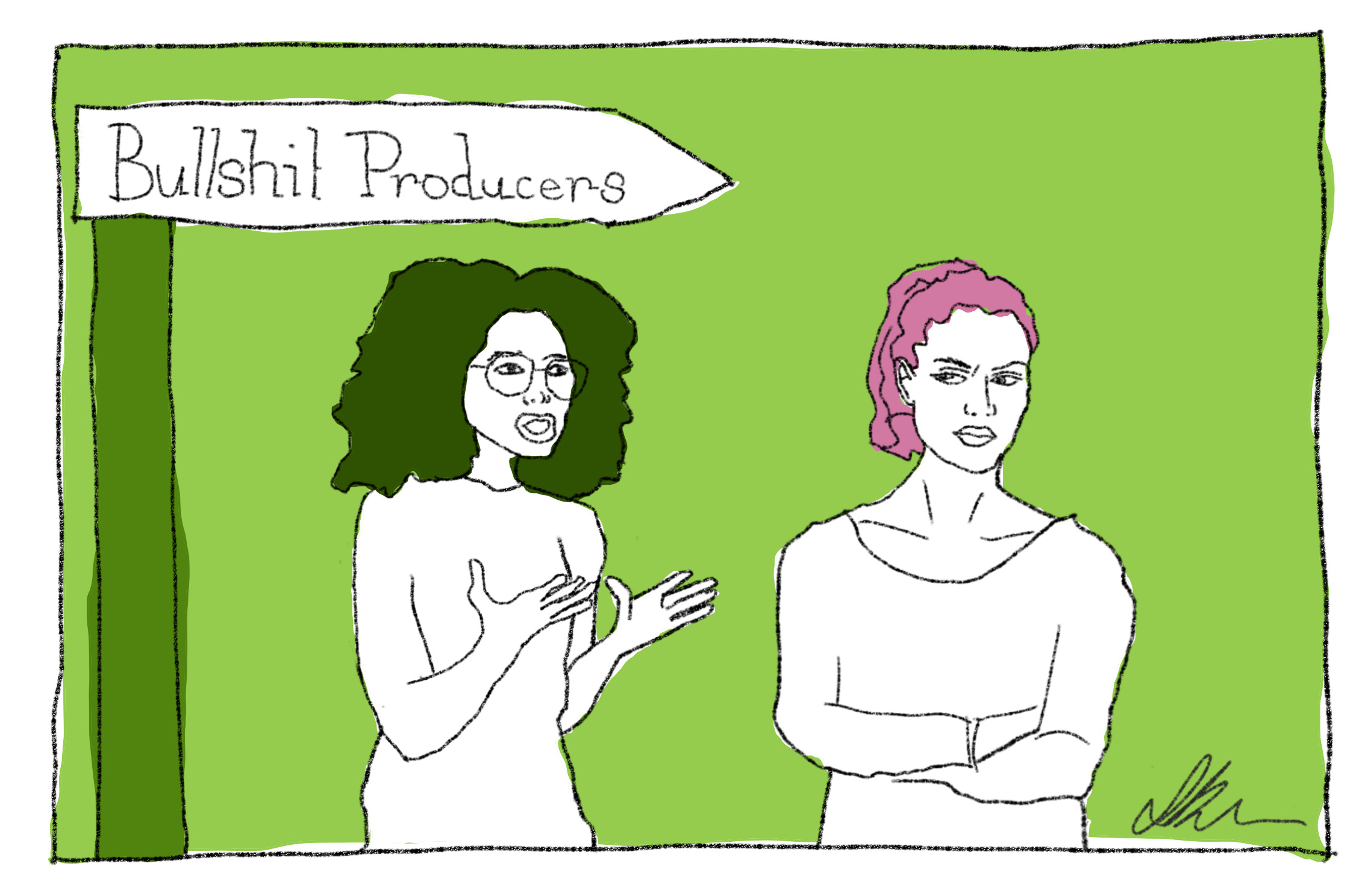
These people were thus the designated “Bullshit Producers.” Their final task was to complete a battery of cognitive tests (verbal intelligence, abstract reasoning, and a measure of their own ability to discern computer-generated pseudo-profound bullshit from real aphorisms).
In the next phase of the study, a separate group of 263 participants, the “Bullshit Raters,” entered the scene. Each rater was given 120 explanations (constituting all 10 statements from 12 random Bullshit Producers) and rated the accuracy of each one and how satisfying they found it, on a scale of 1 to 5. “This resulted in each Bullshit Producer having one ‘satisfyingness’ and ‘accuracy’ judgment for each of the [four fake] bullshit statements generated,” explain the authors. “The highest scoring item out of these bullshit statements was selected to be the best indicator of their bullshit ability. The ‘accuracy’ and ‘satisfyingness’ ratings of this item was averaged to create a “Bullshit Ability” score which was then averaged across all Bullshit Raters who rated that Bullshit Producer’s statements.”
Just as predicted, those participants who’d produced the most believable bullshit indeed scored higher on the two intelligence measures. Interestingly, one’s capacity for generating such convincing bollocks was completely unrelated to their willingness to bullshit, as gauged on that first task assessing their self-proclaimed “familiarity” with the completely made-up terms. This finding too, the authors postulate, may be due to these people’s higher intelligence. “In casual language,” they write, “this may be explained as ‘knowing your audience’ and as such, they may possess a more sophisticated understanding of when and where bullshitting will work if attempted.” Also, given that intelligent people are likely to be hanging out with other intelligent people, who in turn are probably better than the average person at sniffing out bullshit, this may “lower its appeal as a first-order social strategy.”
Indeed, although those who scored high on bullshit willingness overall were more likely to be tricked on that computer-generated bullshit task (rating such scrambled text baloney as more profound than their peers, and having more trouble discerning between the real aphorisms and the fake content), the most talented bullshitters (i.e., those producing the most “accurate” and “satisfying” bs in the eyes of others) saw right through it: these more able bullshitters were less likely themselves to view the pseudo-profound bullshit as profound.
Another significant finding, which emerged in a nearly identical follow-up study, showed that not only were the best bullshitters more intelligent than their less able peers (confirming the honest signaling hypothesis), but they were also perceived to be more intelligent by the raters, which was, again, just as predicted. “From the perspective of navigating social systems,” note the authors, “being perceived as intelligent may be just as valuable to an agent as actually being intelligent, as this perception may afford one opportunities to obtain status and form relationships as well as have greater trust placed in their competence.”
Turpin at el. do clarify that these findings should not be interpreted as suggesting that all intelligent people are good bullshitters. Yet the reverse may in fact hold. This asymmetry is kind of like humor, they point out, in that while being funny requires being fairly intelligent, “one can identify many brilliant people who are profoundly unfunny.” God, that’s so true. Similarly, they write, “bullshit ability is a reliable indicator of when someone is intelligent, but having low bullshitting ability does not necessarily mean that one is unintelligent.”
Whether you find the adaptive reasoning behind Turpin and his colleagues’ study to be “accurate” and “satisfying” in itself will, I suspect, depend on your view of evolutionary psychology in general. But there’s certainly a clear enough logic to it. “A person can engage in the arduous process of acquiring expert skills in domains that they could then leverage to accomplish certain goals,” the authors reason, “or use bullshit as a strategy that potentially produces the same benefits at a much smaller cost.”
They can’t help but add rather cheekily—and not, I think, inaccurately—that “bullshit may help even highly skilled individuals achieve their goals over equally skilled peers. This may be especially true in domains in which success depends largely on the subjective evaluations of others (e.g., art, advertising, politics, life coaching, journalism, humanities).” Ouch.
Turpin, M. H., Kara-Yakoubian, M., Walker, A. C., Walker, H. E., Fugelsang, J. A., & Stolz, J. A. (2021). Bullshit ability as an honest signal of intelligence. Evolutionary Psychology, 19(2), 14747049211000317.
Questions? Concerns? Ideas? Email the corresponding author, Martin Harry Turpin, directly: mhturpin@uwaterloo.ca
Like what you read? Toss a tip in the jar—any amount that makes sense for you—so I can keep overthinking things on your behalf.