


If you’ve ever noticed that men with light eyes tend to marry women who also have light eyes, it’s not just your imagination. Perhaps, you may think, it’s an uninteresting observation that can be brushed away by, say, creeping Western beauty standards, or maybe it’s just another example of assortative mating, whereby people prefer partners similar to themselves. But according to the evolutionary psychologist Paola Bressan from the University of Padova, you’d be on the wrong track.
Rather, this pairing of light-eyed men and women appears to belie an adaptive strategy on the part of the male in the scenario. Bressan offers a helpful primer on the expression and heritability of human eye color, the key to understanding her claims:
Eye color depends on the number and size of melanin particles in the layers of the iris: more melanin, darker eyes. Although the amount of melanin is determined by multiple genes, an important one serves as an on-off switch. This gene sits on chromosome 15 and has two alleles, one dominant and one recessive. The dominant, ancestral allele stimulates melanin production in the eye and, by making the eyes dark brown, masks the color that would be displayed otherwise. The recessive allele reduces melanin production fivefold, allowing the eyes to appear any shade of blue, grey, green, or hazel (depending on other genes and modifiers), but not dark brown. If neither parent carries the dominant allele, thus, a child is extremely unlikely to have dark eyes.
That last line, which simply means that any offspring born to two light-eyed parents will also have light eyes, may therefore be a handy heuristic for light-eyed men in addressing the cuckoldry problem. To date myself with a trashy Maury Povich reference, this ‘you ARE (NOT) the father’ situation is a genuine adaptive problem for males of many species, including our own. The risk of being cuckolded—basically, tricked—into providing limited resources to offspring that were sired surreptitiously by another male, and therefore directly aiding that competitor’s genetic success rather than your own, can never be eliminated entirely. So given that paternal investment (i.e., being a good father) is always something of a gamble in this evolutionary sense, any long-term mating strategy reducing this risk is prized.
However, such strategies are surprisingly few, because men also needed to retain their own cuckoldry potential for the short-term mating game. That other guy investing in your genetic depository (I mean, “child”) might have no idea he’s not your offspring’s real father. That form of free ride confers a leg-up as well in genetic fitness. In other words, while it’s adaptive to be able to suss out your own biological kid, the ability to do so is imperfect for a reason. DNA testing—and Maury Povich—weren’t around when these adaptive problems emerged.
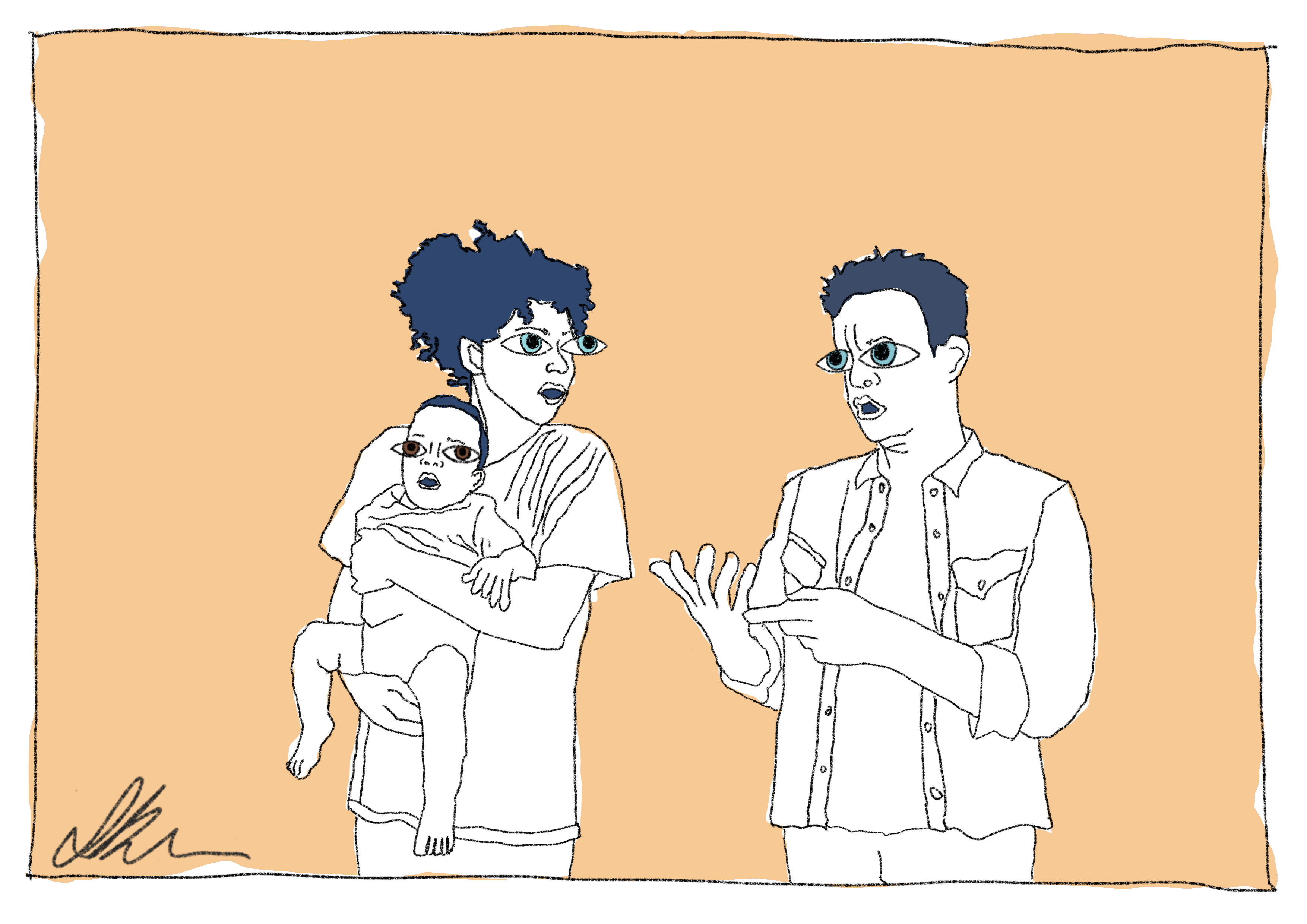
While that Hallmark scene of a cooing couple in a maternity ward, with the mom holding a swaddled newborn and saying to her husband “she’s got your nose” (or whatever) is very sweet (and appears to be a female adaptive strategy in its own right), the truth is that human infants are notoriously cryptic creatures. Yes, children often look a lot like their parents, and many even bear a striking resemblance to their fathers. But this happens only as they get older. In a previous study, Bressan found that naïve judges were far more likely to correctly identify the parents of 16-year-olds than they were of 1-year-olds. And when shown pictures of newborns and asked who’s the baby daddy (out of three options), people were barely higher than chance. But if you’re a blue-eyed man and your blue-eyed bride gives birth to what turns out to be a brown-eyed baby, well, you don’t need Maury on the case for that one.
This basic evolutionary logic behind eye-color pairings led Bressan to formulate several interrelated hypotheses. First, compared to men with dark eyes, men with light eyes should have a stronger preference for light-eyed women. However, this difference should only be apparent when light-eyed men are looking for women to raise kids with (i.e., high paternal investment). For casual hookups, wherein those men are more likely to be the cuckolder if conception occurs, that preference should be diminished. So, Bressan presented over a thousand straight Italian men (light-eyed and dark-eyed) with facial photographs “of attractive young women of European ancestry.” Each photo was digitally manipulated to change the model’s eye color, so that the men saw the same face side-by-side: one showing the woman with light (blue or green) eyes and one showing her with dark (brown) eyes.
For each counterbalanced photo comparison, the men were asked three simple questions.
· Which of these two people would you prefer? (left or right)
· How attractive do you find the person on the left? (0-10)
· How attractive do you find the person on the right? (0-10)
The rub was that each of these comparisons was qualified with either “If you were looking for a long-term relationship…” or “If you were looking for a short-term relationship…” Just to be safe, participants were given clear descriptions of what was meant by these terms:
By a long-term relationship, we mean someone you may consider leaving your current partner for, or with whom you may like to create a stable relationship, leading to cohabitation or marriage, in case of a breakup with your current partner or if you are single. By a short-term-relationship, we mean a single date accepted on the spur of the moment, an affair within a long-term relationship, or a one-night stand.
There were 10 female faces in all, so that each participant saw 5 faces for the short-term, and 5 for the long-term contexts. And the results were just as Bressan predicted. Although light-eyed women were preferred to dark-eyed women overall, this preference really stood out for the light-eyed men. “The point is not that only light-eyed men should prefer light-eyed women,” notes Bressan, “but that light-eyed men should prefer light-eyed women more than dark-eyed men do.” Importantly, this effect was also stronger when the light-eyed men were considering the women for marriage rather than for a one-night stand. Remember, for men with dark eyes, the color of a woman’s eyes is neither here nor there when it comes to boosting paternity confidence, as any resulting offspring could have light or dark eyes.
This related to Bressan’s other core prediction, which was that light-eyed men should see other light-eyed men as more of a sexual threat than dark-eyed men. After all, a light-eyed man reduces his chances of being cuckolded by mating with a light-eyed woman, but any light-eyed babies she pops out might still be the “adulterine offspring” of another light-eyed man. Thus, Bressan presented her male participants with photos of attractive male faces too. As with the female photographs from the first part of the study, here each male photo was shown with either dark or light eyes, again presented side by side. The three questions were:
· If you suspected your partner was being unfaithful to you, which of these two men would you be more jealous of? (left or right)
· How jealous would you be of the man on the left? (0-10)
· How jealous would you be of the man on the right? (0-10)
Jealousy of light-eyed men—relative to dark-eyed ones—was especially pronounced in the male participants who themselves had light eyes. Together, all the data stacked up. “Light-eyed men preferred light eyes in a potential partner more than did dark-eyed men, especially if women were imagined as long-term companions rather than one-night stands,” summarizes Bressan. “[And] light-eyed men feared light eyes in a rival more than did dark-eyed men.”
These findings, she argues, reflect unconscious preferences (and fears) among light-eyed men, not hard-and-fast mating rules. “Disregarding a dark-eyed woman who is available now in favor of a light-eyed woman who might or might not be available in the future amounts to the loss of a sure opportunity for an unsure one,” writes Bressan. “It is easy to see that indiscriminate fussiness would soon put light-eyed men at an evolutionary disadvantage relative to dark-eyed ones. There must come a point where the advantages of higher paternity confidence are surpassed by the disadvantages of lower mating opportunities.”
The author also cleverly anticipates pretty much any criticisms you might lob at her reasoning. You might point out, for instance, that all babies of European ancestry are born with “blue” eyes regardless of their parents’ eye color. Actually, she notes, they’re more slate gray, and they change into their true color by 6 months or so. Anyway, Bressan adds, “this critique appears misplaced . . . paternal (unlike maternal) investment is virtually nil at childbirth and slowly increases thereafter, becoming critical only post childhood or adolescence … [when it matters] a great deal.” The findings can’t be accounted for by some simplistic assortative mating explanation either, otherwise we’d expect dark-eyed men to prefer dark-eyed women, which they don’t. Some type of creepy sexual imprinting effect, with light-eyed men choosing partners whose eye color is the same as their mother’s, can also be “forcefully dismissed,” Bressan contends. This is because she had data on the participants’ parents too, and the crucial effects were independent of Mom’s (or Dad’s) eye color.
Assortative mating and sexual imprinting also can’t account for another intriguing finding from the study, which is that light-eyed participants who reported feeling rejected by their own fathers weren’t quite as picky about women’s eye color, or bothered about that of their rivals. This makes sense, argues Bressan, as there’s a positive correlation between a male’s own childhood experiences with his dad and how much (or little) he invests in his own offspring. If a light-eyed man is unlikely to invest in any children conceived, even in a long-term relationship, any strategy to increase paternity confidence becomes somewhat moot.
There is at least one enduring ocular mystery here, however. “Considering that proper mirrors were unavailable for most of our evolutionary history,” acknowledges Bressan, “one may wonder how people’s eye color could possibly inform their choices.” After all, eye color is highly specific. There can be dissonance on this trait between family members, and again, the fact that dark-eyed people don’t prefer dark-eyed mates makes some sort of familial social mirroring a nonstarter. Were our light-eyed ancestors gazing into pools like Narcissus… or in Bressan’s words, engaging in “self-contemplation on natural reflective surfaces”? She doesn’t believe so, but then, it’s not apparent to me how else they could have known, at least for sure.
I guess they could have just asked someone else, or it might have come up in conversation. But really, with an evolved iris race like this one, you couldn’t even trust your own “father.”
Bressan, P. (2021). Blue eyes help men reduce the cost of cuckoldry. Archives of Sexual Behavior, 50(8), 3725-3732.
Questions? Concerns? Ideas? Email the corresponding author, Paola Bressan, directly: paola.bressan@unipd.it
Like what you read? Toss a tip in the jar—any amount that makes sense for you—so I can keep overthinking things on your behalf.