


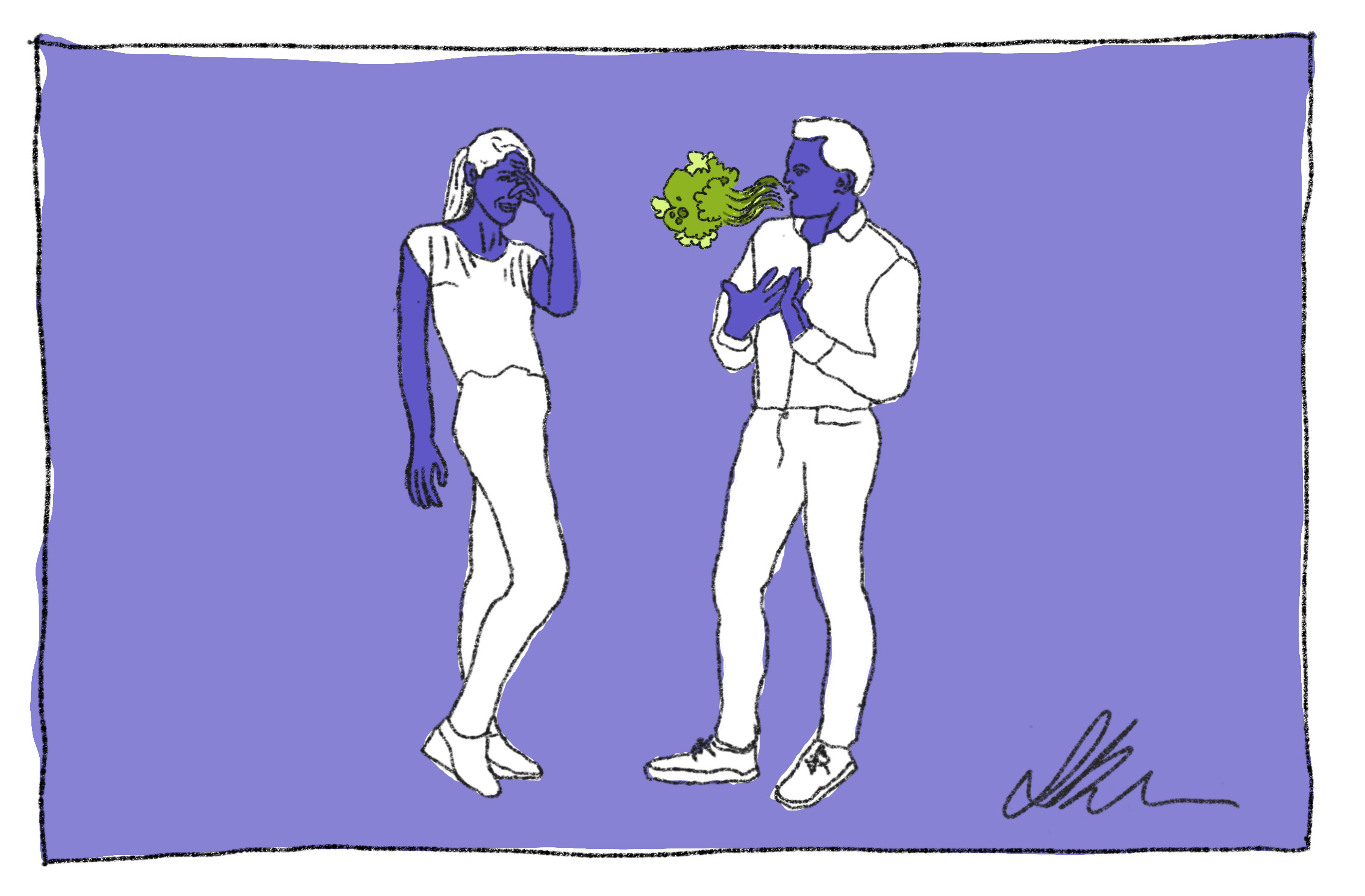
There’s something that verges on militaristic, or at least tactical, about a first date. Each party is covertly gathering intelligence about the other side, informing their decisions about whether to proceed with full genital deployment or, alternatively, to abandon the mission in light of the information being received, often in secret code.
The stakes were historically much higher for women than men when it came to making an error in judgment. Yet for both sexes, finding a compatible long-term partner—one who brought the goods to the table, so to speak—was hugely important to our species. In terms of what most of us want in that other human being our animal brains think we’re going to make and raise offspring with, it’s not complicated. Research on mate preferences shows that we’d like this individual to be, for example, kind, intelligent, nice-looking, interested in us, and to share similar views.
Given how basic and ubiquitous those preferences are, you’d think we’d have evolved a better flirting game. After all, if we’re all blinking marquees advertising our genetic assets to prospective partners, then how we present ourselves to those we want to—let’s be scientists here—copulate with, should be intuitive and breezy. Like our pupils dilating or our diaphragms contracting, flirting should be an automatic mechanism of self-promotion that adjusts to changing conditions of the reproductive environment.
Instead, it’s often excruciating, with self-reported poor flirting skills ranking at the top of many people’s lists for why they’re single. “The high importance of flirting in attracting mates should translate into strong selection pressures that would enhance people’s flirting capacity, making them effective flirting-initiators,” note Menelaos Apostolou and Chrysovalanto Eleftheriou from the University of Nicosia. “This prediction is not supported, however, by the existing literature.” Nor, I would add, by the existence of any woman who has ever received an unsolicited dick pic. (Okay, maybe that one woman that one time, but let’s shelve that for a later, erm, piece.)
The authors believe there’s a reason for our species’ atrocious flirting. In the ancestral past, most marriages would have been either imposed on both parties (e.g., arranged by parents) or imposed on women (e.g., females being acquired by males raiding neighboring groups). What one wanted in a partner wasn’t necessarily what one got. While some degree of free mate choice would have always existed—in surreptitious mating (i.e., cuckoldry), by manipulating parents into preferred arranged marriages, or in later marriages after one’s parents had died—the art of flirting is a recent cultural invention. It’s yet another mismatch problem, whereby the long-ago conditions that shaped our evolved psychology are at odds with challenges facing us now. “Flirting skills would make little difference in mating success in the scenario where a woman’s husband is chosen by her parents or a man takes part in a coalition to fight other men over women,” reason Apostolou and Eleftheriou. “It follows that, in ancestral pre-industrial societies, selection forces on flirting capacity had not been very strong . . . Consequently, [many] people today lack a good capacity for flirting, which in the past, would not give them a hard time finding mates, but in the present does so.”
So, what does this unshaped romantic obliviousness look like in full, awkward, embarrassing practice in today’s world? Guided by evolutionary theory, Apostolou and Eleftheriou unearthed a bounty of bad flirting displays. First, they asked a few hundred men and women from Cyprus and Greece to consider the following scenario:
You are single and someone is approaching and starts flirting with you. Write a few things about him/her (behaviors, traits, etc.) that would make a bad impression on you, leading you to rule out the possibility of giving in to his/her flirting.
As you might imagine, people had no trouble coming up with hypothetical “dealbreakers”. After sifting through this exhaustive list of off-putting approaches, two independent raters identified 69 general items, everything from “bad breath” to “stupid lines” to “she/he only talks about herself/himself.”
With that catalogue of unsexy flirting techniques in hand, the authors recruited a separate group of 734 participants (again, evenly split between men and women), presented them with the list of 69 items, and asked them to consider this scenario:
You are single and someone is approaching and starts flirting with you. Rate how much each of the following would put you off, leading you to rule out the possibility of giving in to his/her flirting.
For each of the items—which were presented in a randomized order—participants were told to choose between 1-5, with 1 being “it would not put me off at all” and 5 being “it would put me off very much.” This enabled the investigators to discern statistically how the 69 items might be clustering together in the responses. Ultimately, they detected 11 broad dealbreaker domains in the realm of flirting. From worst to least bad, here’s how it panned out:
1. Slimy approach
2. Bad hygiene
3. Lack of exclusive interest
4. Different views
5. Vulgar vocabulary
6. Lack of intelligence
7. Narcissism
8. Lack of humor and low self-esteem
9. Excessive intimacy
10. Poor looks
11. Stinginess
Just because items in the poor looks and stinginess (e.g., “she/he expects to split the bill in two”) categories ranked lower, they’re not negligible. “A better interpretation,” explain the authors, “is that they have a considerable effect on damaging people’s flirting effort, but other dealbreakers have an even larger negative effect.”
When you consider that the slimy approach category included rude, sexist, slimy comments (let’s say, for instance, this whole essay is just me flirting with you and I decided to capitalize on that low-hanging “69” fruit earlier, which I most assuredly did not), and bad hygiene meant things like rotten teeth or body odor that would make the wallpaper curl, you can see how it shakes out. Moreover, although the rankings reflect the general scores across all participants, there was one big sex difference when it came to weak flirters sending non-erotic shivers down spines. Women were far more sensitive to dealbreakers across the board, rating the items as more of a turn-off than men. The only exception was for the poor looks category, where both sexes found the flirter’s unappealing aesthetics to be equally problematic (still, there were some differences within that domain, with men finding “unattractive body” and “badly dressed,” for example, to be more of an issue than women, and women not taking kindly to “unkempt” and “the way he walks”). Given the differential costs in parental investment, argue the authors, “women have evolved to be more selective and risk-averse than men, which is reflected in their higher sensitivity to dealbreakers.”
This isn’t a self-help column—if it’s not clear already, I’ve got plenty of issues myself. But I do think Apostolou and Eleftheriou’s findings have applied value for those whose flirting skills could use some polish. First off, although these data show general trends, remember that one person’s dealbreaker might not be a big deal at all for someone else. In fact, even the worst offenders (“slimy approach” and “bad hygiene”) weren’t dealbreakers for everyone. Also, another practical way to look at things is that for every dealbreaker, there’s usually an opposite dealmaker. Don’t get too handsy with “excessive intimacy,” but instead use a “gentle approach.” Get off your phone and stop staring at that woman at the other table (“lack of exclusive interest”) and pay attention to your date (“strong interest and romance”). Give your strident political talk a rest (“different views”) and instead try to find topics that you’re both into (“common characteristics”). The authors offer this advice for would-be suitors:
…avoid making for instance slimy and sexist comments, touching and being too intimate, and avoid also flirting with more than one individual at a time . . . flirting could improve considerably if people improve on their breath, fix their teeth, and generally improve on their personal hygiene . . . improving on vocabulary by avoiding for example the use of words which are considered rude, could improve the effectiveness of flirting. Demonstrating one’s qualities is essential in flirting, but it can have the opposite effect if people overdo it [narcissism]. People can also improve their flirting by improving their looks (e.g., look after their skin) or by not being stingy (e.g., offer to pay the bill).
That all seems obvious in print, but still, for many people, good flirting is much easier said than done. Some “dealbreakers” involve physical attributes that can’t be—and arguably shouldn’t be—changed to match others’ ideals of beauty, or core personality traits that aren’t easily masked. And if they are altered to attract mates, it’s also easy to see how that might by interpreted as “trying to manipulate me” or making “too much effort to impress.” When you’re expected to, say, act confident but not too confident (a dealbreaker) or, I don’t know, if your date reads into your reflecting thoughtfully on their answers as “a gaze that shows a lack of intelligence” (another dealbreaker), you can see how even the most gifted flirt artists still owe much of their success to that other ancient Darwinian rule, which is simply getting lucky.
Apostolou, M., & Eleftheriou, C. (2022). What constitutes bad flirting: An explorative study of dealbreakers. Personality and Individual Differences, 194, 111665.
Questions? Concerns? Ideas? Email the corresponding author, Menelaos Apostolou, directly: m.apostolou@gmail.com
Like what you read? Toss a tip in the jar—any amount that makes sense for you—so I can keep overthinking things on your behalf.
I refrain from dating because it makes me too nervous and besides, I hardly ever have honorable intentions. If I haphazardly end up in a relationship, I'm more or less coerced into it, and it obviously doesn't last for long. There's just a basic flaw in my personality that stands in the way. Sad, perhaps, but I accept most of the time the way things have turned out.