


This article was originally published in Le Point on 14.12.2025
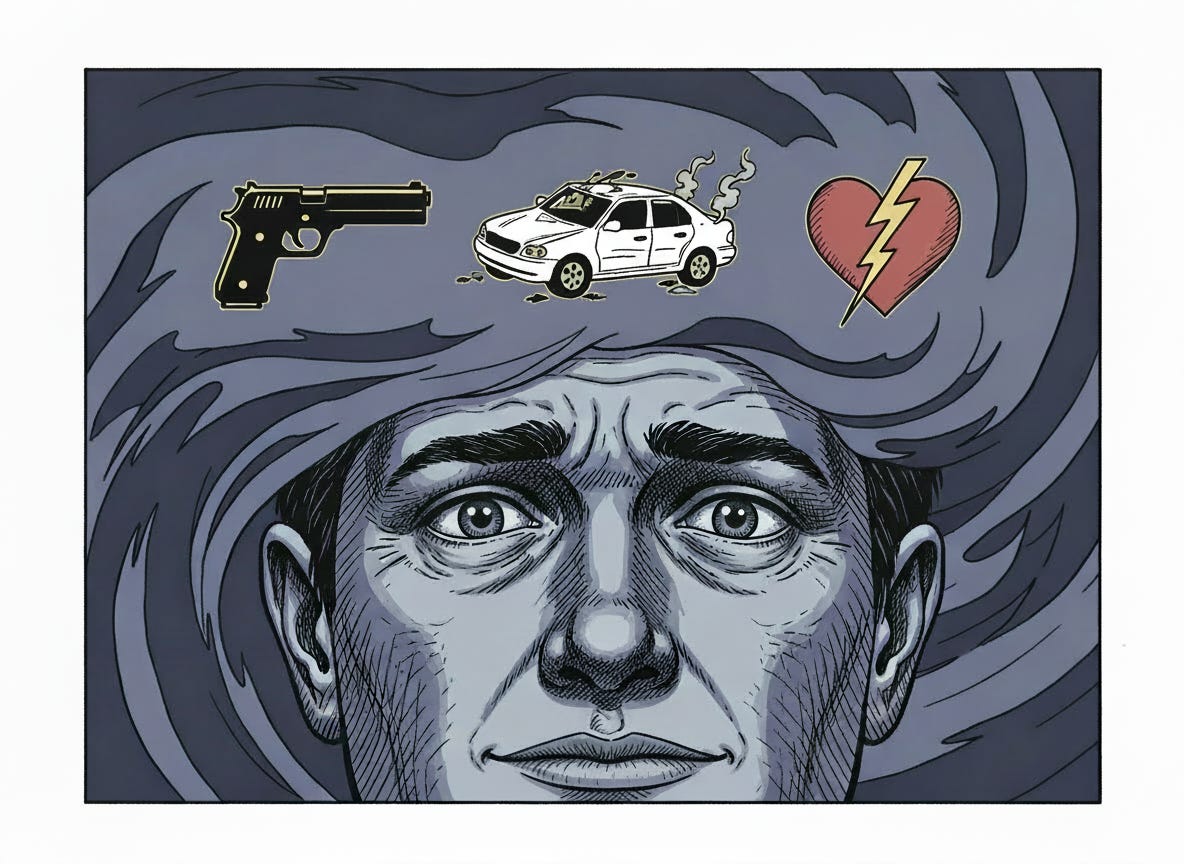
It isn’t every day that a mainstream scientific journal publishes alleged findings of psychic abilities, but that’s just what happened five years ago in the peer-reviewed (and quite respectable, as these things go) journal Brain and Cognition. Given the little fanfare that the study received at the time, not to mention any discernible controversy since, I can only assume it went unnoticed by just about everyone. I mean, how could scientific evidence of people’s ability to accurately judge the cause of random strangers’ deaths—based solely on facial photographs often taken years before they died—not have gotten more attention?
Led by French neuroscientist Arnaud Delorme, a principal investigator at a CNRS brain-imaging lab in Toulouse with a longstanding research interest in consciousness and spirituality, the original intent of the study was to test so-called mediums’ claims of being able to communicate with the dead. Weird, yes. But in fact there’s a rich and storied history of mediumship studies. Much of it is dubious old nonsense buried in the cobwebbed shelves of occultist libraries or published in fringe sources that no “serious scientist” would ever be, ahem, caught dead reading. However, a handful of tightly controlled experimental investigations—ones that have managed to pass the militantly stringent safeguards of objectively non-wacky editors and reviewers—aren’t so easy to dismiss. That isn’t to say they constitute proof of the paranormal, only that the debunkers’ go-to list (e.g., fraud, experimental confounds, researcher bias, statistical errors, etc.) doesn’t seem to obviously apply. I rank Delorme et al.’s 2020 study among these rare few.
Here’s how it worked. First, the investigators searched for mediums in the San Francisco Bay Area, where Delorme’s coauthors are based and he has his own affiliations. “Mediums are often eager to provide verifiable information to demonstrate that they are indeed communicating with the DI [deceased individual],” the authors explain. Assuming the methods employ rigorous controls, there is no reason—aside from the a priori belief that such things couldn’t possibly be true so scientists shouldn’t even bother looking for them—not to give these people the opportunity to do so. Now, it isn’t very hard to find someone claiming to be a medium in California, but in an effort to recruit those who do it for a living and at least have a reputation for accurate readings, the authors did what any diligent shopper would do: they looked at Yelp reviews. They reached out only to those with “dozens of positive reviews,” inviting them to participate in the study. “The goal of this study is to assess the accuracy of mediums at determining the cause of death, providing robust scientific evidence regarding the mediumship phenomena,” read the letter of invitation. This yielded twelve mediums eager to prove their mettle, all of whom claimed that they could connect with the dead based on the examination of photographs alone. A second group of participants was composed of matched controls—twelve people of similar age, sex, and ethnicity plucked from the general population who believed that they had no psychic abilities whatsoever.
The task itself was quite simple: look at images of strangers’ faces on a computer screen and make an intuitive judgement about how that person died. While doing so, the participant’s brain activity was being measured (EEG) as well as their heart rate, respiration, and other physiological changes (ECG). Perhaps, reasoned the authors, these biomarkers might reveal something about the secret inner workings of mediums while they tap into the other side.
The most critical part of the study design, however, was in the selection of images used for the test stimuli. After all, you don’t need a sixth sense to guess correctly that an elderly person died of natural causes, a morbidly obese person succumbed to diabetes complications, or someone with gang symbols tattooed all over his face got murdered. So, where does one go to get a balanced image pool of dead people’s faces? The answer, sadly, is the “Officer Down Memorial Page,” a regularly updated website honoring fallen US police officers who died in the line of duty. The searchable database includes information about the cause of death as well as the officer’s age when they died. Many also include photos—just the standard studio headshot, the sort that might be taken of all staff on annual picture day at the office.
Of 2,119 profiles that included photos, the authors tell us, the three leading causes of death were found to be firearm (1357), car crash (380), and heart attack (113). (Motorcycle crashes were also common, but these were seen as too similar to car crashes). Next, the researchers removed any images of very poor quality, or showing more than just a face and shoulders, or where the officer was wearing a hat. Images of officers who were not obviously one of three race categories (Black, White, or Asian) were also excluded. Moreover, “death by heart attack usually involved older individuals,” the authors explain, “so to help balance apparent age across the three categories, images depicting younger individuals in the death by firearm category, and some images in the death by car crash were randomly removed.”
After that initial vetting, this left a total of 381 photos: 211 firearm, 102 car crash, and 68 heart attacks. Then, those face images were processed using custom software to standardize the images, including cropping and resizing so that the exact same dimensions for each face were the same across the board, removing any background imagery and replacing with a transparent background, and converting to equalized grayscale settings for all images.
Following this, each of those 381 processed images was rated independently by three hypothesis-naive judges on a set of ten appearance-based features, including: gender (M/F); perceived age (20-30, 30-40, 40-50, 50-60, 60-70); direct gaze (yes/no); glasses (yes/no); head position (facing camera, tilted, profile); hair color (light/dark); weight (normal weight, overweight, obese); race (Caucasian, African American, Asian); and picture resolution (acceptable, medium, poor). “The median of the three judges’ ratings were then used to generate three photo subgroups with 60 images in each cause-of-death category,” explain the authors, “minimizing the differences between groups on the eight judged characteristics.”
But what really earns the investigators a gold star, in my book, is that they went above and beyond expected methodological demands of this sort. “Because the image selection procedure did not remove all possible information related to a combination of features and to further ensure the subgroup balance,” write Delorme et al., “a machine learning algorithm was used to see if it could differentiate between the three categories based solely on the characteristics described above.” The short answer is that it could not.
Anyway, all of this is to say that, clearly, the researchers went to great lengths to ensure there were no physical features, detectable by either humans or machine, that were different for the faces of cops who’d perished one way in the line of duty from those who had lost their lives in some other way. After this was established, the actual testing could finally get underway.
Essentially, each participant entered a quiet lab space, was seated in front of a computer, and told that they would see a series of faces of people who had since died. They were not informed that these people were fallen police officers. Their job was simply to press one of three keys on the keyboard (“1”, “2”, or “3”, the order being randomized across participants for the three different cause-of-death categories) to indicate whether they thought that individual had died from a firearm incident, a car crash, or a heart attack. Presentation of the images was of course completely randomized, with the 180 faces appearing on the screen one at a time and followed by the next face after a delay of three seconds once a key was pressed. (Some initial training with the task—using sample images that weren’t included in the final data analysis—ensured that they got the gist of the instructions.) Importantly, participants received no feedback trial to trial; that is, they weren’t told if they’d answered correctly or incorrectly for any given face. Oh, and don’t forget, all the while they were donning EEG skull caps and electrodes to measure brain waves and heart rate and other visceral data.
Now, here’s where it gets really strange, even stranger than Delorme and his colleagues anticipated. The participants as a whole were above chance at judging cause of death. There was no difference in accuracy across the three death categories, either. “Had subtle health cues biased the results,” the authors write, anticipating the naysayers, “then the heart attack category should have increased accuracy as compared to death by firearm or [car] accident, and this was not observed.” But here’s the thing: it was the control participants, not the ostensible mediums, driving this startling effect. In fact, as a group, these twelve everyday folks—people like you and me and anyone else who doesn’t claim to see dead people—were significantly more accurate than those professing to have a direct line to the spirit world.
As for those EEG data, the controls showed higher activity in the occipital regions of the brain, which might have reflected their greater attention to the visual stimuli. The only other notable trend was that the mediums seemed to be a little more anxious than the controls, exhibiting a slightly higher mean heart rate, for instance. So, all in all, while it was a very lackluster performance by the mediums, it was a truly mind-boggling result for the normies.
Still, as anyone who has bothered to read the parapsychology literature knows all too well, those who believe wholeheartedly in these anomalous phenomena—and those who study them—don’t give up the ghost easily. “Some of the mediums,” point out the authors:
commented that they found it difficult to differentiate between the type of death, as they reported feeling the pain of the deceased individual, but not the cause of that pain. They might have interpreted a given type of pain as a heart attack, but a similar pain could have occurred by being shot in the chest, or by chest trauma associated with with a car accident.
Whether this cloudy explanation is convincing is up to you to decide, but one way to address it in future studies, the authors cleverly suggest, is to use cause-of-death categories that are more, well, phenomenologically discrete. Maybe, I don’t know—and this is grim—the faces of people who choked to death, those who were stabbed to death, and those who died of a surgical mishap while under general anesthesia. In terms of sensed pain, those must all feel pretty different to a medium, right? Also, perhaps, the authors add, the mediums were just a little too eager to prove themselves, and their performance anxiety (see, increased heart rate) interfered with their genuine psychic abilities. After all, in their day jobs, they’d typically get more than 30 seconds to connect with sitters and their dead loved ones, and being emotionally bombarded by the souls of 180 dead cops must be pretty disorienting. By contrast, the latent psychic abilities of the stress-free controls might have been liberated.
Or—and here comes cynical, skeptical old me—there’s a more parsimonious, entirely natural explanation for the study’s findings that the authors still haven’t accounted for. At the very least, it’s begging for replication.
What do you think?
This newsletter is free. But it’s a lot of work! Like what you read? Toss a tip in the jar—any amount that makes sense for you—so I can keep overthinking things on your behalf.
The two groups of judges recruited by the researchers were distinctly different:
- The mediums had too much to prove; in too little time; in a situation they were not in control of, unlike when doing their everyday job. So, they were more anxious. So, they were less likely to channel their everyday intuition.
- The "normies" had nothing to prove, and as much time as they needed to make their best guess. So, they were more likely to go with their gut instinct.
The chief confounding factor here is the threat of status loss to the putative mediums.
Why not replicate, with several diverse groups of judges? Perhaps another group who fear status loss, such as public debunkers and sceptics of parapsychology.
BTW, I'm not convinced that even the normies _knew_ anything - were their guesses actually any better than chance? - I'd have to know more about the statistical methods and measures used, and the experimental assumptions &c.