



Hate to break it to you, but you may not be as in control of your own emotions, thoughts, and even behaviors as you’d like to believe. I’m referring not so much to that airy philosophical notion of ‘free will’—although this has implications for such discussions—but rather the biological concreteness of chemosignals. These are chemical compounds emitted by human bodies that not only transmit social information, but also subtly manipulate our brains and get us to do nature’s bidding. It’s not a subject without controversy, but for current purposes, think of them as undetectable little puppet masters reaching up through your nostrils to finger your vulnerable cortex, convincingly altering your perception of reality and prompting you to act in ways that promote your genetic replication.
One of the more extensively studied chemosignals is called androstadienone, or “AND” for short. Although this androgen derivative is produced by men and women—present, for instance, in the underarm and groin sweat of both sexes—its concentration is higher in men.
It is also most abundant in semen, and for this reason is thought to play an adaptive role in social contexts specific to sex and reproduction.
Many studies have indeed already found that women’s exposure to AND under controlled conditions—the double-blinded type where participants take whiffs from test tubes, not knowing which is the real stuff and which is the control—elicits perceptual distortions, emotional shifts, attentional biases, and arousal responses that favor reproduction. Smelling the AND compound appears to make women hornier in general. They also judge the faces of male strangers to be more attractive (or at least, less repugnant), especially those faces with more masculine features. AND boosts women’s mood and makes them better at perceiving (even overperceiving) men’s—but not women’s—happy and relaxed faces. According to a group of Chinese investigators led by psychologist Yue Wu of Southwest University, these effects of AND may serve to “facilitate [women’s] interactions with the opposite sex.”
Now, before any of you ladies go bottling up men’s groin sweat—or worse—for use as an aphrodisiac, be aware that AND may not be all sunshine and rainbows in the dating world. In fact, a new study by Wu and colleagues published in Archives of Sexual Behavior has found compelling evidence that AND enhances women’s innate tendency for “intrasexual competition.” Basically, those exposed to this odorless chemosignal suddenly get cattier.
It’s all very Darwinian. Whereas men tend to compete with one another for mating access to the opposite sex through physical prowess and overt fighting, women’s preferred methods of aggression are more “indirect” and, arguably, Machiavellian. Damaging the reputations of other females through negative gossip is one such tactic; previous studies have demonstrated that women are most likely to deploy this strategy when they perceive other women as being romantic threats. Think Regina George, queen bee of Mean Girls’ “The Plastics,” and her ruthless takedown of other girls through vicious rumors and gossip to defend her territory—including her ex-boyfriend, whom she still considers hers. Such indirect aggression has functional utility, evolutionarily speaking. When men are asked to rate images of female strangers whom they’ve just read nasty gossip about, they judge them as being less attractive.

In fact, it’s not just actively spreading mean-spirited information about perceived female interlopers. Some theorists have speculated that women may also be more likely to withhold positive information about their rivals. Sure, Julie has been around the block, as they say, and is rumored to have chlamydia, but she’s also a Fulbright Scholar and once heroically saved a baby from a burning building. Only, someone like Regina George isn’t likely to mention those more flattering details about Julie, even if she knows them to be true.
Now back to those sneaky little chemosignals: does being exposed to AND enhance women’s innate tendencies for intrasexual competition? It might, figured Wu and colleagues, and there’s only one way to find out. Well, probably many ways, methodologically speaking. But the study design they settled on went like this.
First, a group of 52 young Chinese women aged between 18 and 25 agreed to serve as guinea pigs and were tested individually. On two consecutive days, each woman was instructed to inhale from one of two vials (earlier pretests established that the odors were impossible to discern from one another). One vial contained AND, and the other was a placebo. The order of presentation was randomized, and the research assistants administering the task (all females too), as well as the participants themselves, had no idea what the true purpose of the study was. Instead, they were told it was about “exploring the effects of a common compound present within a clove on first impressions and social interactions.”
There were strict vetting rules: no wearing perfume or makeup in the lab, no smoking or drinking the day of the experiment, no current use of hormonal contraceptives. Also, to standardize the procedure, all participants were tested during the fertile phase of their menstrual cycles. This is when, theoretically, the young women would be most receptive to male suitors and therefore the most vigilant toward the threat of romantic rivals interfering with their mating prospects.
After duly sniffing—again, either the vial containing AND or the placebo—participants sat down at a computer screen and read the following scenario:
You are at a college community activity when you meet a handsome man (A). You participated in the last community activity and have spoken to him several times. You find out that this handsome guy is single, just like you, and you seem to have a lot of chemistry. He spends some time talking to you; you two seem to be hitting it off. However, you later notice that he also talked to another woman (B), a new member of the community. They seem to enjoy each other’s company. Unfortunately, you know that B is also single, and you are not sure whether A is more interested in you or her.
I don’t know if naming the other woman “B” was a Freudian slip, but it does set the stage. The investigators showed the participants a random photo of one of ten young Chinese models and told them to imagine that the woman in the photo was B herself. They were asked about their first impression of her. How flirtatious was B? How friendly? How trustworthy? Next, they were given nine pieces of information about this B: three negative items (“She sleeps around a lot,” “She cheated on her last boyfriend,” “She has an STD [sexually transmitted disease]”); four positive items (“Her IQ classifies her as a genius,” “She donates to charity,” “She speaks four languages,” “She has traveled all over the world”); and two neutral items (“She loves watching TV shows,” “She has a lot of courses this semester”). For each item—juicy, impressive, or bland—participants were asked how likely they were to share that information, again while looking at a photo of one of the ten models said to be B.
“It was hypothesized,” the authors explain, “that in the context of intrasexual competition, women’s likelihood of spreading negative information about romantic rivals would increase, whereas their likelihood of spreading positive information would decrease when they were exposed to AND compared to a placebo. We also hypothesized that AND would bias women to perceive romantic rivals as more flirtatious, which signals a [reproductive] threat.”
So, is that what they found?
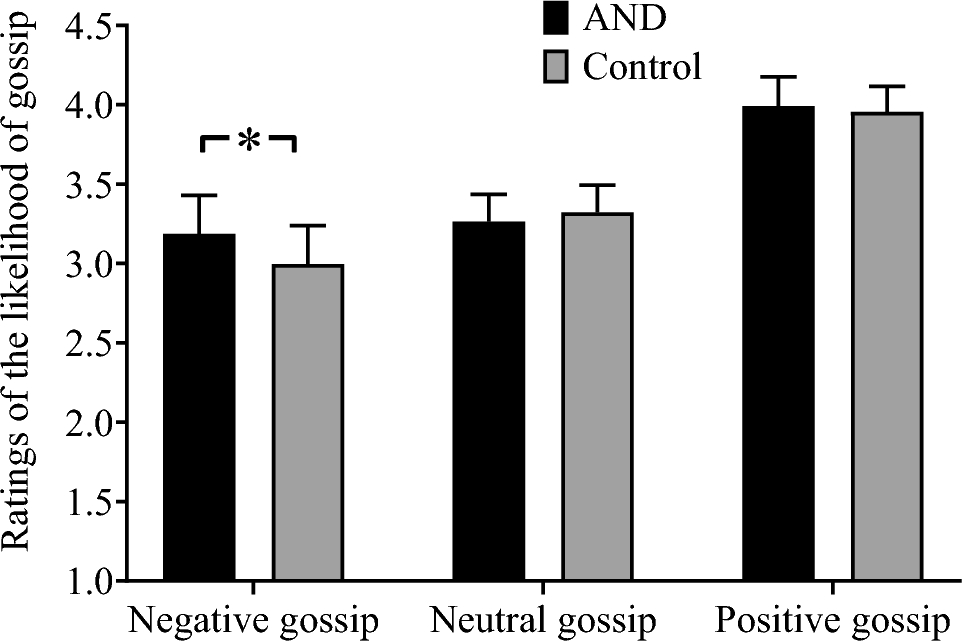
Yes and no. After smelling the androstadienone, the participants indeed perceived B to be more flirtatious, and they were also more likely to say that they intended to share the negative gossip about her. Exposure to the chemosignal, however, had no effect on their self-reported intent to share B’s good qualities. In fact, irrespective of what they’d just sniffed, women were more likely to say that they would share the neutral and positive items than the negative ones. That may sound encouragingly like “women supporting women,” but Wu and coauthors urge caution. They speculate that even that is part and parcel of female intrasexual competition. Women who only have bad things to say about other women, they point out, aren’t trusted or seen as desirable partners either, and so they must cushion their barbs with idle chatter and praise. The negative gossip is more potent anyway. “Although negative gossip is an effective strategy,” summarize the researchers, “the cost . . . may constrain its usage. The positive gossip may function as a mask for women’s indirect aggression (e.g., masking the [significant] increase of negative gossip under AND exposure).”
Oh, the games we play. Or the ones that play us. Nature, it seems, prefers her puppets to smile while they scheme.