


This article was originally published in French at Le Point on 02.05.2026
Once, while in one of those bleary-eyed, zombified states that comes from flying halfway across the planet to attend some long-forgotten academic conference in middle America, I found myself stumbling out of the plane and into the nearest airport restroom. Perhaps there was a subliminal part of my brain that registered something was off—the unusually clean facilities, the pleasant floral notes, the utter absence of urinals—but honestly, it wasn’t until I zipped myself up and exited the stall to find myself face-to-face with a woman, of all things, that I realized the gravity of my faux pas.
This was long before the trans bathroom debates poured gasoline on this issue, but I still wanted desperately to explain I was merely an absentminded gay professor with no sexually deviant intent whatsoever. I figured that would have been even more awkward, so I just apologized profusely for the confusion and beat a hasty retreat.
Anyway, it was that woman’s facial expression that I remember to this day: a mélange of bewilderment, irritation, scorn, and maybe even a bit of fear. (I must say, however, that I also recall being a little surprised by the perfectly unbothered reactions of the other ladies primping themselves at the mirror.)
What do facial expressions reveal about our tacit expectations of adherence to gender norms? Potentially, a lot, according to the psychologist Karen Man Wa Kwan and her colleagues in a study published last year in the journal Archives of Sexual Behavior. Whereas one might say that they are perfectly okay with a man wearing a dress, or a woman going headfirst into frontline infantry combat, or, I don’t know, some idiot ambling into a ladies’ bathroom at a crowded airport, those verbal “socially desirable” responses may mask deeper emotions at odds with one’s expressed liberal views.
Here is how the authors put it:
People’s appraisals of stigmatized characteristics are governed by two psychological systems—a reflective, controlled system and a reflexive system. For verbal reports, the reflective system is dominant and may produce socially desirable responses. When nonverbal measures are used to gauge participants’ implicit, non-deliberated responses, the reflexive system may be dominant and better reflect the underlying attitude . . . both explicit and implicit measures are predictive of judgments and behaviors.
In other words, a proper implicit measure allows clever researchers to hear the quiet part out loud.
To tease apart surface-level attitudes toward gender-nonconformity from a more visceral emotional response, Kwan and her team conducted the first-ever study on young children’s facial reactions to violations of gender norms. Why kids? Well, for several reasons, explain the authors. First, it’s to help gender-nonconforming children. They experience higher rates of ostracism and bullying, leading to poorer mental health outcomes. This is especially true for boys with traditionally feminine traits. By carefully discerning the affective components behind their discrimination, clinicians are in a better position to create interventions that help gender-conforming kids accept their gender-nonconforming peers. If you don’t know what specific raw emotions are behind such unfriendly attitudes, you can’t begin to address them.
Also, have you ever met a kindergartner with a poker face? Compared with adults, kids aren’t that great at hiding their true feelings. “There is a more limited possibility for children to manipulate or control their facial expressions,” the authors note. Thus, by studying their facial reactions to another child violating gender norms, the scientists could get a relatively unadulterated look at how kids really feel about “girlish boys” and “boyish girls.”
By the age of three, most children have a firm understanding of their own gender identity. Gender identity is also a social identity. And interestingly, the more gender-conforming a child is—who they’re friends with, how they like to play, how they prefer to dress, and so on—the more negative their view of other children who stray from gender norms. This, reason the authors, may constitute a sort of outgroup bias against the latter, especially if such unacceptance is bolstered by intolerant parents and peers. “It is [also] possible,” they write, “that the violation of gender norms threatens children’s own gender identity, which contributes to less positive appraisals of gender-nonconforming peers.”
Prior studies focused only on children’s reflective systems, relying entirely on verbal responses to questions regarding gender-nonconforming peers. For instance, children in such studies would be presented with, say, stories of a boy who plays with dolls, or a girl who prefers to dress like her dad rather than her mom, and are then asked how much they would want to be that child’s friend, or whether the child was doing something wrong by acting that way, and so on. But nowadays, in woke-ish societies where rigid gender stereotypes are seen as backward or ignorant, even young children may learn that the “appropriate” (i.e., socially desirable) response to such questions is to embrace or even celebrate gender diversity.
Is that how children actually feel about the issue, however?
The researchers came up with a straightforward way to address this more reflexive question. Over 600 children aged between four and nine years—boys and girls—sat down in front of a computer screen to watch a slide show. Half of the participants were Canadian, and the other half from Hong Kong. With a video camera trained on their faces, each kid saw four illustrated vignettes in a random order. The vignettes featured a hypothetical child (gender-conforming boy; gender-nonconforming boy; gender-conforming girl; gender-nonconforming girl) along with an audio description made by a female narrator speaking in a neutral tone.
Each vignette included five illustrations . . . the first illustration lasted for 15 s and introduced the target’s name and grade (same grade as the participant). Then, another four illustrations with accompanying audio were presented for 15 s each (1 min total), with the four images presenting the target’s gendered preference for toys (car vs. Barbie), activities (tackle football vs. toy kitchen), clothing and hairstyle (dressing like dad vs. mom), and gender of playmates (boys vs. girls), respectively.
Using an advanced software program called FaceReader, the researchers could then subsequently analyze the facial expressions—and micro-expressions—of each child as they viewed the target character going about their gendered business. Frame-by-frame, the program provides accurate estimates of the presence and intensity of the six basic human emotions: anger, disgust, happiness, sadness, fear, and surprise. After each vignette, participants were also asked the standard verbal set of questions:
· “Would you like being friends with [this child]?”
· “Do you think other children would like being friends with [this child]?”
· “Do you think [this child] is happy?”
· “Would you like to do what [this child] did in the story?”
· “Was what [this child] was doing in the story right?”
This general approach enabled Kwan and her colleagues to measure the relationship, if any, between children’s reflexive (facial expressions) and reflective reactions (verbal responses) to other kids’ expressions of gender-nonconformity.
What do you think they found?
Curiously, for the facial expression measure, only one emotion was statistically significant. It wasn’t surprise, disgust, anger, happiness, or sadness. Just fear. Moreover, it was only on seeing the gender-nonconforming boy—not the gender-nonconforming girl—that children’s faces showed this heightened scared look. The more fear a child showed on their face while viewing the gender-nonconforming boy, the less happy they judged him to be. No other meaningful links were found. “Perhaps feeling somewhat scared informed children’s perception of the emotional state of the target,” the authors speculate.
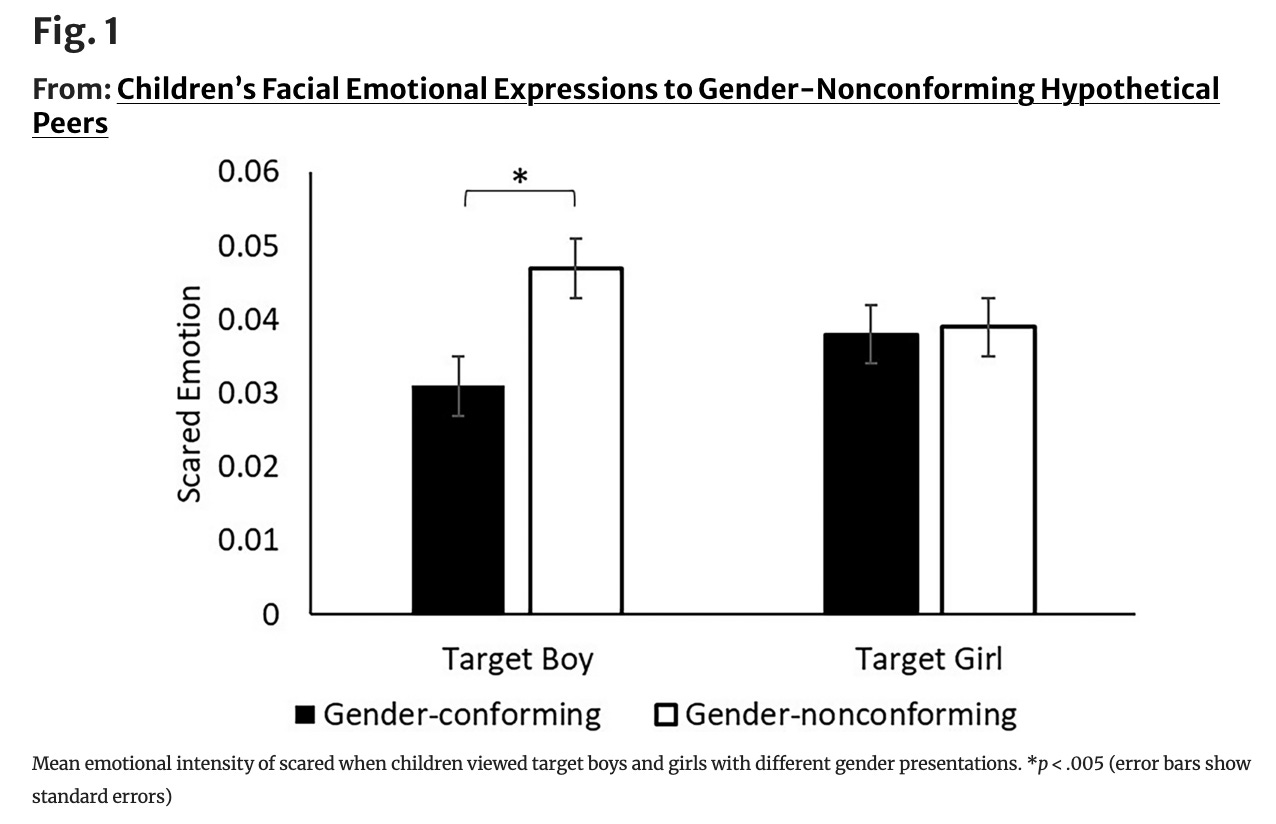
What these findings don’t tell us, of course, is where children’s apparent fear toward gender-nonconforming boys comes from. The authors suspect that it is a culturally learned or imitated emotional response, with society’s harsh disapproval of effeminate males (femmephobia) generating an ambient disliking of such figures that children are absorbing, even if just implicitly. But why, then, is it fear—and not other negative emotions, such as anger, disgust, or sadness—in their facial expressions? And if it’s just a general outgroup bias, then why aren’t gender-nonconforming girls evoking that same look of fear?
From an evolutionary perspective, I wouldn’t be surprised if there were an innate component to all this, given that effeminate males are disproportionately more of a threat than masculine females to the reproductive interests of both sexes. (See my writeups about the sneaky f*cker hypothesis and transphobia.) I doubt any of this would have put a smile on the face of that woman in the airport restroom, and I don’t blame her. But whether it’s “nature or nurture” (that old false dichotomy) at play, identifying fear as the key emotion underlying children’s intolerance, particularly of boys who stray innocently from gender norms, does have clinical importance. Since fearful people are more likely to make sweeping categorical judgments against whole groups, early opportunities to calibrate children’s emotions through positive early experiences with gender-nonconforming boys might ease a lot of future suffering.